Begin of page section:
Page sections:

  • Go to contents (Accesskey 1)
  • Go to position marker (Accesskey 2)
  • Go to main navigation (Accesskey 3)
  • Go to sub navigation (Accesskey 4)
  • Go to additional information (Accesskey 5)
  • Go to page settings (user/language) (Accesskey 8)
  • Go to search (Accesskey 9)

End of this page section. Go to overview of page sections

Begin of page section:
Page settings:

English en
Deutsch de
Search
Login

End of this page section. Go to overview of page sections

Begin of page section:
Search:

Search for details about Uni Graz
Close

End of this page section. Go to overview of page sections


Search

Begin of page section:
Main navigation:

Page navigation:

  • University

    University
    • About the University
    • Organisation
    • Faculties
    • Library
    • Working at University of Graz
    • Campus
    Developing solutions for the world of tomorrow - that is our mission. Our students and our researchers take on the great challenges of society and carry the knowledge out.
  • Research Profile

    Research Profile
    • Our Expertise
    • Research Questions
    • Research Portal
    • Promoting Research
    • Research Transfer
    • Ethics in Research
    • Commission for Scientific Integrity
    Scientific excellence and the courage to break new ground. Research at the University of Graz creates the foundations for making the future worth living.
  • Studies

    Studies
    • Prospective Students
    • Students
  • Community

    Community
    • International
    • Location
    • Research and Business
    • Alumni
    The University of Graz is a hub for international research and brings together scientists and business experts. Moreover, it fosters the exchange and cooperation in study and teaching.
  • Spotlight
Topics
  • Sustainable University
  • Researchers answer
  • Work for us
Close menu

End of this page section. Go to overview of page sections

Begin of page section:
You are here:

University of Graz News Modellierung, Maßsysteme und Magie

End of this page section. Go to overview of page sections

Thursday, 09 February 2017

Modellierung, Maßsysteme und Magie

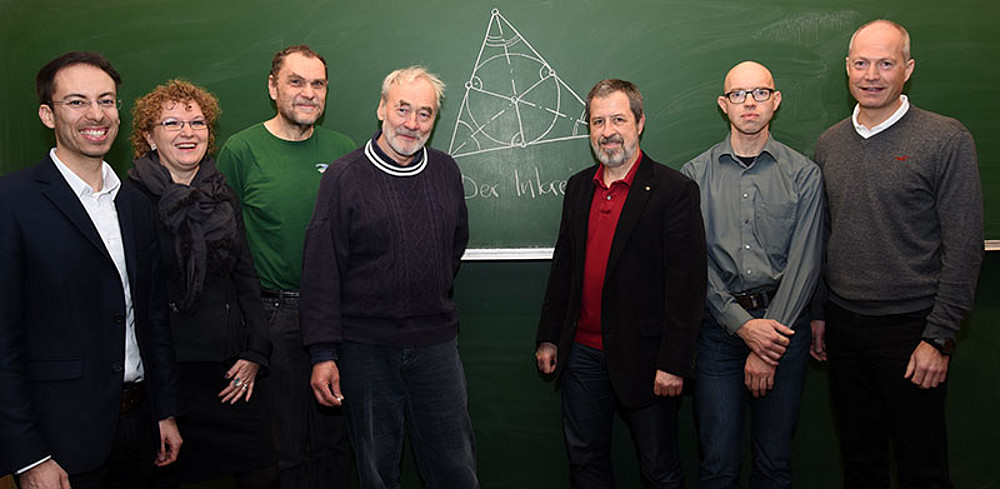
Robert Schütky, Michaela Kraker, Robert Geretschläger, Hans Walser, Bernd Thaller, Johannes Wallner und Günter Maresch. Foto: Uni Graz/Kastrun.

Robert Schütky, Michaela Kraker, Fachinspektorin für Mathematik und Angewandte Mathematik des Landesschulrat für Steiermark, Robert Geretschläger, Hans Walser, Bernd Thaller, Johannes Wallner und Günter Maresch. Foto: Uni Graz/Kastrun.

ForscherInnen und Lehrende werfen Licht auf mathematische Fragestellungen

Seit mehr als 10 Jahren findet der Tag der Mathematik als Fortbildungsveranstaltung für Lehrende aus dem Pflichtschulbereich sowie von allgemein bildenden höheren Schulen (AHS) und berufsbildenden höhere Schulen (BHS) alternierend entweder an der TU Graz oder an der Karl-Franzens-Universität statt. „Dabei stehen sowohl mathematische Fragestellungen als auch deren Vermittlung im Unterricht im Mittelpunkt“, erklärt Organisator Ao.Univ.-Prof. Dr. Bernd Thaller, Institut für Mathematik und Wissenschaftliches Rechnen der Uni Graz und Regionales Fachdidaktikzentrum für Mathematik und Geometrie. Rund 150 TeilnehmerInnen werden heute, am diesjährigen Tag der Mathematik, erwartet.

Nach der Eröffnung durch Landesschulinspektor Mag. Bernd Steiner widmet sich der der Plenarvortrag des Schweizers Dr. Hans Walser dem Inkreis. Danach geht Univ.-Prof. Dr. Johannes Wallner, Institut für Geometrie der TU Graz, auf Erdvermessung und Kugelgeometrie ein. Im Anschluss diskutiert Assoz.-Prof. Dr. Günter Maresch, Universität Salzburg, Ansätze und Theorien für Differenzierung und Individualisierung im naturwissenschaftlichen Unterricht. Dr. Robert Geretschläger, Uni Graz und BRG Kepler, der auch als Moderator der Veranstaltung fungiert, widmet sich Schachbrettaufgaben des Wettbewerbs „Mathematisches Duell“, bei dem SchülerInnen rein durch elementar-logisches Denken zur Lösung einer Aufgabenstellung gelangen können.

In einem weiteren Vortrag spricht Dr. Robert Schütky, KPH Graz, zur Entstehung und Vereinheitlichung von Maßsystemen. Am Nachmittag wird Ao.Univ.-Prof. Dr. Jürgen Maaß, Universität Linz, Beispiele für Modellieren im Mathematikunterricht präsentieren. Das dialogische Lernen ebenda wird Gegenstand des Vortrags von Dr. Christine Fischer, Lachdesfachkoordinatorin für Mathematik für NMS in der Steiermark, sein. Den „magischen“ Abschluss der Veranstaltung bildet der Vortrag von Mag. Dieter Kadan, Kollegium Kalksberg in Wien und ehemaliger Vizestaatsmeister der Zauberkunst: Er wird aufzeigen, wie Mathematik die Zauberei erklärbar macht.

created by Gerhild Kastrun

Related news

Studying at the University of Graz: How to enrol

Ready for a new chapter in your life with the start of your studies at the University of Graz in the winter semester 2026/27? Here you will find information on deadlines, admission procedures, registration, and everything else you need to successfully start your studies in the fall.

Interpreting data: Why studies sometimes get it wrong

Hilmar Brohmer and Ziva Korda from the Institute of Psychology, together with 500 international colleagues, have re-evaluated a hundred scientific publications and have often come to different conclusions.

Crystal-clear: AI method revolutionises solar observation

The Sun makes life on Earth possible. However, its magnetic fields can also cause massive disruption. This makes it all the more important to gain a better understanding of the processes taking place on our nearest star. A research team from the University of Graz and the High Altitude Observatory in Boulder (USA) has succeeded in doing just that. The astrophysicists have developed an AI-supported method that makes even the smallest structures on the Sun visible. The scientists are convinced that this will bring about a lasting change in solar observation and that the new method can be used for the planned European Solar Telescope.

Long Night of Research: How many languages are there in the world?

From a linguistic perspective, there are worlds of difference between Bern, Berlin and Vienna. A dialect impersonator will demonstrate live just how varied German can sound. How many languages are there in the world? What are their distinctive features? Which of these are spoken in Austria? These and other questions will be answered during the Long Night of Research at the University of Graz: on Friday, 24 April 2025, from 5 pm to 11 pm, in the University Library. Visitors can immerse themselves in the diversity of languages without travelling far by taking part in a quiz at the station.

Begin of page section:
Additional information:

University of Graz
Universitaetsplatz 3
8010 Graz
Austria
  • Contact
  • Web Editors
  • Moodle
  • UNIGRAZonline
  • Imprint
  • Data Protection Declaration
  • Accessibility Declaration
Weatherstation
Uni Graz

End of this page section. Go to overview of page sections

End of this page section. Go to overview of page sections

Begin of page section:

End of this page section. Go to overview of page sections