



Begin of page section:
Page sections:

  • Go to contents (Accesskey 1)
  • Go to position marker (Accesskey 2)
  • Go to main navigation (Accesskey 3)
  • Go to sub navigation (Accesskey 4)
  • Go to additional information (Accesskey 5)
  • Go to page settings (user/language) (Accesskey 8)
  • Go to search (Accesskey 9)

End of this page section. Go to overview of page sections

Begin of page section:
Page settings:

English en
Deutsch de
Search
Login

End of this page section. Go to overview of page sections

Begin of page section:
Search:

Search for details about Uni Graz
Close

End of this page section. Go to overview of page sections


Search

Begin of page section:
Main navigation:

Page navigation:

  • University

    University
    • About the University
    • Organisation
    • Faculties
    • Library
    • Working at University of Graz
    • Campus
    Developing solutions for the world of tomorrow - that is our mission. Our students and our researchers take on the great challenges of society and carry the knowledge out.
  • Research Profile

    Research Profile
    • Our Expertise
    • Research Questions
    • Research Portal
    • Promoting Research
    • Research Transfer
    • Ethics in Research
    • Commission for Scientific Integrity
    Scientific excellence and the courage to break new ground. Research at the University of Graz creates the foundations for making the future worth living.
  • Studies

    Studies
    • Prospective Students
    • Students
    • Welcome Weeks for First Year Students
  • Community

    Community
    • International
    • Location
    • Research and Business
    • Alumni
    The University of Graz is a hub for international research and brings together scientists and business experts. Moreover, it fosters the exchange and cooperation in study and teaching.
Topics
  • Sustainable University
  • Researchers answer
  • Work for us
Close menu

End of this page section. Go to overview of page sections

Begin of page section:
You are here:

University of Graz News Mobilität im Fokus

End of this page section. Go to overview of page sections

Monday, 20 August 2012

Mobilität im Fokus

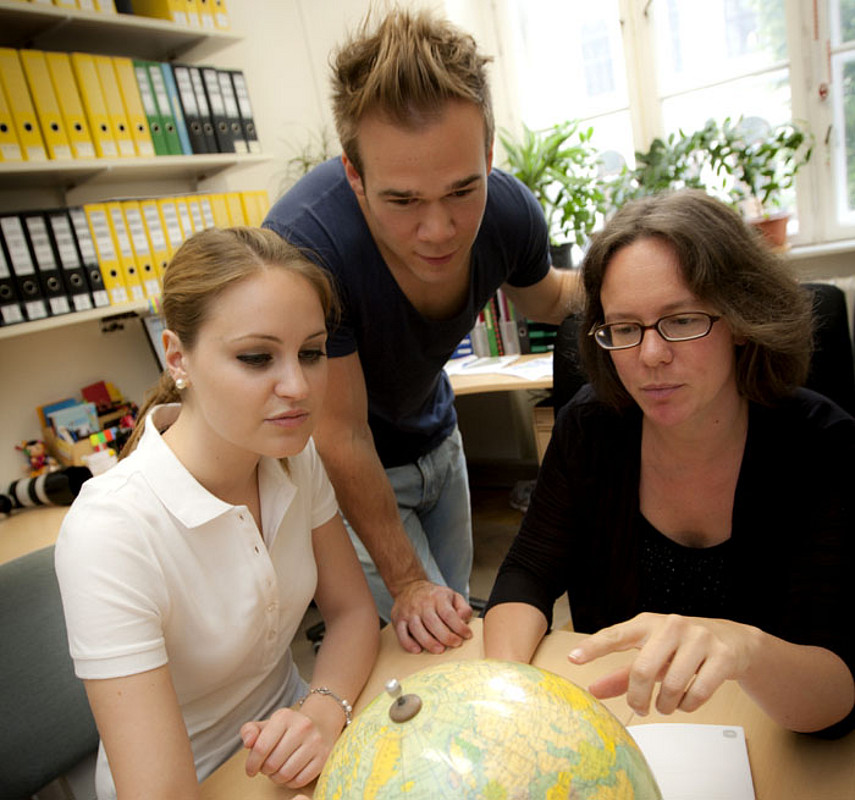
Mitarbeiterin zeigt zwei Studierenden Länder am Globus

Das Büro für internationale Beziehungen informiert über die neuen Mobilitätsprogramme. Foto: Lunghammer

Uni Graz wirbt acht neue EU-Mobilitätsprogramme ein

Eine überaus positive Bilanz der Antragsrunde 2012 für das ERASMUS MUNDUS-Programm der Europäischen Kommission zieht die Karl-Franzens-Universität: Insgesamt acht Projekte, in denen die Uni Graz entweder als Koordinatorin oder als Partnerin vertreten ist, bewilligte kürzlich die Education, Audiovisual and Culture Executive Agency (EACEA).


Die Programme im Rahmen der Förderschiene „ERASMUS MUNDUS „Aktion 2“ ermöglichen Studierenden und Bediensteten der Uni Graz die Absolvierung von finanziell geförderten Studien-, Lehr- und/oder Forschungsaufenthalten an Universitäten in diversen Drittstaatenregionen, darunter Armenien, Brasilien, Südafrika und Serbien. Gleichzeitig wird die Universität Graz im Rahmen der Mobilitätsprojekte als Gastuniversität für StipendiatInnen von Partnerinstitutionen aus den Drittstaatenregionen fungieren. „Die Kooperation mit Partnerinstitutionen auf europäischer Ebene sowie mit PartnerInnen aus den unterschiedlichsten Drittstaatenregionen ermöglicht die Vernetzung in verschiedenen Bereichen, sowohl in akademischer als auch in institutioneller Hinsicht“, erklärt Rektorin Christa Neuper

Das von der Universität Graz seit 2009 koordinierte JoinEU-SEE Projekt mit den Ländern des westlichen Balkans wurde bereits zum vierten Mal in Folge genehmigt. Im Herbst wird eine neue Bewerbungsrunde für JoinEU-SEE IV Stipendien gestartet.
Als Partnerin ist die Uni Graz infolge der Antragsrunde 2012 nunmehr in sieben weiteren Mobilitätsprogrammen vertreten. Diese werden wieder von renommierten europäischen Universitäten, wie TU Berlin, Universität Antwerpen oder Universität Padua, koordiniert und bieten hochdotierte Stipendien für akademischen Austausch mit verschiedenen Drittstaaten. „Die Uni Graz kann damit ihr internationales Profil weiter stärken“, freut sich Neuper.

>> Details gibt es im Büro für internationale Beziehungen


created by Andreas Schweiger

Related news

ERC Starting Grants: three million euros for two researchers at the University of Graz

Two researchers from the University of Graz have secured prestigious and generously funded grants from the EU. Starting Grants from the European Research Council (ERC), each worth 1.5 million euros, have been awarded to the human geographer Heide Bruckner and the social scientist Silvana Weiss.

Austria’s emissions rose in 2025: University of Graz researchers analyse the causes

The Environment Agency Austria has today published the figures for the country’s greenhouse gas emissions in 2025. While emissions fell sharply year on year from 2022 to 2024, they rose again by just under 0.7 per cent in 2025. Researchers at the University of Graz have analysed how much of this increase was due to structural changes in the economy and how much was attributable to external factors over which there is little control. “In 2025, the colder winter compared with 2024 increased emissions by 0.81 per cent, while the weak economy reduced them by 0.38 per cent. If we factor out these influences, we find an underlying increase of 0.26 per cent compared with the previous year,” reports economist Karl Steininger. “This clearly means that Austria is not on track to meet its climate targets, which require a substantial reduction in emissions by 2030.”

Electrifying: Researchers film the first moments on the way from light to electricity

Physicists at the University of Graz (Austria), in collaboration with colleagues from Marburg University and Forschungszentrum Jülich (Germany), have achieved a scientific breakthrough. For the first time, the generation of electrical energy from light has been filmed and described theoretically. This work is of far-reaching significance, not least for optimising sustainable energy production from photovoltaics. This is because it provides fundamental building blocks for understanding the physical processes that take place, for example, in organic solar cells. The paper was published in the journal Physical Review X, one of the world’s most prestigious physics journals.

University of Graz: Working together to make Styria a sustainable centre of learning

Round table calls for sustainable funding for the 2028–2030 performance agreement period between the five Styrian universities and the federal government.

Begin of page section:
Additional information:

University of Graz
Universitaetsplatz 3
8010 Graz
Austria
  • Contact
  • Web Editors
  • Moodle
  • UNIGRAZonline
  • Imprint
  • Data Protection Declaration
  • Accessibility Declaration
Weatherstation
Uni Graz

End of this page section. Go to overview of page sections

End of this page section. Go to overview of page sections

Begin of page section:

End of this page section. Go to overview of page sections