Begin of page section:
Page sections:

  • Go to contents (Accesskey 1)
  • Go to position marker (Accesskey 2)
  • Go to main navigation (Accesskey 3)
  • Go to sub navigation (Accesskey 4)
  • Go to additional information (Accesskey 5)
  • Go to page settings (user/language) (Accesskey 8)
  • Go to search (Accesskey 9)

End of this page section. Go to overview of page sections

Begin of page section:
Page settings:

English en
Deutsch de
Search
Login

End of this page section. Go to overview of page sections

Begin of page section:
Search:

Search for details about Uni Graz
Close

End of this page section. Go to overview of page sections


Search

Begin of page section:
Main navigation:

Page navigation:

  • University

    University
    • About the University
    • Organisation
    • Faculties
    • Library
    • Working at University of Graz
    • Campus
    Developing solutions for the world of tomorrow - that is our mission. Our students and our researchers take on the great challenges of society and carry the knowledge out.
  • Research Profile

    Research Profile
    • Our Expertise
    • Research Questions
    • Research Portal
    • Promoting Research
    • Research Transfer
    • Ethics in Research
    Scientific excellence and the courage to break new ground. Research at the University of Graz creates the foundations for making the future worth living.
  • Studies

    Studies
    • Prospective Students
    • Students
  • Community

    Community
    • International
    • Location
    • Research and Business
    • Alumni
    The University of Graz is a hub for international research and brings together scientists and business experts. Moreover, it fosters the exchange and cooperation in study and teaching.
  • Spotlight
Topics
  • Our digital Advent calendar
  • Sustainable University
  • Researchers answer
  • Work for us
Close menu

End of this page section. Go to overview of page sections

Begin of page section:
You are here:

University of Graz News Mittelalter und Moderne

End of this page section. Go to overview of page sections

Monday, 15 April 2013

Mittelalter und Moderne

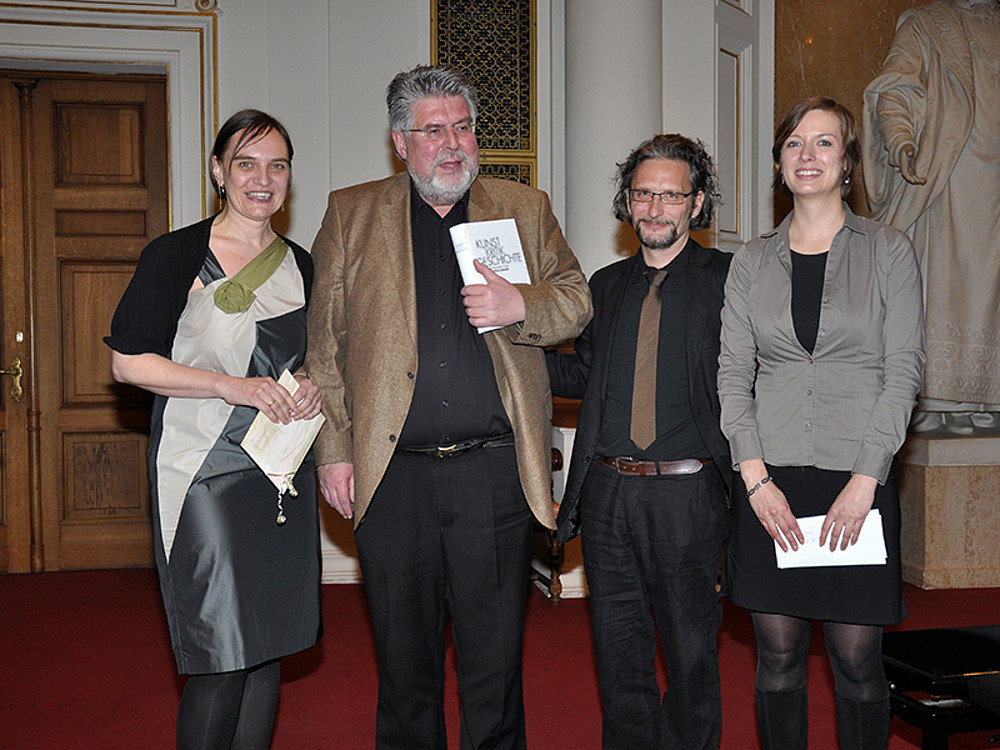
Claudia Steinhardt-Hirsch, Johann Konrad Eberlein, Gunther Reisinger, Johanna Aufreiter (v.l.) mit der Festschrift für den Jubilar

Claudia Steinhardt-Hirsch, Johann Konrad Eberlein, Gunther Reisinger, Johanna Aufreiter (v.l.) mit der Festschrift für den Jubilar

Vizedekan Lukas Meyer

Vizedekan Lukas Meyer

Laudator Harald Wolter-von dem Knesebeck

Laudator Harald Wolter-von dem Knesebeck

Festakt für Kunsthistoriker Johann Konrad Eberlein zum 65. Geburtstag

Zu Ehren von Univ.-Prof. Dr. Johann Konrad Eberlein fand am 12. April 2013 in der Aula der Uni Graz ein Festakt statt. KollegInnen, WeggefährtInnen und FreundInnen gratulierten dem Kunsthistoriker zu seinem 65. Geburtstag. Der gebürtige Nürnberger lehrt und forscht seit 1998 am Institut für Kunstgeschichte der Karl-Franzens-Universität Graz.

Nach dem Studium in Erlangen, München, Freiburg und Bonn promovierte Eberlein 1978 in Würzburg, 1992 habilitierte er sich in Kassel. Ab 1985 war er in München, Frankfurt, Innsbruck, Kassel, Graz, Bern und Salzburg wissenschaftlich tätig, bis er 1998 dem Ruf als Ordinarius für Kunstgeschichte an die Karl-Franzens-Universität Graz folgte. Seine Schwerpunkte setzte er in der Kunst des Mittelalters und der Moderne sowie in der Kunsttheorie und Methodik seines Fachs.

In seiner Ansprache hob Vizedekan Lukas Meyer das umfangreiche Wirken Johann Konrad Eberleins hervor: „Mit fast 100 Veröffentlichungen seit 1998 hat die Kunstgeschichte in Graz eine langanhaltende Explosion Ihres Schaffens erlebt“, dankte Meyer dem Jubilar für sein produktives Engagement und unterstrich auch Eberleins Bemühungen, das Studium der Kunstgeschichte für die Arbeitswelt und Praxis zu öffnen. „Ein großes Anliegen war ihm unter anderem die Denkmalpflege“, so Meyer.

Eberleins beeindruckende Leistungen und Qualitäten als Forscher und Lehrer stellte Prof. Dr. Harald Wolter-von dem Knesebeck, Kunsthistoriker der Rheinischen Friedrich-Wilhelms-Universität Bonn in den Mittelpunkt seiner Laudatio und erzählte von einprägsamen Begegnungen.

Univ.-Prof. Dr. Anselm Wagner vom Institut für Architekturtheorie, Kunst- und Kulturwissenschaften der TU Graz hielt den anschließenden Festvortrag über den berühmten Pavillon des deutschen Architekten Ludwig Mies van der Rohe (1886–1969), der bei der Weltausstellung 1929 in Barcelona zu sehen war und nach seinem Wiederaufbau als „Barcelona-Pavillon“ bis heute eine Architekturikone darstellt.

SchülerInnen und KollegInnen von Johann Konrad Eberlein schilderten schließlich persönliche Erfahrungen und Erlebnisse, die sie mit dem Lehrer und Freund verbinden.

Eine 700 Seiten starke Überraschung erwartete den Kunsthistoriker, der demnächst „offiziell“ in den Ruhestand tritt, zum Schluss: die Festschrift „Kunst – Kritik – Geschichte“, herausgegeben von Mag. Johanna Aufreiter, Dr. Gunther Reisinger, Dr. Elisabeth Sobieczky und Dr. Claudia Steinhardt-Hirsch, an der 30 AutorInnen mitgewirkt haben.

Durch die Veranstaltung führte Gunther Reisinger. Musikalisch umrahmt am Klavier wurde die Feier von Eberleins Freund O.Univ.-Prof. Wolfgang Watzinger, Professor an der Universität für Musik und darstellende Kunst Wien, und seiner Frau Mag. Maki Saeki.

created by Gudrun Pichler

Related news

Chemical Christmas show at the University of Graz: An explosive evening at the Schauspielh

At the beginning of December, the University of Graz transformed the theater into a laboratory: as part of “Chemical Life,” teacher training students staged a chemical Christmas show for Styrian school classes—complete with ethanol rockets, nitrogen snow, and glowing effects. An evening designed to inspire interest in studying chemistry.

Train by train: Koralm railway accelerates exchange between the Universities

Lectures at the University of Klagenfurt in the morning, seminars at the University of Graz in the afternoon: Austria's longest tunnel and a journey time of around 45 minutes make it easy. The Koralm railway increases the speed of networking between the two university locations. The collaboration builds on existing cooperation - for example in the areas of teacher training, Slavic studies and as employers, the universities are well coordinated.

On the trail of the Big Bang: University of Graz receives 1.5 million euros for doctoral programmes

The Austrian Science Fund FWF has selected the Doctoral Programme in Theoretical Particle Physics at the University of Graz for funding from the Doc.funds. Six young scientists will be funded for 3.5 years. They will gain fundamentally new insights into the origins of the world.

From trans women and knee prostheses: sports science prizes awarded

Walking better with a prosthesis, successfully getting rid of excess weight, training more effectively, more fairness for trans people in sport: these were the topics addressed by the students at the University of Graz who were awarded the sports science prizes for their Master's theses on 3 December 2025.

Begin of page section:
Additional information:

University of Graz
Universitaetsplatz 3
8010 Graz
Austria
  • Contact
  • Web Editors
  • Moodle
  • UNIGRAZonline
  • Imprint
  • Data Protection Declaration
  • Accessibility Declaration
Weatherstation
Uni Graz

End of this page section. Go to overview of page sections

End of this page section. Go to overview of page sections

Begin of page section:

End of this page section. Go to overview of page sections