Begin of page section:
Page sections:

  • Go to contents (Accesskey 1)
  • Go to position marker (Accesskey 2)
  • Go to main navigation (Accesskey 3)
  • Go to sub navigation (Accesskey 4)
  • Go to additional information (Accesskey 5)
  • Go to page settings (user/language) (Accesskey 8)
  • Go to search (Accesskey 9)

End of this page section. Go to overview of page sections

Begin of page section:
Page settings:

English en
Deutsch de
Search
Login

End of this page section. Go to overview of page sections

Begin of page section:
Search:

Search for details about Uni Graz
Close

End of this page section. Go to overview of page sections


Search

Begin of page section:
Main navigation:

Page navigation:

  • University

    University
    • About the University
    • Organisation
    • Faculties
    • Library
    • Working at University of Graz
    • Campus
    Developing solutions for the world of tomorrow - that is our mission. Our students and our researchers take on the great challenges of society and carry the knowledge out.
  • Research Profile

    Research Profile
    • Our Expertise
    • Research Questions
    • Research Portal
    • Promoting Research
    • Research Transfer
    • Ethics in Research
    • Commission for Scientific Integrity
    Scientific excellence and the courage to break new ground. Research at the University of Graz creates the foundations for making the future worth living.
  • Studies

    Studies
    • Prospective Students
    • Students
    • Welcome Weeks for First Year Students
  • Community

    Community
    • International
    • Location
    • Research and Business
    • Alumni
    The University of Graz is a hub for international research and brings together scientists and business experts. Moreover, it fosters the exchange and cooperation in study and teaching.
Topics
  • Sustainable University
  • Researchers answer
  • Work for us
Close menu

End of this page section. Go to overview of page sections

Begin of page section:
You are here:

University of Graz News Mit großem Erfolg

End of this page section. Go to overview of page sections

Friday, 16 September 2022

Mit großem Erfolg

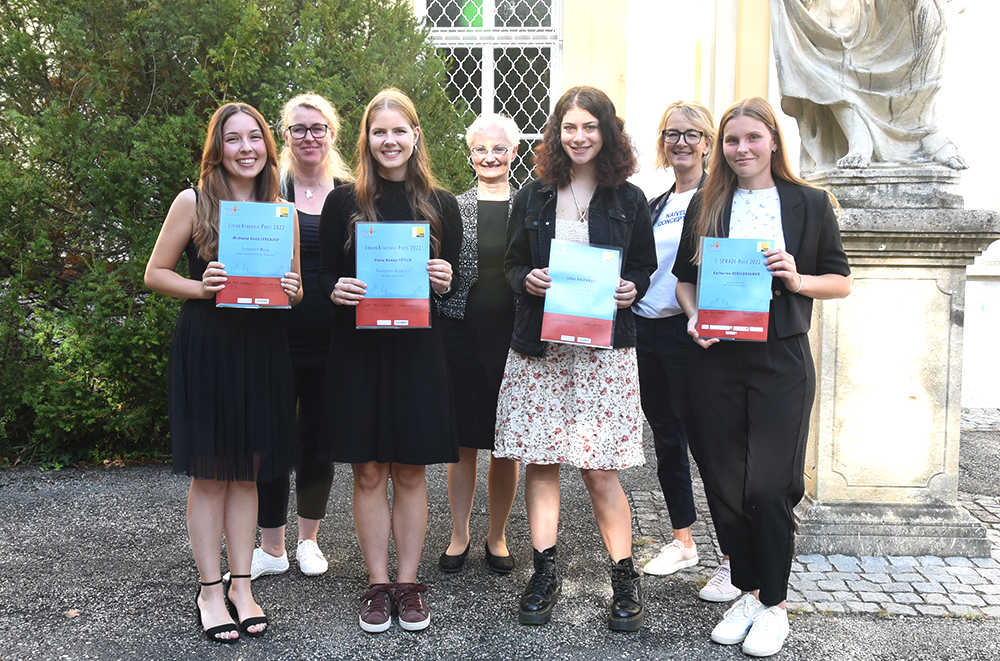
Gewinnerinnen und Gratulantinnen des JuniorAcademics- sowie SPRADI-Preises. Foto: Uni Graz/Schweiger

Gewinnerinnen und Gratulantinnen des JuniorAcademics- sowie SPRADI-Preises. Foto: Uni Graz/Schweiger

KinderUniGraz zeichnete vorwissenschaftliche Arbeiten steirischer SchülerInnen aus

We work for tomorrow – dieses Motto treibt sowohl ForscherInnen als auch Studierende der Universität Graz an. Sie arbeiten an Lösungen für die Welt für morgen – um mit dem Klimawandel umzugehen, um Krankheiten zu bekämpfen oder um Licht in ungelöste Phänomene zu bringen.
Diesen ForscherInnengeist fördert die KinderUniGraz – eine Einrichtung aller Grazer Universitäten und Hochschulen – schon bei den Jungen und zeichnet mit Hilfe von SponsorInnen alljährlich vorwissenschaftliche Arbeiten steirischer SchülerInnen aus. Insgesamt wurden Preise im Gesamtwert von mehr als 10.000 Euro vergeben.

Die Dr.-Hans-Riegel-Fachpreise werden von der Kaiserschild-Stiftung für naturwissenschaftliche Fächer vergeben. Die JuniorAcademic-Preise sowie der SPRADI-Preis der Universität Graz würdigen exzellente vorwissenschaftliche Arbeiten in den Geistes- und Kulturwissenschaften.
Die beiden feierlichen Verleihungen gingen kürzlich im Meerscheinschlössl an der Universität Graz über die Bühne. Mit zahlreichen GratulantInnen, darunter Vizebürgermeisterin Judith Schwentner, Stadtrat Günter Riegler, Landtagsklubobfrau-Stellvertreterin Alexandra Pichler-Jessenko, Bundesrat Karlheinz Kornhäusl, Landtagsabgeordneter Klaus Zenz, geschäftsführender Rektor Peter Riedler und Vizerektorin Catherine Walter-Laager.

Hier nun die „Wall of Fame“ – mit den GewinnerInnen der verschiedenen Preiskategorien:

Dr.-Hans-Riegel-Fachpreise
Die Preise werden für Arbeiten in einzelnen Unterrichtsfächern vergeben.

Biologie
1.    Sarah Weber: Die Jugend und der Alkohol – auf Fragebogenerhebung basierende Darlegung des Alkoholkonsumverhaltens der SchülerInnen am BORG Birkfeld
2.    Katrin Mathe: Die Auswirkungen der elektromagnetischen Strahlung von W-Lan-Routern auf Pflanzen
3.    Anna Führer: Chronobiologie. Wenn der innere Rhythmus auf den Schulalltag trifft

Chemie
1.    Lilian Bruss: Polymere für die additive Fertigung in der Medizintechnik – Auswahl, Charakterisierung und Anwendung spezieller Polymere für unterschiedliche 3D-Druck-Anlagen
2.    Anna Köhldorfer: Wasserstoff im Hochofen – Methoden zur Emissionsreduktion bei der Stahlproduktion
3.    Thomas Klimisch: Molekülorbitale - Quantenmechanik in der Chemie

Informatik
1.    Christian Kroißenbrunner: CO2-Ampeln – Aufbau, Funktion und Nutzen in Bezug auf eine Optimierung des Lüftungsverhaltens in Innenräumen
2.    Alen Saracevic: Neuromorphic Engineering – Brain-Inspired Hardware Architectures
3.    Paul Alexander Wendl: Verwendung von Hash-Funktionen in der Kryptographie

Mathematik
1.    Johannes Thuswaldner: The SIR Model - Mathematical modeling of epidemics
2.    Miriam Rainer: Das Gekreuzte-Leitern-Problem
3.    Moses Breitegger: Die Division durch Null

Physik
1.    Gloria Schimetta: Die Physik des Kiteschirms und die Beeinflussung der Flugeigenschaften durch Variation der Leinenlänge
2.    Nikolaus Leonid Lackner: The Strange Properties of Light
3.    Leon Ehrhard Tschurtschenthaler: Star Wars: Science vs. Fiction


JuniorAcademic-Preise

  • Elena Hanna Fötsch: Die Spanische Grippe in Ligist
  • Michaela Anna Lengauer: Förderung frühgeborener Kinder durch Musiktherapie
  • Inbal Rosenmann: An Analysis of the Waltzes of Chopin Op. 64

Verleihung JuniorAcademic-Anerkennungspreise

  • Simon Aringer: Die Wiener Symphoniker – Aspekte ihrer Geschichte und Gegenwart
  • Cara Spitzer: Psychologische Einflussfaktoren für die Erbringung von Höchstleistung im Spitzensport

SPRADI-Preis
Katharina Kerschbaumer: Modern Slavery in Europe and the Toll it takes on Minor
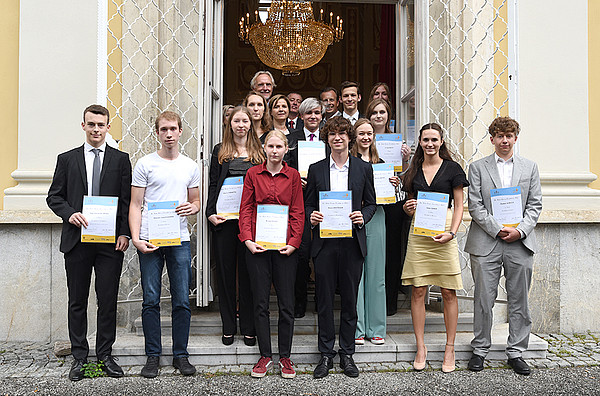
Gewinnerinnen und Gratulantinnen der Dr.-Hans-Riegel-Fachpreise. Foto: Uni Graz/Leljak
created by Gerhild Leljak & Andreas Schweiger

Related news

Electrifying: Researchers film the first moments on the way from light to electricity

Physicists at the University of Graz (Austria), in collaboration with colleagues from Marburg University and Forschungszentrum Jülich (Germany), have achieved a scientific breakthrough. For the first time, the generation of electrical energy from light has been filmed and described theoretically. This work is of far-reaching significance, not least for optimising sustainable energy production from photovoltaics. This is because it provides fundamental building blocks for understanding the physical processes that take place, for example, in organic solar cells. The paper was published in the journal Physical Review X, one of the world’s most prestigious physics journals.

University of Graz: Working together to make Styria a sustainable centre of learning

Round table calls for sustainable funding for the 2028–2030 performance agreement period between the five Styrian universities and the federal government.

How can we teach using YouTube and AI? The University of Graz is strengthening media education in schools

A journey through the blood vessels using VR headsets brings biology lessons to life. An interactive quiz brings physics to life. The YouTube video explains the First World War. Whilst mobile phones are increasingly being banned from the classroom, social media platforms, apps and AI are playing an ever-greater role in knowledge transfer at school. But how can teaching with media be made even more effective? What are the challenges in media-based teaching? At the University of Graz, researchers are discussing these issues at a conference being held in Austria for the first time.

Jurassic Sounds: Biologist reconstructs insect songs from 165 million years ago

It was apparently not just the roars of the dinosaurs that made up the soundscape of the animal world during the Jurassic period. Crickets and grasshoppers communicated through a variety of songs and high-pitched sounds, as Thorin Jonsson from the Institute of Biology at the University of Graz discovered together with colleagues from the universities of Lincoln, Bristol (UK), Beijing (China) and Tempe (USA). The findings on what are so far the oldest traces of sound on Earth have just been published in the journal PNAS.

Begin of page section:
Additional information:

University of Graz
Universitaetsplatz 3
8010 Graz
Austria
  • Contact
  • Web Editors
  • Moodle
  • UNIGRAZonline
  • Imprint
  • Data Protection Declaration
  • Accessibility Declaration
Weatherstation
Uni Graz

End of this page section. Go to overview of page sections

End of this page section. Go to overview of page sections

Begin of page section:

End of this page section. Go to overview of page sections