Begin of page section:
Page sections:

  • Go to contents (Accesskey 1)
  • Go to position marker (Accesskey 2)
  • Go to main navigation (Accesskey 3)
  • Go to sub navigation (Accesskey 4)
  • Go to additional information (Accesskey 5)
  • Go to page settings (user/language) (Accesskey 8)
  • Go to search (Accesskey 9)

End of this page section. Go to overview of page sections

Begin of page section:
Page settings:

English en
Deutsch de
Search
Login

End of this page section. Go to overview of page sections

Begin of page section:
Search:

Search for details about Uni Graz
Close

End of this page section. Go to overview of page sections


Search

Begin of page section:
Main navigation:

Page navigation:

  • University

    University
    • About the University
    • Organisation
    • Faculties
    • Library
    • Working at University of Graz
    • Campus
    Developing solutions for the world of tomorrow - that is our mission. Our students and our researchers take on the great challenges of society and carry the knowledge out.
  • Research Profile

    Research Profile
    • Our Expertise
    • Research Questions
    • Research Portal
    • Promoting Research
    • Research Transfer
    • Ethics in Research
    • Commission for Scientific Integrity
    Scientific excellence and the courage to break new ground. Research at the University of Graz creates the foundations for making the future worth living.
  • Studies

    Studies
    • Prospective Students
    • Students
  • Community

    Community
    • International
    • Location
    • Research and Business
    • Alumni
    The University of Graz is a hub for international research and brings together scientists and business experts. Moreover, it fosters the exchange and cooperation in study and teaching.
  • Spotlight
Topics
  • Sustainable University
  • Researchers answer
  • Work for us
Close menu

End of this page section. Go to overview of page sections

Begin of page section:
You are here:

University of Graz News Mit der Uni im Gleichklang

End of this page section. Go to overview of page sections

Tuesday, 31 March 2015

Mit der Uni im Gleichklang

Das Projektteam zur Work-Life-Balance präsentiert Maßnahmen, wie man wissenschaftliche Karriere und familiäre Anforderungen besser unter einen Hut bringt.

Junge ForscherInnen sollen auch unter den aktuellen Rahmenbedingungen wissenschaftliche Karriere und Privatleben gut vereinbaren können. Das Projekt Work-Life-Balance in der Wissenschaft der Koordinationsstelle für Geschlechterstudien hat sich zum Ziel gesetzt, dafür erstens mehr Bewusstsein zu schaffen und zweitens konkrete Maßnahmen zu entwickeln, die die Karl-Franzens-Universität für ihren Nachwuchs setzen kann. Bei der großen Abschlusspräsentation mit dem Titel "Die neue Universität (über?)leben" wurden dieser Tage die Ergebnisse präsentiert.

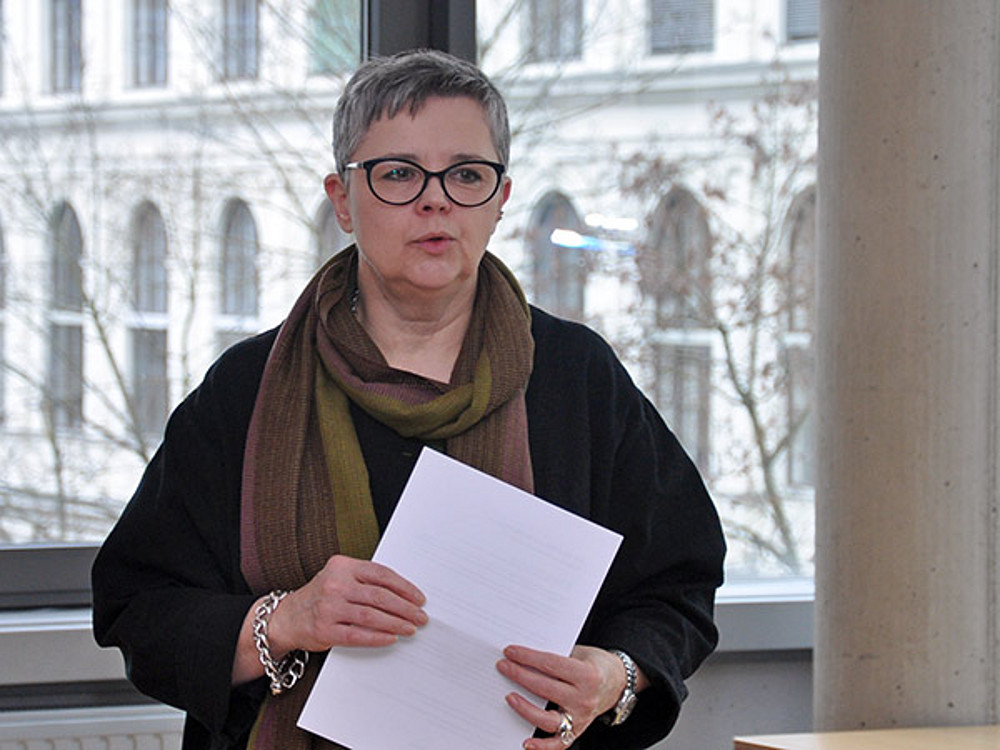
In den letzten 15 Jahren hat sich der Wissenschaftsbetrieb stärker verändert als je zuvor, das metrische Messen von Leistungen rückt immer stärker ins Blickfeld. Das sorgt nicht nur für Fairness, sondern auch für zusätzlichen Druck. Im Vorfeld der Veranstaltung gaben daher ForscherInnen mittels Fragebögen und Interviews Einblick in die Hürden, Tücken und Vorteile ihres wissenschaftlichen Alltags. Vizerektorin Renate Dworczak dankte ihnen für ihre Mitwirkung, die wesentlich zum Gelingen des Projekts beigetragen hat. "Wir waren überrascht, dass die Anforderungen und Bedürfnisse unserer MitarbeiterInnen anders gelagert sind, als wir erwartet hätten. Daher haben wir die Abkürzung WLB für Work-Life-Balance auch schnell umgedeutet in Wissenschaft in Balance erleben", so Dworczak bei der Eröffnung des Abschlussevents.

Über die Vor- und Nachteile des alten wie des neuen Systems diskutierten der Theologe Rainer Bucher und die junge Assistenzprofessorin Emma Lantschner. Anschließend gaben Uni-Rat und Generaldirektor der Pensionsversicherungsanstalt Wilfried Pinggera, Arbeitspsychologe Wolfgang Kallus, der Leiter dies Instituts für Wissenschafts- und Technikforschung der Uni Wien Maximilian Fochler sowie der Hochschulexperte Hans Pechar in Impulsreferaten Einblick in die sozialen und wissenschaftlichen Kosten der Veränderungen im Forschungsbetrieb.


 

created by Dagmar Eklaude

Related news

Building biological bridges: Chemist discovers an ecological tool for the pharmaceutical industry

Building a relationship on a solid foundation is also important in chemistry. To produce medicines, disinfectants or plant protection products, stable bonds between carbon atoms must be formed. Conventional chemical methods rely on environmentally harmful reagents and solvents to carry out the desired reaction. This process also produces unusable by-products. Chemist Lilla Gal has discovered an enzyme that enables the same process to take place efficiently and sustainably. The results of her research were recently published in the prestigious journal Angewandte Chemie.

Higher Education Strategy 2040: Austria’s universities on course for the future

Austria has 77 higher education institutions, which is above the EU average – but does this really make sense? The new Higher Education Strategy 2040 focuses on cooperation rather than mergers. As one of the six largest universities in Austria, the University of Graz plays a central role in this.

Climate research in Greenland: Old data provides new insights

The polar explorer and University of Graz professor Alfred Wegener left behind a unique collection of climate data from Greenland. A research team from the University of Graz is now analysing this 100-year-old treasure trove of data and comparing it with current measurements.

Diversity in nature and science: How we talk about plants and each other

Ginkgo, kiwi, hemp: they exist as male and female plants. Anyone who paid attention in biology class will confirm this. But is this categorisation, established by Carl von Linné almost 300 years ago, still valid today? An interdisciplinary team at the University of Graz is questioning these attributions and using this as a starting point to provide food for thought for gender-sensitive interaction between students, scientific and teaching staff.

Begin of page section:
Additional information:

University of Graz
Universitaetsplatz 3
8010 Graz
Austria
  • Contact
  • Web Editors
  • Moodle
  • UNIGRAZonline
  • Imprint
  • Data Protection Declaration
  • Accessibility Declaration
Weatherstation
Uni Graz

End of this page section. Go to overview of page sections

End of this page section. Go to overview of page sections

Begin of page section:

End of this page section. Go to overview of page sections