Begin of page section:
Page sections:

  • Go to contents (Accesskey 1)
  • Go to position marker (Accesskey 2)
  • Go to main navigation (Accesskey 3)
  • Go to sub navigation (Accesskey 4)
  • Go to additional information (Accesskey 5)
  • Go to page settings (user/language) (Accesskey 8)
  • Go to search (Accesskey 9)

End of this page section. Go to overview of page sections

Begin of page section:
Page settings:

English en
Deutsch de
Search
Login

End of this page section. Go to overview of page sections

Begin of page section:
Search:

Search for details about Uni Graz
Close

End of this page section. Go to overview of page sections


Search

Begin of page section:
Main navigation:

Page navigation:

  • University

    University
    • About the University
    • Organisation
    • Faculties
    • Library
    • Working at University of Graz
    • Campus
    Developing solutions for the world of tomorrow - that is our mission. Our students and our researchers take on the great challenges of society and carry the knowledge out.
  • Research Profile

    Research Profile
    • Our Expertise
    • Research Questions
    • Research Portal
    • Promoting Research
    • Research Transfer
    • Ethics in Research
    • Commission for Scientific Integrity
    Scientific excellence and the courage to break new ground. Research at the University of Graz creates the foundations for making the future worth living.
  • Studies

    Studies
    • Prospective Students
    • Students
  • Community

    Community
    • International
    • Location
    • Research and Business
    • Alumni
    The University of Graz is a hub for international research and brings together scientists and business experts. Moreover, it fosters the exchange and cooperation in study and teaching.
  • Spotlight
Topics
  • Sustainable University
  • Researchers answer
  • Work for us
Close menu

End of this page section. Go to overview of page sections

Begin of page section:
You are here:

University of Graz News Using beard lichen to fight cancer: How the promising usnic acid works

End of this page section. Go to overview of page sections

Monday, 28 October 2024

Using beard lichen to fight cancer: How the promising usnic acid works

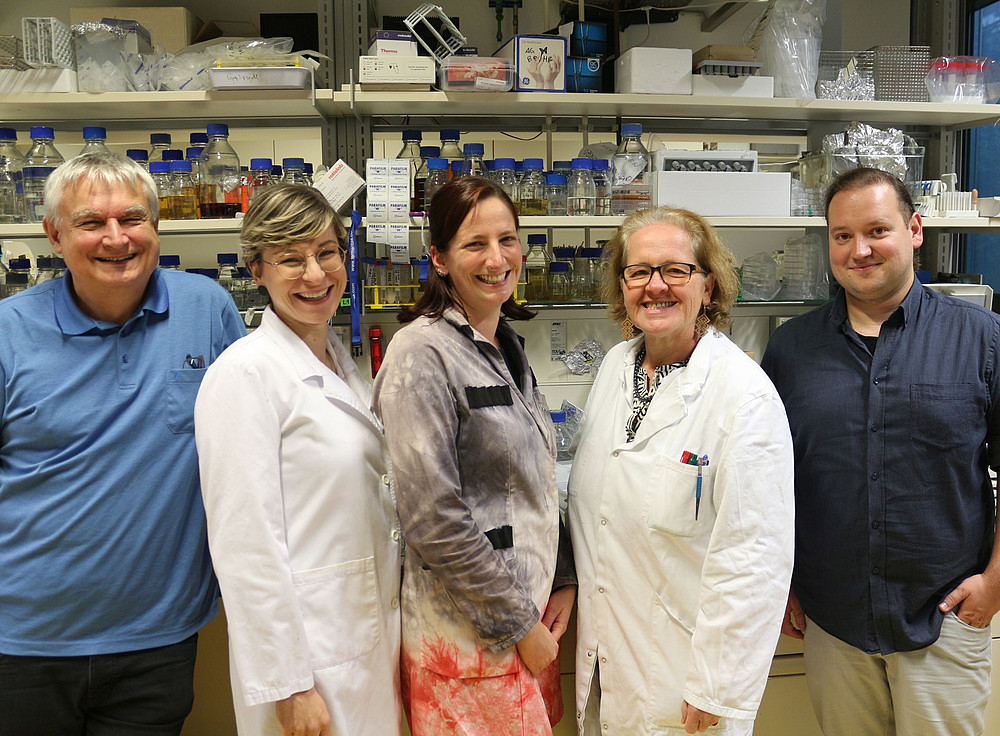
5 scientists standing in front of the laboratory, one man with a blue shirt, one woman with short blonde hair wearing a labor cote, one woman with long brown hair and a grey blouse, one women wearing Labor cote , on man has short dark hair dressed in navy-blue shirt jeans, laboratory full of shelves filled up by test tubes and small plastic containers with different glowing colors inside

Helmut Bergler's team is researching new active ingredients to combat cancer. Photo: Uni Graz

Researchers at the University of Graz have deciphered the mechanism of action of usnic acid, which is found in beard lichen and is highly regarded in the fight against cancer. The natural substance disrupts the production of ribosomes and can thus inhibit the growth of tumour cells without harming healthy cells. The study was published in Nature Communications.

Beard lichen usually grows on conifers and is quite inconspicuous at first glance. However, it is an important source of hope in the treatment of cancer. The reason for this is the active ingredient it contains, usnic acid, which is being considered as a candidate for the treatment of tumours or even infectious diseases. However, exactly how the substance works has been a mystery until now.

Researchers at the University of Graz, in cooperation with the IMP Vienna, have investigated the process and deciphered the mechanism by which the active ingredient prevents cancer cells from dividing. ‘Usnic acid attacks at the very beginning of ribosome production,’ explains Helmut Bergler, professor at the Institute of Molecular Biosciences at the University of Graz: ‘Ribosomes are, so to speak, machines in our cells that can produce proteins. When a cell divides, many new proteins are needed and therefore a corresponding number of ribosomes.’

Production stops

Bergler compares the effect of usnic acid with a targeted disruption in a factory, which completely paralyses production. ‘Tumour cells require enormous amounts of energy and a constant supply of new ribosomes for their rapid division,’ says the molecular biologist. ‘Without these important cell-building materials, which can produce proteins, this does not work and the growth of the tumour is severely slowed down.’ Another advantage is that healthy body cells divide much less frequently than tumour cells and therefore require fewer new ribosomes. As a result, they remain largely unaffected by a temporary disruption in production.

To better understand the process, the researchers in Bergler's team used yeast cells. These microorganisms produce ribosomes in a very similar way to human cells and are easy to cultivate in the laboratory. ‘What we discover in yeast can therefore also work in humans,’ explains Bergler.

However, there is still a long way to go before the findings can be applied to patients. The research on the effect of usnic acid on tumour cells is not yet complete. However, the new findings represent a major advance. ‘Now we can specifically look for molecules with similar properties,’ explains Bergler. This lays an important foundation for further research that could lead to initial clinical tests.

The study

https://doi.org/10.1038/s41467-024-51754-3


created by Roman Vilgut

Related news

Forscher:innen entdecken natürlichen Wirkstoff zum Schutz vor Lebererkrankungen

Die Leber leidet still. „Fetteinlagerungen, strukturelle Zerstörung des Gewebes oder mutierende Tumorzellen – all das fliegt eine Weile unter dem Radar. Begleitet werden diese Veränderungen oft von leichten, jedoch chronischen Entzündungen“, erklärt Andreas Koeberle, Pharmazeut an der Universität Graz. Er hat mit seinem Team und Kolleg:innen der Universität Innsbruck den Wirkstoff Mitrephoron B untersucht, der neue Behandlungsansätze ermöglicht. Die Ergebnisse der Studie wurden kürzlich in der Open-Access-Fachzeitschrift „Theranostics“ veröffentlicht.

Climate at the cliffs: Researchers unravel the evolution of the Greenland ice margin

Vertical ice walls, up to 40 metres high: in "Game of Thrones" they were dramatised as fortifications; during the Cold War, they were studied with great interest. How these imposing walls along Greenland’s 80,000-kilometre-long ice margin formed, how they are evolving, and what impact they have on the climate is not yet fully understood. Researchers from the Universities of Graz and Innsbruck have come one step closer to solving the mystery. The results of their latest study have been published in the journal The Cryosphere.

Achieving climate goals: Researchers highlight need for fair country shares in CO2

As the war in the Middle East is currently reminding us once again, many countries around the world are heavily reliant on oil and gas. Lax climate policy and limited options for removing CO₂ from the atmosphere could cement this dependence for future generations. Scientists at the University of Graz highlight this danger in a new study published in the journal Global Environmental Change. They find that rights to carbon dioxide removal should be distributed across countries just as fairly as emission budgets in order to halt global warming.

Electrons and AI: New approaches to the search for new medicines

Researchers at the University of Graz are revolutionising the development of new medicines by combining electrochemistry and artificial intelligence. Thanks to smart optimisation, the search for new active ingredients will in future be faster, more sustainable and safer.

Begin of page section:
Additional information:

University of Graz
Universitaetsplatz 3
8010 Graz
Austria
  • Contact
  • Web Editors
  • Moodle
  • UNIGRAZonline
  • Imprint
  • Data Protection Declaration
  • Accessibility Declaration
Weatherstation
Uni Graz

End of this page section. Go to overview of page sections

End of this page section. Go to overview of page sections

Begin of page section:

End of this page section. Go to overview of page sections