Begin of page section:
Page sections:

  • Go to contents (Accesskey 1)
  • Go to position marker (Accesskey 2)
  • Go to main navigation (Accesskey 3)
  • Go to sub navigation (Accesskey 4)
  • Go to additional information (Accesskey 5)
  • Go to page settings (user/language) (Accesskey 8)
  • Go to search (Accesskey 9)

End of this page section. Go to overview of page sections

Begin of page section:
Page settings:

English en
Deutsch de
Search
Login

End of this page section. Go to overview of page sections

Begin of page section:
Search:

Search for details about Uni Graz
Close

End of this page section. Go to overview of page sections


Search

Begin of page section:
Main navigation:

Page navigation:

  • University

    University
    • About the University
    • Organisation
    • Faculties
    • Library
    • Working at University of Graz
    • Campus
    Developing solutions for the world of tomorrow - that is our mission. Our students and our researchers take on the great challenges of society and carry the knowledge out.
  • Research Profile

    Research Profile
    • Our Expertise
    • Research Questions
    • Research Portal
    • Promoting Research
    • Research Transfer
    • Ethics in Research
    Scientific excellence and the courage to break new ground. Research at the University of Graz creates the foundations for making the future worth living.
  • Studies

    Studies
    • Prospective Students
    • Students
    • Welcome Weeks for First Year Students
  • Community

    Community
    • International
    • Location
    • Research and Business
    • Alumni
    The University of Graz is a hub for international research and brings together scientists and business experts. Moreover, it fosters the exchange and cooperation in study and teaching.
  • Spotlight
Topics
  • Sustainable University
  • Researchers answer
  • Work for us
Close menu

End of this page section. Go to overview of page sections

Begin of page section:
You are here:

University of Graz News Minister Eva-Maria Holzleitner visits the University of Graz

End of this page section. Go to overview of page sections

Tuesday, 11 November 2025

Minister Eva-Maria Holzleitner visits the University of Graz

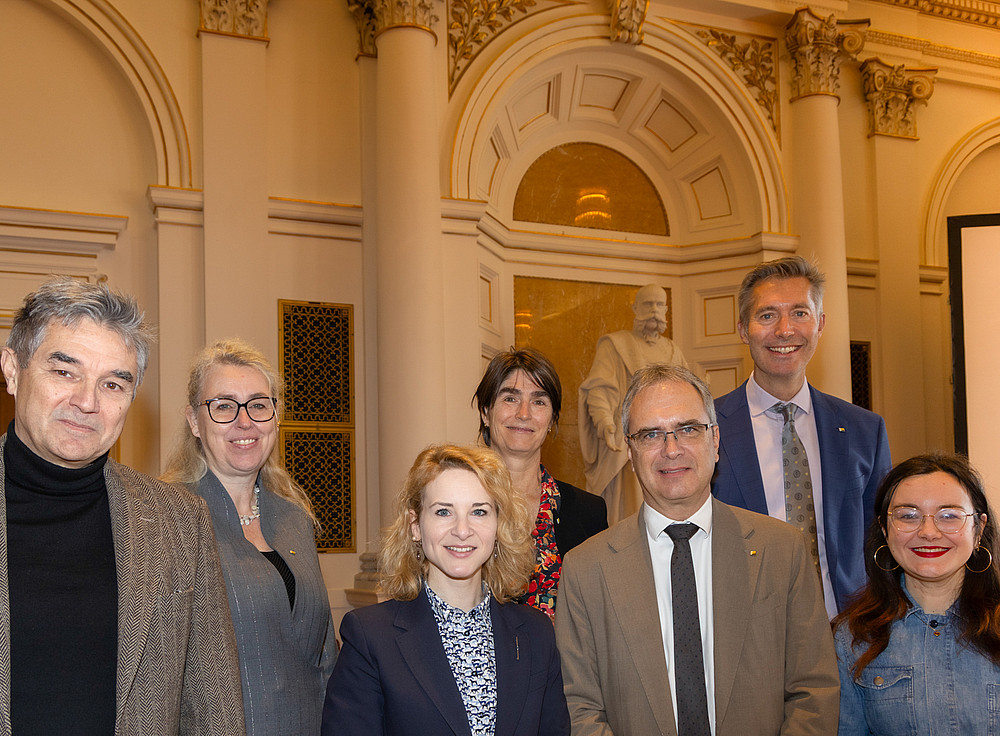
Group photo taken during the minister's visit to the auditorium of the University of Graz ©Uni Graz/Lunghammer

Federal Minister or Education Eva-Maria Holzleitner (3rd from left) was welcomed on her first visit to the University of Graz by Vice-Rectors Joachim Reidl, Mireille van Poppel, Catherine Walter-Laager, Rector Peter Riedler, Vice-Rector Markus Fallenböck and the Chair of the Students' Union Mary Weitzer. Photo: University of Graz/Lunghammer

Eva-Maria Holzleitner, the Federal Minister for Women, Science and Research, visited the University of Graz on 11 November with great interest and in a very good atmosphere. Her discussions with Rector Peter Riedler, members of the Rectorate and students focused on current challenges in the area of university funding, the training of elementary school teachers and issues relating to the organisation of teacher training courses.

The Minister praised the University of Graz as one of Austria's central scientific institutions, especially in the south of Austria, and emphasised its importance for the further development of the entire Austrian and European higher education area.

"The University of Graz is one of the central scientific institutions in our country. It combines excellent research with a high level of social responsibility and, as a general university, makes an indispensable contribution to our education system and the innovative strength of Austria and Europe," said Federal Minister Eva-Maria Holzleitner during her visit. "However, I was also particularly impressed by the university's commitment to the training of teachers and elementary educators. These areas are crucial for the future of our children and young people."

Another focus of the discussion was the training of teachers. In view of the existing shortage of teachers and the organisation of teacher training courses, it was emphasised that the University of Graz makes a decisive contribution to the future of the education system with its teacher training courses and will continue to do so in the future. Around 21 per cent of active students are currently enrolled in teacher training programmes. The aim of the Rectorate is to ensure the high quality and scientific anchoring of this training programme in the long term and to maintain it centrally at the University of Graz.

The training of elementary school teachers and the associated challenges were also a topic of the visit. With the recently launched training offensive and the funding of a further 150 training places, the University of Graz is providing important impetus for early childhood education and strengthening the link between research, practice and training.

During her visit, the Minister also learnt about current initiatives on campus. These included the LUIS*A campaign against sexual harassment, which contributes to a culture of respectful interaction, as well as the plans to redesign the former canteen into a modern learning zone for students, which will be available around the clock from mid-January. A short tour of the university library with its important special collection offered insights into the university's rich academic tradition. The subsequent meeting with representatives of the Austrian Students' Union (ÖH) centred on the perspectives and concerns of students over coffee.

Another topic that is currently being discussed intensively within the University of Graz is the question of how academic achievements can be evaluated and made visible. During the discussion, it became clear that there is a tension between scientific freedom and the social demand for measurable results, which - similar to current debates in the USA - gives rise to different perspectives and positions.

"The Federal Minister's visit was an important and very positive signal for the University of Graz. We took the opportunity to discuss key topics such as future funding, but also the further development of teacher training programmes and training in elementary education. These areas are of great social relevance and are crucial for us to respond to the challenges in the field of education," said Peter Riedler, Rector of the University of Graz. "We are particularly pleased that the Minister explicitly recognised the role of our university as an important research and educational institution in Austria, but above all in southern Austria and Europe. This encourages us to continue on our path consistently and in dialogue with politics, society and our students".

created by Gerlinde Tuscher

Related news

Survival yesterday and today: exhibition at the University of Graz makes poverty audible

What connects Anna from Styria, who lost her job two years ago due to illness, with the blacksmith Giulio, who worked in Bologna almost 500 years ago? Both are afraid of no longer being able to pay their rent. And what does the medieval Nuremberg begging ordinance have to do with current regulations in Graz? In both cases, the aim is to prevent too many people from begging for alms in the city. How do people cope with existential worries? To what extent are such experiences the same today as they were then? From 5 to 31 March 2026, an exhibition at the University of Graz will bring poverty in the present and the Middle Ages to life.

New AI Method Revolutionises the Design of Enzymes

Researchers at TU Graz and the University of Graz can use the technology to construct artificial biocatalysts. These new enzymes are significantly faster, more stable and more versatile than previous artificial biocatalysts.

The dark side of life: new method developed to identify soil organisms

A large number of soil animals are smaller than one millimetre and are therefore difficult to study scientifically. Biologists from the University of Graz have now developed a method to determine both the shape and the DNA of the organisms. The results have been published in the journal Geoderma.

How does peace succeed? Maximilian Lakitsch drives research forward

Donald Trump is rattling his proverbial sabre ever louder, unrest in the Middle East is escalating and the war in Ukraine continues to rage. Maximilian Lakitsch knows what political measures could contribute to reconciliation. He is the coordinator of an EU-wide initiative to strengthen peace research.

Begin of page section:
Additional information:

University of Graz
Universitaetsplatz 3
8010 Graz
Austria
  • Contact
  • Web Editors
  • Moodle
  • UNIGRAZonline
  • Imprint
  • Data Protection Declaration
  • Accessibility Declaration
Weatherstation
Uni Graz

End of this page section. Go to overview of page sections

End of this page section. Go to overview of page sections

Begin of page section:

End of this page section. Go to overview of page sections