



Begin of page section:
Page sections:

  • Go to contents (Accesskey 1)
  • Go to position marker (Accesskey 2)
  • Go to main navigation (Accesskey 3)
  • Go to sub navigation (Accesskey 4)
  • Go to additional information (Accesskey 5)
  • Go to page settings (user/language) (Accesskey 8)
  • Go to search (Accesskey 9)

End of this page section. Go to overview of page sections

Begin of page section:
Page settings:

English en
Deutsch de
Search
Login

End of this page section. Go to overview of page sections

Begin of page section:
Search:

Search for details about Uni Graz
Close

End of this page section. Go to overview of page sections


Search

Begin of page section:
Main navigation:

Page navigation:

  • University

    University
    • About the University
    • Organisation
    • Faculties
    • Library
    • Working at University of Graz
    • Campus
    Developing solutions for the world of tomorrow - that is our mission. Our students and our researchers take on the great challenges of society and carry the knowledge out.
  • Research Profile

    Research Profile
    • Our Expertise
    • Research Questions
    • Research Portal
    • Promoting Research
    • Research Transfer
    • Ethics in Research
    • Commission for Scientific Integrity
    Scientific excellence and the courage to break new ground. Research at the University of Graz creates the foundations for making the future worth living.
  • Studies

    Studies
    • Prospective Students
    • Students
    • Registration for Study Programme (Winter semester 2026/27)
    • Study Days 22-26 June 2026
  • Community

    Community
    • International
    • Location
    • Research and Business
    • Alumni
    The University of Graz is a hub for international research and brings together scientists and business experts. Moreover, it fosters the exchange and cooperation in study and teaching.
Topics
  • Sustainable University
  • Researchers answer
  • Work for us
Close menu

End of this page section. Go to overview of page sections

Begin of page section:
You are here:

University of Graz News Mehrfachdiskriminierung

End of this page section. Go to overview of page sections

Friday, 30 January 2015

Mehrfachdiskriminierung

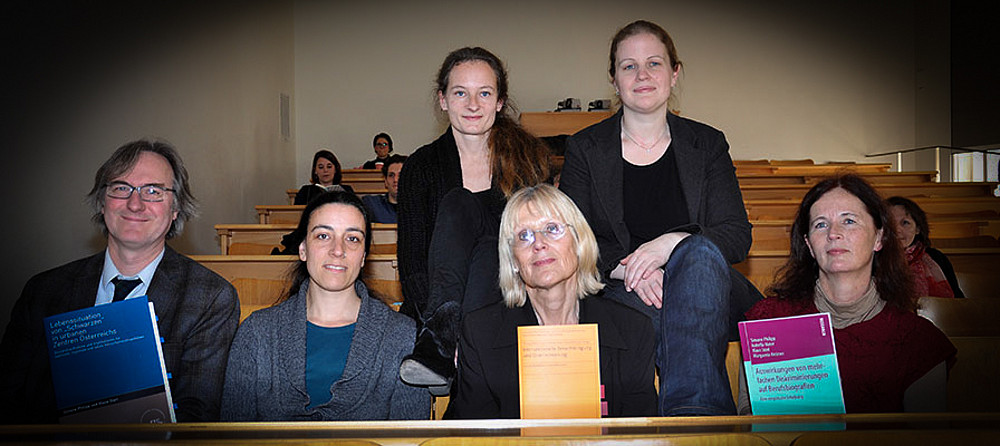
Präsentierten ihre Ergebnisse zur Mehrfachdiskriminierung: Klaus Starl, Simone Philipp, Isabella Meier, Karin Schmidlechner, Veronika Apostolovski und Margareta Kreimer (v.l.). Foto: Uni Graz/Kastrun

Präsentierten ihre Ergebnisse zur Mehrfachdiskriminierung: Klaus Starl, Simone Philipp, Isabella Meier, Karin Schmidlechner, Veronika Apostolovski und Margareta Kreimer (v.l.). Foto: Uni Graz/Kastrun

Neue Publikationen des Europäischen Trainings- und Forschungszentrum für Menschenrechte

Wenn Frauen mit Migrationsgeschichte oder Menschen mit schwarzer Hautfarbe am Arbeitsmarkt diskriminiert werden, liegen meist mehrere Diskriminierungsmotive vor. "Intersektionalität" bedeutet - grob gesagt - dass jede Person in sich mehrere Charakteristika, wie beispielweise Alter, Geschlecht oder ethnische Zugehörigkeit, vereint beziehungsweise diese ihr von außen zugeschrieben werden. Um diese Formen der Mehrfachdiskriminierung drehen sich drei vom Europäischen Trainings- und Forschungszentrum für Menschenrechte (ETC) koordinierte, miteinander verknüpfte Forschungsprojekte. Die Ergebnisse wurden am 28. Jänner 2015 an der Karl-Franzens-Universität vorgestellt. 


Bei der Präsentation der Projektpublikationen hob Joseph Marko, Dekan  der Rechtswissenschaftlichen Fakultät, in seiner Einführung insbesondere hervor, dass die vorliegenden Ergebnisse nur durch die Interdisziplinarität des Teams erzielt werden konnten, da fachinterne Beschränkungen und Begrenzungen, etwa der juristischen Perspektive auf ausschließlich individuelle Grundrechte, den Blick auf systemische und strukturelle Diskriminierung verstellen.


Publikationen:
Philipp, Simone, Meier, Isabella, Apostolovski, Veronika, Starl, Klaus, Schmidlechner, Karin, Intersektionelle Benachteiligung und Diskriminierung – Soziale Realitäten und Rechtspraxis, Nomos, 2014


Philipp, Simone, Meier, Isabella, Starl, Klaus, Kreimer, Margareta, Auswirkungen von mehrfachen Diskriminierungen auf Berufsbiografien. Eine empirische Erhebung, Springer VS, Wiesbaden, 2014


Simone Philipp, Klaus Starl: Lebenssituation von „Schwarzen“ in urbanen Zentren Österreichs. Bestandsaufnahme und Implikationen für nationale, regionale und lokale Menschenrechtspolitiken, 2014




created by Barbara Schmiedl & Gerhild Kastrun

Related news

Getting even hotter: Researchers predict global warming of 1.7 degrees by 2027

While Europe is currently sweltering in the heat, global temperatures are also rising towards concerning record levels. In 2026, Earth’s surface air temperature is expected to reach 1.62 degrees, and in 2027 even 1.71 degrees Celsius above pre-industrial levels. The long-term temperature rise – an average over a 20-year period – is predicted to exceed the 1.5-degree threshold of the Paris Agreement as of 2026 already. For the first time, researchers at the University of Graz have been able to make such a forecast so far in advance. The intensifying El Niño climate event favors forecast skill and thereby facilitates a reliable computation.

Forest fire at Rosenhain: Volunteer fire brigade carried out an evacuation drill at the Jesuit refectory

Thick smoke in the stairwell, flames at the edge of the forest, people missing in the Jesuit refectory at the University of Graz: at Rosenhain, the Graz Volunteer Fire Brigade carried out a drill simulating a scenario that is becoming increasingly realistic given the heat and drought

Full effort in the heat: the Sports Centre was in full swing at the Kleeblattlauf

On 19 June 2026, 2,000 runners and hundreds of supporters made their way to the Rosenhain for a sporting end-of-term event.

Save, invest or guarantee: What Austrians expect from the state

Austria needs to make savings. But where? And what should the Republic actually be spending its money on? The answers are provided by the initial findings of a major study involving the University of Graz. 99 per cent of those surveyed are in favour of the state ensuring healthcare provision. Almost three-quarters would like to see more public funding for education, whilst only around three per cent are in favour of cuts in this sector.

Begin of page section:
Additional information:

University of Graz
Universitaetsplatz 3
8010 Graz
Austria
  • Contact
  • Web Editors
  • Moodle
  • UNIGRAZonline
  • Imprint
  • Data Protection Declaration
  • Accessibility Declaration
Weatherstation
Uni Graz

End of this page section. Go to overview of page sections

End of this page section. Go to overview of page sections

Begin of page section:

End of this page section. Go to overview of page sections