



Begin of page section:
Page sections:

  • Go to contents (Accesskey 1)
  • Go to position marker (Accesskey 2)
  • Go to main navigation (Accesskey 3)
  • Go to sub navigation (Accesskey 4)
  • Go to additional information (Accesskey 5)
  • Go to page settings (user/language) (Accesskey 8)
  • Go to search (Accesskey 9)

End of this page section. Go to overview of page sections

Begin of page section:
Page settings:

English en
Deutsch de
Search
Login

End of this page section. Go to overview of page sections

Begin of page section:
Search:

Search for details about Uni Graz
Close

End of this page section. Go to overview of page sections


Search

Begin of page section:
Main navigation:

Page navigation:

  • University

    University
    • About the University
    • Organisation
    • Faculties
    • Library
    • Working at University of Graz
    • Campus
    Developing solutions for the world of tomorrow - that is our mission. Our students and our researchers take on the great challenges of society and carry the knowledge out.
  • Research Profile

    Research Profile
    • Our Expertise
    • Research Questions
    • Research Portal
    • Promoting Research
    • Research Transfer
    • Ethics in Research
    • Commission for Scientific Integrity
    Scientific excellence and the courage to break new ground. Research at the University of Graz creates the foundations for making the future worth living.
  • Studies

    Studies
    • Prospective Students
    • Students
    • Welcome Weeks for First Year Students
  • Community

    Community
    • International
    • Location
    • Research and Business
    • Alumni
    The University of Graz is a hub for international research and brings together scientists and business experts. Moreover, it fosters the exchange and cooperation in study and teaching.
Topics
  • Sustainable University
  • Researchers answer
  • Work for us
Close menu

End of this page section. Go to overview of page sections

Begin of page section:
You are here:

University of Graz News Mathematik im Herzen

End of this page section. Go to overview of page sections

Wednesday, 13 March 2013

Mathematik im Herzen

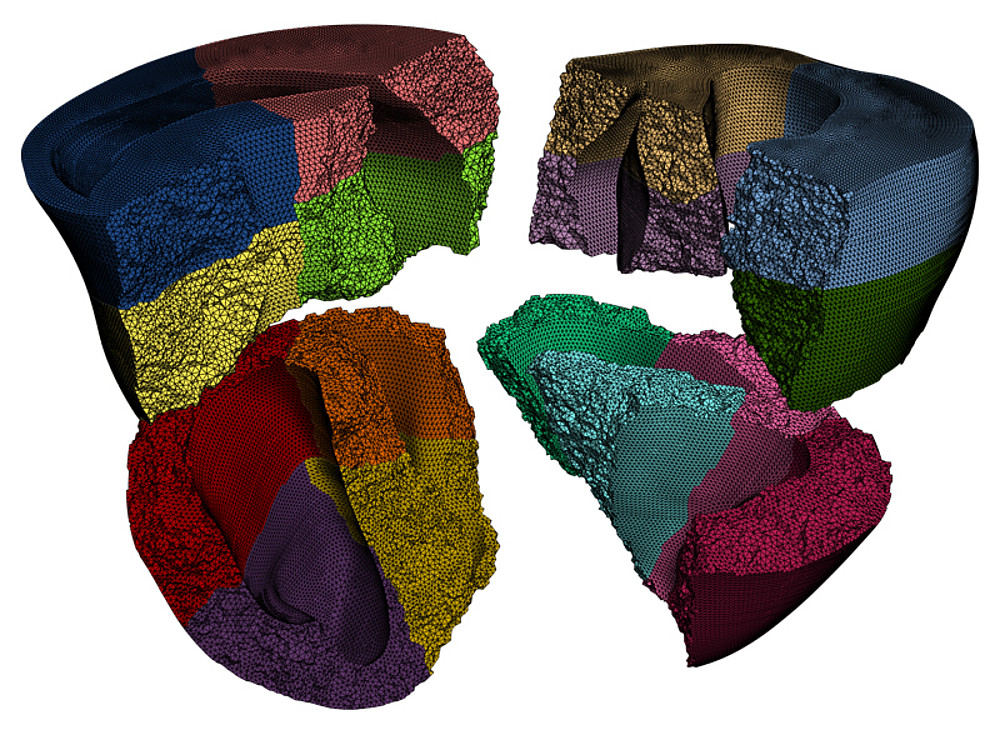
Numerische Geometriedarstellung des Herzens: MathematikerInnen konstruieren Modelle von Heren am Computer. Foto: DI Aurel Neic, Uni Graz

Numerische Geometriedarstellung des Herzens: MathematikerInnen konstruieren Herz-Modelle am Computer. Foto: DI Aurel Neic, Uni Graz

Kleinere Defibrillatoren, wie dieser hier, sind mittlerweile an vielen öffentlichen Plätzen zu finden.

Kleinere Defibrillatoren, wie dieser hier, sind mittlerweile an vielen öffentlichen Plätzen zu finden.

ForscherInnen der Uni Graz suchen nach Methoden zur Optimierung von Defibrillatoren

Defibrillatoren können Leben retten. Seit 2002 ist es auch Laien in Österreich erlaubt, in Notfallsituationen „Schockgeber“ zu verwenden. Zwar sind diese nach dem neuesten Stand der Technik gebaut, doch ihr Gebrauch beruht in vielen Fällen einfach auf den Erfahrungswerten der AnwenderInnen. Mithilfe von Computermodellen basteln MathematikerInnen der Karl-Franzens-Universität Graz – gemeinsam mit WissenschafterInnen der Medizinischen Universität Graz und der TU Graz – gerade an der Simulation eines virtuellen Herzens, um Erkenntnisse für die Optimierung von Defibrillatoren oder für bessere Operationsmethoden zu gewinnen.


O. Univ.-Prof. Dr. Karl Kunisch und sein Team arbeiten seit 2007 im Rahmen des vom Wissenschaftsfonds FWF geförderten Spezialforschungsbereiches „Mathematische Optimierung und Anwendungen in der Biomedizin“ daran, Phänomene in der Physik, Physiologie und Medizin mathematisch zu beschreiben. „Nur MedizinerInnen können aufgrund ihres Wissens abschätzen, wie stark die Stromstöße verabreicht werden müssen, damit der Herzrhythmus stabilisiert wird“, erklärt Kunisch, Leiter des Instituts für Mathematik und Wissenschaftliches Rechnen. Durch das Schocken mit dem Defibrillator wirken elektrische Ströme auf das Herz ein. Dabei sollte der Stromstoß so schwach wie möglich sein. „Wenn man Erfahrung nicht mehr an der Person, am Subjekt, sammeln kann, ist man auf die Unterstützung von mathematischen Modellen angewiesen“, betont Univ.-Prof. Dr. Gundolf Haase. Durch einen Automatisierungsprozess, den die Modelle ermöglichen, kommen die ForscherInnen zu wertvollen Daten, die in der Praxis nur schwer zu ermitteln sind.


Simulation mit „insilico-Modellen“

Der Traum vom „virtuellen Herzen“ ist nicht neu. Vor mehr als zehn Jahren begann der Biophysiker an der Med Uni Graz Univ.-Prof. Dr. Gernot Plank mit Forschungen auf diesem Gebiet. In sogenannten „insilico-Modellen“ wird das menschliche Herz bis in das kleinste Detail am Computer nachgebaut und simuliert. Die Parameter reichen von der elektrophysiologischen Beschreibung des Herzens über die mechanische Koppelung mit anderen Organen bis hin zu den Strömungseigenschaften des Blutes. „Das Herz hat eine sehr komplizierte, dreidimensionale Geometrie. Um mit dieser rechnen zu können, ist eine detaillierte Modellierung in Verbindung mit moderner numerischer Mathematik nötig“, sagt Haase. Mithilfe von partiellen Differenzialgleichungen wird zum Beispiel simuliert, wie sich elektrische Impulse im Herz fortpflanzen.


Wesentlich ist, die wissenschaftlichen Fragestellungen in die Praxis zu überführen. „Vielleicht gelingt es, das Herz mit seinen Eigenschaften so gut zu simulieren, dass wir den ChirurgInnen bereits vor dem Eingriff sagen können, wo der Schnitt angesetzt werden muss, um einen heilenden Erfolg zu erzielen“, sagt Haase. „Oder dass es möglich wird, mittels dosierter Stromstöße Fehlfunktionen des Herzens zu korrigieren, um Leben zu retten.“
„Mathematische Optimierung und Anwendungen in der Biomedizin“ ist im universitären Forschungsschwerpunkt „Modelle und Simulation“ der Karl-Franzens-Universität Graz fest verankert.


Näheres unter http://math.uni-graz.at/mobis/ 


Den ganzen Artikel in der UNIZEIT 1/13 lesen HIER

Rückfragen:
O. Univ.-Prof. Dr. Karl Kunisch
Institut für Mathematik und Wissenschaftliches Rechnen
Karl-Franzens-Universität Graz
Tel.: (0316) 380 5162
E-Mail: karl.kunisch(at)uni-graz.at

Assoz. Prof. Dr. Gernot Plank
Institut für Biophysik
Medizinische Universität Graz
Tel.: (0316) 380 7756
E-Mail: gernot.plank(at)medunigraz.at

created by Konstantinos Tzivanopoulos

Related news

Austria’s emissions rose in 2025: University of Graz researchers analyse the causes

The Environment Agency Austria has today published the figures for the country’s greenhouse gas emissions in 2025. While emissions fell sharply year on year from 2022 to 2024, they rose again by just under 0.7 per cent in 2025. Researchers at the University of Graz have analysed how much of this increase was due to structural changes in the economy and how much was attributable to external factors over which there is little control. “In 2025, the colder winter compared with 2024 increased emissions by 0.81 per cent, while the weak economy reduced them by 0.38 per cent. If we factor out these influences, we find an underlying increase of 0.26 per cent compared with the previous year,” reports economist Karl Steininger. “This clearly means that Austria is not on track to meet its climate targets, which require a substantial reduction in emissions by 2030.”

Electrifying: Researchers film the first moments on the way from light to electricity

Physicists at the University of Graz (Austria), in collaboration with colleagues from Marburg University and Forschungszentrum Jülich (Germany), have achieved a scientific breakthrough. For the first time, the generation of electrical energy from light has been filmed and described theoretically. This work is of far-reaching significance, not least for optimising sustainable energy production from photovoltaics. This is because it provides fundamental building blocks for understanding the physical processes that take place, for example, in organic solar cells. The paper was published in the journal Physical Review X, one of the world’s most prestigious physics journals.

University of Graz: Working together to make Styria a sustainable centre of learning

Round table calls for sustainable funding for the 2028–2030 performance agreement period between the five Styrian universities and the federal government.

How can we teach using YouTube and AI? The University of Graz is strengthening media education in schools

A journey through the blood vessels using VR headsets brings biology lessons to life. An interactive quiz brings physics to life. The YouTube video explains the First World War. Whilst mobile phones are increasingly being banned from the classroom, social media platforms, apps and AI are playing an ever-greater role in knowledge transfer at school. But how can teaching with media be made even more effective? What are the challenges in media-based teaching? At the University of Graz, researchers are discussing these issues at a conference being held in Austria for the first time.

Begin of page section:
Additional information:

University of Graz
Universitaetsplatz 3
8010 Graz
Austria
  • Contact
  • Web Editors
  • Moodle
  • UNIGRAZonline
  • Imprint
  • Data Protection Declaration
  • Accessibility Declaration
Weatherstation
Uni Graz

End of this page section. Go to overview of page sections

End of this page section. Go to overview of page sections

Begin of page section:

End of this page section. Go to overview of page sections

