Begin of page section:
Page sections:

  • Go to contents (Accesskey 1)
  • Go to position marker (Accesskey 2)
  • Go to main navigation (Accesskey 3)
  • Go to sub navigation (Accesskey 4)
  • Go to additional information (Accesskey 5)
  • Go to page settings (user/language) (Accesskey 8)
  • Go to search (Accesskey 9)

End of this page section. Go to overview of page sections

Begin of page section:
Page settings:

English en
Deutsch de
Search
Login

End of this page section. Go to overview of page sections

Begin of page section:
Search:

Search for details about Uni Graz
Close

End of this page section. Go to overview of page sections


Search

Begin of page section:
Main navigation:

Page navigation:

  • University

    University
    • About the University
    • Organisation
    • Faculties
    • Library
    • Working at University of Graz
    • Campus
    Developing solutions for the world of tomorrow - that is our mission. Our students and our researchers take on the great challenges of society and carry the knowledge out.
  • Research Profile

    Research Profile
    • Our Expertise
    • Research Questions
    • Research Portal
    • Promoting Research
    • Research Transfer
    • Ethics in Research
    Scientific excellence and the courage to break new ground. Research at the University of Graz creates the foundations for making the future worth living.
  • Studies

    Studies
    • Prospective Students
    • Students
  • Community

    Community
    • International
    • Location
    • Research and Business
    • Alumni
    The University of Graz is a hub for international research and brings together scientists and business experts. Moreover, it fosters the exchange and cooperation in study and teaching.
  • Spotlight
Topics
  • Sustainable University
  • Researchers answer
  • Work for us
Close menu

End of this page section. Go to overview of page sections

Begin of page section:
You are here:

University of Graz News Does fasting make us younger, Tobias Eisenberg?

End of this page section. Go to overview of page sections

Monday, 02 March 2026

Does fasting make us younger, Tobias Eisenberg?

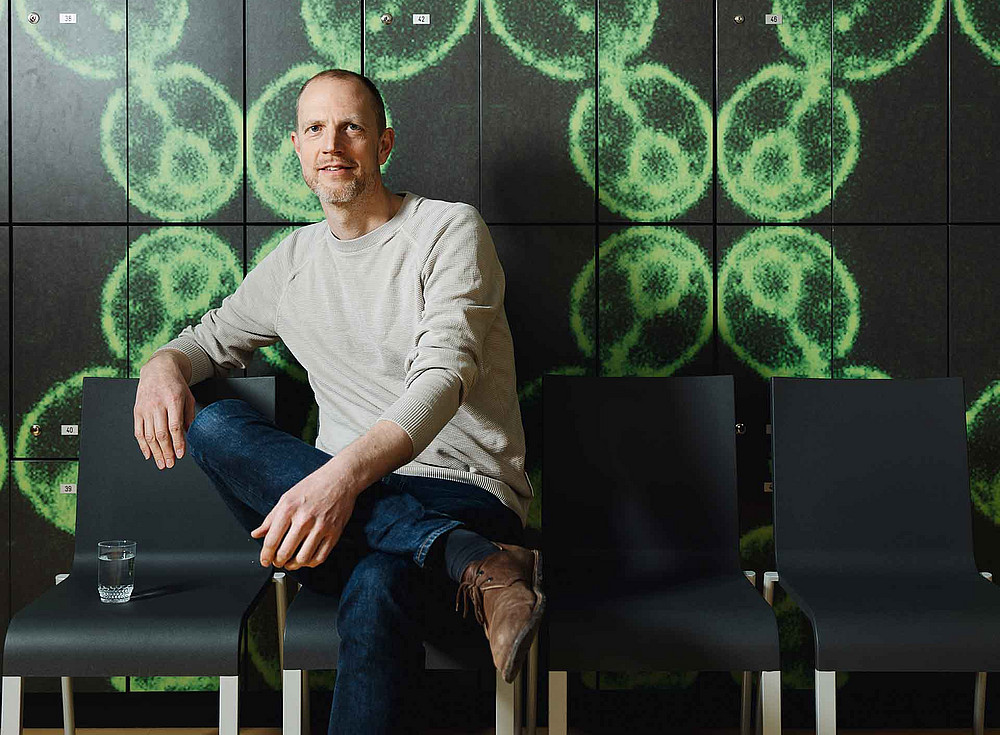
Tobias Eisenberg ©KANIZAJ 2022

Molecular biologist Tobias Eisenberg investigates how food deprivation affects the organism. Photo: Uni Graz/Kanizaj

Not eating is currently on everyone's lips. It's Lent, and the next swimming season is just around the corner. This phase is equated with weight and calorie reduction. Biochemist and molecular biologist Tobias Eisenberg is investigating how short-term food deprivation – a very common occurrence for our ancestors – affects the organism.

Proper fasting promotes the balance of our metabolism, known as homeostasis, and triggers the process of autophagy, a cellular recycling programme. Tobias Eisenberg explains: "Defective components are broken down. Their remains serve as building blocks for new functional components. This promotes cell repair." At the same time, ketone bodies are produced as a by-product of fat burning. They replace sugar as an energy source and in turn promote autophagy. Eisenberg tested this effect on himself: "What fascinated me during my several-day fasting regimen was the disappearance of the feeling of hunger. After two to three days, I experienced a surge of energy that felt like a relaxed endurance run."

By abstaining, you put your body in an exceptional situation. "We are not only investigating how fasting changes energy metabolism, but also whether and how it delays cell ageing," says Eisenberg. "Studies on model organisms such as flies, nematodes and mice show that this can work." In the Cluster of Excellence MetAGE, funded by the Austrian Science Fund (FWF), the researcher is investigating these processes with colleagues from the Medical Universities of Graz and Vienna. And what is the best method of fasting? Even the molecular biologist cannot answer that question. "There are too few good comparative studies with humans."

Risks

Eisenberg points out the dangers of food deprivation: "Without calorie intake, a person will eventually die. Our organism is not capable of obtaining energy from light; we do not photosynthesise." The molecular biologist also warns against extreme forms of fasting. "In addition to the possible benefits, there are also risks such as malnutrition or undernourishment." A permanent reduction in calorie intake of more than 30 percent can be harmful. Children, adolescents, pregnant and breastfeeding women, as well as elderly and sick people should not fast, or only do so under medical supervision. "The most important thing is to listen to your own body," advises Eisenberg. "What is good for one person's health may be harmful to another."

created by Roman Vilgut

Related news

Cosmetics in the environment: University of Graz proves danger to ants

Titanium dioxide, which is found in cosmetics, for example, is increasingly entering the environment in the form of nanoparticles. This could also put insects at risk. If ants ingest the substance in combination with the pesticide glyphosate, it disturbs the development of their offspring. Scientists at the University of Graz are drawing attention to the negative consequences of this toxic cocktail.

Varied and healthy: studies move

Exercise is the ideal way to balance out everyday stress, prevent illness and keep fit. Why this is the case, how to do it properly and what role human bodily functions and psychology play can be studied at the University of Graz.

Religious scholar Theresia Heimerl: Fasting as a spiritual boost

Fasting is not just a strategy for losing weight – it is a ritual dating back thousands of years with spiritual and evolutionary roots that has positive effects on the body. At the University of Graz, religious scholar Theresia Heimerl is investigating why fasting is a "spiritual boost".

Sustainable reforestation: Researchers identify key factors for successful restoration

Natural forests are not only valuable for CO₂ storage, but also reservoirs of biodiversity. For this reason, areas that are no longer used for agriculture are being reforested as part of renaturation projects. To ensure successful forest restoration, there are a number of factors to consider. For example, the combination of early- and late-successional tree species plays a role. At the outset, the correct spacing between seedlings is crucial for the survival of young forest plants. Sarah Bürli, head of the Botanical Garden at the University of Graz, has analysed the results of experiments on forest renaturation together with colleagues in Aotearoa/New Zealand. Her findings on beneficial planting strategies were recently published in the science magazine Ecological Solutions and Evidence.

Begin of page section:
Additional information:

University of Graz
Universitaetsplatz 3
8010 Graz
Austria
  • Contact
  • Web Editors
  • Moodle
  • UNIGRAZonline
  • Imprint
  • Data Protection Declaration
  • Accessibility Declaration
Weatherstation
Uni Graz

End of this page section. Go to overview of page sections

End of this page section. Go to overview of page sections

Begin of page section:

End of this page section. Go to overview of page sections