



Begin of page section:
Page sections:

  • Go to contents (Accesskey 1)
  • Go to position marker (Accesskey 2)
  • Go to main navigation (Accesskey 3)
  • Go to sub navigation (Accesskey 4)
  • Go to additional information (Accesskey 5)
  • Go to page settings (user/language) (Accesskey 8)
  • Go to search (Accesskey 9)

End of this page section. Go to overview of page sections

Begin of page section:
Page settings:

English en
Deutsch de
Search
Login

End of this page section. Go to overview of page sections

Begin of page section:
Search:

Search for details about Uni Graz
Close

End of this page section. Go to overview of page sections


Search

Begin of page section:
Main navigation:

Page navigation:

  • University

    University
    • About the University
    • Organisation
    • Faculties
    • Library
    • Working at University of Graz
    • Campus
    Developing solutions for the world of tomorrow - that is our mission. Our students and our researchers take on the great challenges of society and carry the knowledge out.
  • Research Profile

    Research Profile
    • Our Expertise
    • Research Questions
    • Research Portal
    • Promoting Research
    • Research Transfer
    • Ethics in Research
    • Commission for Scientific Integrity
    Scientific excellence and the courage to break new ground. Research at the University of Graz creates the foundations for making the future worth living.
  • Studies

    Studies
    • Prospective Students
    • Students
  • Community

    Community
    • International
    • Location
    • Research and Business
    • Alumni
    The University of Graz is a hub for international research and brings together scientists and business experts. Moreover, it fosters the exchange and cooperation in study and teaching.
Topics
  • Sustainable University
  • Researchers answer
  • Work for us
Close menu

End of this page section. Go to overview of page sections

Begin of page section:
You are here:

University of Graz News Lernpsychologie

End of this page section. Go to overview of page sections

Friday, 27 June 2014

Lernpsychologie

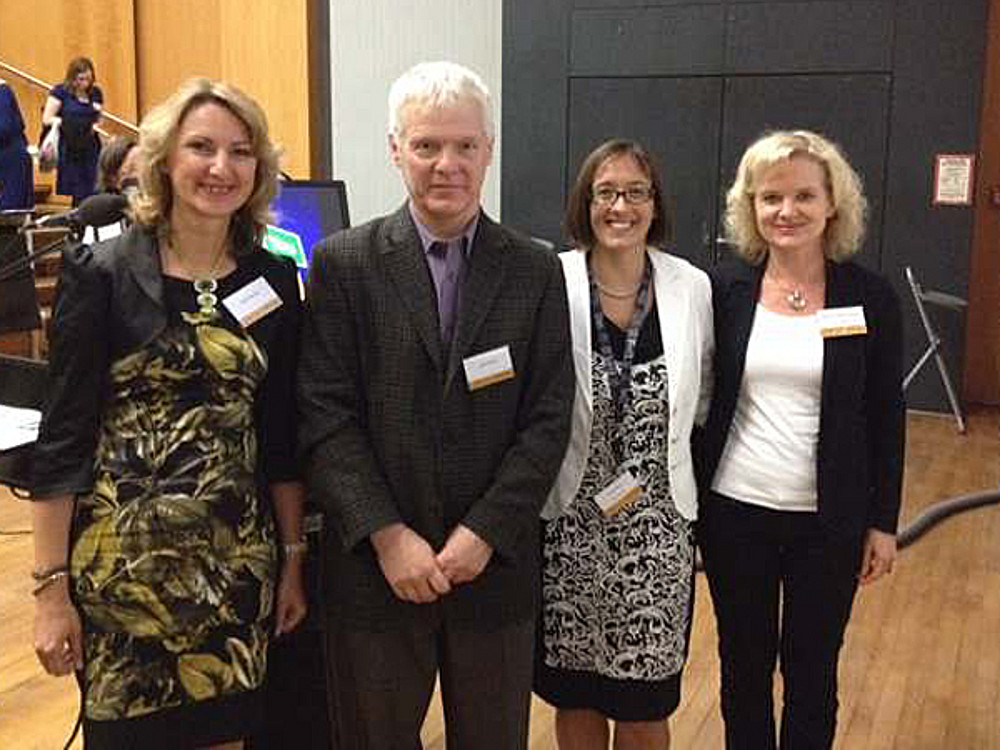
GEWI-Vizestudiendekanin Margit Reitbauer, Plenarsprecher Zoltan Dörnyei, Sarah Mercer, Organisatorin der Konferenz, und Sabine Schmölzer-Eibinger, Leiterin des Fachdidaktikzentrums der Geisteswissenschaftlichen Fakultät (v.l.).

GEWI-Vizestudiendekanin Margit Reitbauer, Plenarsprecher Zoltan Dörnyei, Sarah Mercer, Organisatorin der Konferenz, und Sabine Schmölzer-Eibinger, Leiterin des Fachdidaktikzentrums der Geisteswissenschaftlichen Fakultät (v.l.).

Erfolgreiche Konferenz des GEWI-Fachdidaktikzentrums

Die Lernpsychologie im Bereich des Fremdsprachelernens (Language Learning Psychology) stand im Mittelpunkt der internationalen Fachtagung "Matters of the Mind: Psychology and Language Learning", die vom Fachdidaktikzentrum der Geisteswissenschaftlichen Fakultät organisiert wurde. Über 260 TeilnehmerInnen aus aller Welt waren der Einladung nach Graz gefolgt. 


Das Thema Language Learning Psychology selbst vereint unter anderem die Fachgebiete der Sprachlehr-/lernforschung, Sprachendidaktik, Psychologie, Erziehungs- und Bildungswissenschaften und Pädagogik. "Diese interdisziplinäre Ausrichtung wird international derzeit sehr forciert und ist auch auf lokaler Ebene zurzeit im Hinblick auf die Entwicklungen im Bereich der PädagogInnenbildung relevant", unterstrich die Organisatorin der Tagung, Priv.-Doz. Dr. Sarah Mercer, stellvertretende Leiterin des Fachdidaktikzentrums der Geisteswissenschaftlichen Fakultät. 


Ziel der Tagung war es, alle ForscherInnen der einzelnen Bereiche zusammen zu führen und Verknüpfungen zwischen verschiedenen Aspekten der Lernpsychologie im Fremdsprachenlernen herzustellen. Während der Tagung wurden einzelne Themenschwerpunkte von Language Learning Psychology, wie zum Beispiel Motivation, Identität, Lernstrategien oder Gruppendynamik, in Vorträgen und Workshops diskutiert. Bis dato gab es weltweit keine Veranstaltung dieser Größe, die alle Bereiche des Fachgebiets zusammenführte und somit eine vergleichbare interdisziplinäre Ausrichtung erzielen konnte.

created by Petra Kletzenbauer & Gerhild Kastrun

Related news

What matters in the end: moral theologian takes stock of assisted suicide

Since 1 January 2022, assisted suicide has been legal in Austria under certain conditions. This was made possible by a ruling of the Constitutional Court, which overturned the blanket ban on assisting in suicide. Four years on, it is clear that: “Although the legal framework is in place, many pressing questions remain unanswered when it comes to its practical implementation,” says Johann Platzer, a moral theologian at the University of Graz.

Noise is the signal: new simulation method enables secure communication

Researchers from Graz, Vienna and Munich have developed a new simulation method that makes it possible to calculate quantum light using classical software – a step towards secure quantum communication.

Massacre and Memory: University of Graz addresses the wounds of history

A conference on 12 and 13 June 2026 at the Jesuit Refectory will focus on trauma in Eastern and South-Eastern Europe.

Uni Vibes: An open-air stage for science and street art

At the third Uni Vibes event hosted by the University of Graz, visitors enjoyed science, music and performances on campus. Guided tours focusing on democracy, educational sciences and the Graz Centre of Physics demonstrated how research shapes community life, urban development and culture.

Begin of page section:
Additional information:

University of Graz
Universitaetsplatz 3
8010 Graz
Austria
  • Contact
  • Web Editors
  • Moodle
  • UNIGRAZonline
  • Imprint
  • Data Protection Declaration
  • Accessibility Declaration
Weatherstation
Uni Graz

End of this page section. Go to overview of page sections

End of this page section. Go to overview of page sections

Begin of page section:

End of this page section. Go to overview of page sections

