

From law and sociology to digitalisation – academics are examining the ‘elasticity’ of the EU’s external borders from a variety of perspectives. “Borders expand, can recede and adapt. This creates stress and tension for everyone involved,” explains political scientist Bilgin Ayata, referring to the title of the project funded by the Swiss NOMIS Foundation.
Artist and researcher Carolyn Defrin has explored how art engages with border regions as part of a Marie Curie fellowship. The result, ‘Portals to the Future’, is now being presented as part of the ‘steirischer Herbst’ festival.
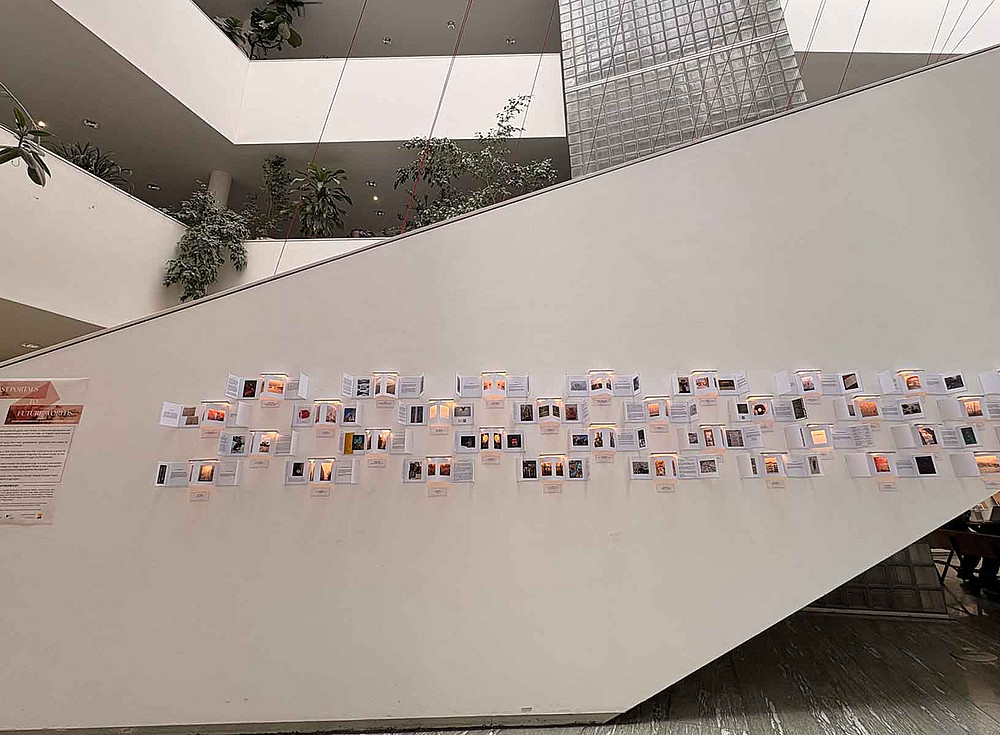
An exhibition at the RESOWI Centre, ground floor, Building E, is showing 32 works by artists from Europe, Africa and the Americas until 18 October. The works, which centre on the theme of migration, are illustrated through photographs and descriptions.
Audio installations across the city of Graz allow listeners to hear how people view the future from five different perspectives. A total of 100 locations are planned until 18 October, including the University of Graz, the main railway station and Griesplatz.
On 16 October at 2.30 pm, Carolyn Defrin and researchers from the ‘Elastic Borders’ project are hosting a public guided tour. Meeting point: Griesgasse 40, 8020 Graz
. Participation is free of charge. Please register in advance: carolyn.defrin@uni-graz.at
⇒ Learn more about the ‘Portals to the Future’ art project
Great Moments of Interdisciplinarity
Students and researchers from the Gewi Faculty, in collaboration with steirischer herbst, had already been exploring the intersection of time and space—or science and art. The symposium “Space, Time, and Material: Trajectories between Science and Art” took place as part of the ORF musikprotokoll and was also held during the festival. The participants drew inspiration from the SciArt Dialogue Week 2026 at the European Organization for Nuclear Research (CERN).