Begin of page section:
Page sections:

  • Go to contents (Accesskey 1)
  • Go to position marker (Accesskey 2)
  • Go to main navigation (Accesskey 3)
  • Go to sub navigation (Accesskey 4)
  • Go to additional information (Accesskey 5)
  • Go to page settings (user/language) (Accesskey 8)
  • Go to search (Accesskey 9)

End of this page section. Go to overview of page sections

Begin of page section:
Page settings:

English en
Deutsch de
Search
Login

End of this page section. Go to overview of page sections

Begin of page section:
Search:

Search for details about Uni Graz
Close

End of this page section. Go to overview of page sections


Search

Begin of page section:
Main navigation:

Page navigation:

  • University

    University
    • About the University
    • Organisation
    • Faculties
    • Library
    • Working at University of Graz
    • Campus
    Developing solutions for the world of tomorrow - that is our mission. Our students and our researchers take on the great challenges of society and carry the knowledge out.
  • Research Profile

    Research Profile
    • Our Expertise
    • Research Questions
    • Research Portal
    • Promoting Research
    • Research Transfer
    • Ethics in Research
    • Commission for Scientific Integrity
    Scientific excellence and the courage to break new ground. Research at the University of Graz creates the foundations for making the future worth living.
  • Studies

    Studies
    • Prospective Students
    • Students
    • Welcome Weeks for First Year Students
  • Community

    Community
    • International
    • Location
    • Research and Business
    • Alumni
    The University of Graz is a hub for international research and brings together scientists and business experts. Moreover, it fosters the exchange and cooperation in study and teaching.
Topics
  • Sustainable University
  • Researchers answer
  • Work for us
Close menu

End of this page section. Go to overview of page sections

Begin of page section:
You are here:

University of Graz News Kunst, Wirtschaft und Wissenschaft

End of this page section. Go to overview of page sections

Wednesday, 30 January 2013

Kunst, Wirtschaft und Wissenschaft
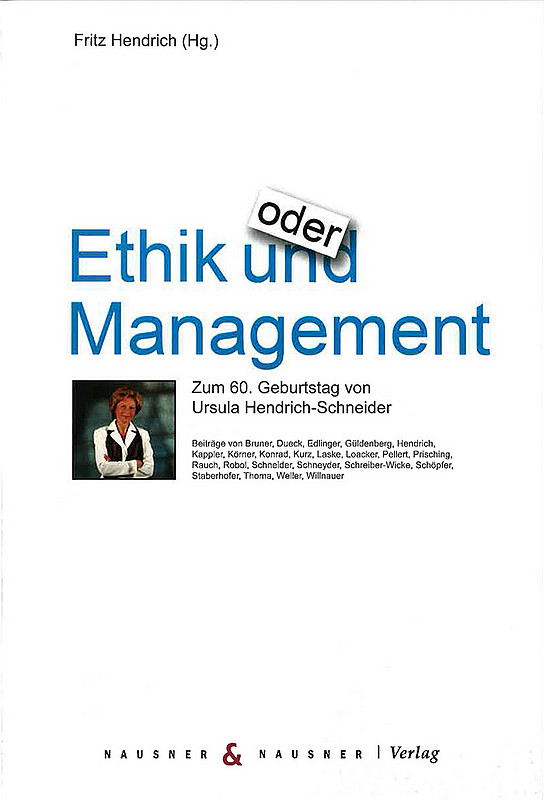
Cover des Buches Ethik und Management

Konstanze Breitebner und Werner Schneyder am 7. Februar 2013 an der Uni Graz - ein Fest im Gedenken an Ursula Schneider-Hendrich

Ethik und Management – zwei Begriffe, die Hand in Hand gehen können, wie es Ursula Hendrich-Schneider, erste Dekanin der Karl-Franzens-Universität Graz, in Forschung und Lehre gelebt hat. Im Gedenken an die vor vier Jahren verstorbene Wissenschafterin, die heuer ihren 60. Geburtstag gefeiert hätte, erscheint die Festschrift „Ethik und Managament“, die am 7. Februar 2013 um 19 Uhr in der Aula der Uni Graz präsentiert wird. Eine große Anzahl prominenter Persönlichkeiten bildet den festlichen Rahmen: die Kabarettisten Werner Schneyder, Ernst Sittinger und Jörg-Martin Willnauer, Schauspielerin Konstanze Breitebner, IBM-Generaldirektorin Tatjana Oppitz und Berndorf-Sanierer Norbert Zimmermann.

„Jetzt reicht’s – aber nicht für alle“ lautet der Titel des abwechslungsreichen Abends, den Fritz Hendrich im Gedenken an den 60. Geburtstag seiner 2009 verstorbenen Frau zusammengestellt hat. Das Programm spannt einen unterhaltsamen Bogen von Kunst über Wirtschaft bis hin zur Wissenschaft:
Film- und TV-Schauspielerin Konstanze Breitebner liest aus der Festschrift „Ethik und Management“, in der zahlreiche anerkannte WissenschafterInnen, darunter Helmut Konrad, Ada Pellert, Manfred Prisching, Wolf Rauch und Gerald Schöpfer, zu Wort kommen.
Kabarettistische Beiträge kommen von Autor, Regisseur und Schauspieler Werner Schneyder sowie vom Duo Ernst Sittinger und Jörg-Martin Willnauer.
Wie Ethik und Management in der Praxis zu vereinen sind, schildern hautnah zwei Top-ManagerInnen: Tatjana Oppitz, Generaldirektorin von IBM Austria, und Norbert Zimmermann, Aufsichtsratsvorsitzender der Berndorf AG.


Ethik und Management
Jetzt reicht’s – aber nicht für alle

WANN: Donnerstag, 7. Februar 2013, 19 Uhr
WO: Aula, Hauptgebäude der Karl-Franzens-Universität Graz
Der Eintritt ist frei.

created by Andreas Schweiger

Related news

Austria’s emissions rose in 2025: University of Graz researchers analyse the causes

The Environment Agency Austria has today published the figures for the country’s greenhouse gas emissions in 2025. While emissions fell sharply year on year from 2022 to 2024, they rose again by just under 0.7 per cent in 2025. Researchers at the University of Graz have analysed how much of this increase was due to structural changes in the economy and how much was attributable to external factors over which there is little control. “In 2025, the colder winter compared with 2024 increased emissions by 0.81 per cent, while the weak economy reduced them by 0.38 per cent. If we factor out these influences, we find an underlying increase of 0.26 per cent compared with the previous year,” reports economist Karl Steininger. “This clearly means that Austria is not on track to meet its climate targets, which require a substantial reduction in emissions by 2030.”

Electrifying: Researchers film the first moments on the way from light to electricity

Physicists at the University of Graz (Austria), in collaboration with colleagues from Marburg University and Forschungszentrum Jülich (Germany), have achieved a scientific breakthrough. For the first time, the generation of electrical energy from light has been filmed and described theoretically. This work is of far-reaching significance, not least for optimising sustainable energy production from photovoltaics. This is because it provides fundamental building blocks for understanding the physical processes that take place, for example, in organic solar cells. The paper was published in the journal Physical Review X, one of the world’s most prestigious physics journals.

University of Graz: Working together to make Styria a sustainable centre of learning

Round table calls for sustainable funding for the 2028–2030 performance agreement period between the five Styrian universities and the federal government.

How can we teach using YouTube and AI? The University of Graz is strengthening media education in schools

A journey through the blood vessels using VR headsets brings biology lessons to life. An interactive quiz brings physics to life. The YouTube video explains the First World War. Whilst mobile phones are increasingly being banned from the classroom, social media platforms, apps and AI are playing an ever-greater role in knowledge transfer at school. But how can teaching with media be made even more effective? What are the challenges in media-based teaching? At the University of Graz, researchers are discussing these issues at a conference being held in Austria for the first time.

Begin of page section:
Additional information:

University of Graz
Universitaetsplatz 3
8010 Graz
Austria
  • Contact
  • Web Editors
  • Moodle
  • UNIGRAZonline
  • Imprint
  • Data Protection Declaration
  • Accessibility Declaration
Weatherstation
Uni Graz

End of this page section. Go to overview of page sections

End of this page section. Go to overview of page sections

Begin of page section:

End of this page section. Go to overview of page sections