



Begin of page section:
Page sections:

  • Go to contents (Accesskey 1)
  • Go to position marker (Accesskey 2)
  • Go to main navigation (Accesskey 3)
  • Go to sub navigation (Accesskey 4)
  • Go to additional information (Accesskey 5)
  • Go to page settings (user/language) (Accesskey 8)
  • Go to search (Accesskey 9)

End of this page section. Go to overview of page sections

Begin of page section:
Page settings:

English en
Deutsch de
Search
Login

End of this page section. Go to overview of page sections

Begin of page section:
Search:

Search for details about Uni Graz
Close

End of this page section. Go to overview of page sections


Search

Begin of page section:
Main navigation:

Page navigation:

  • University

    University
    • About the University
    • Organisation
    • Faculties
    • Library
    • Working at University of Graz
    • Campus
    Developing solutions for the world of tomorrow - that is our mission. Our students and our researchers take on the great challenges of society and carry the knowledge out.
  • Research Profile

    Research Profile
    • Our Expertise
    • Research Questions
    • Research Portal
    • Promoting Research
    • Research Transfer
    • Ethics in Research
    • Commission for Scientific Integrity
    Scientific excellence and the courage to break new ground. Research at the University of Graz creates the foundations for making the future worth living.
  • Studies

    Studies
    • Prospective Students
    • Students
    • Registration for Study Programme (Winter semester 2026/27)
    • Welcome Weeks for First Year Students
  • Community

    Community
    • International
    • Location
    • Research and Business
    • Alumni
    The University of Graz is a hub for international research and brings together scientists and business experts. Moreover, it fosters the exchange and cooperation in study and teaching.
Topics
  • Sustainable University
  • Researchers answer
  • Work for us
Close menu

End of this page section. Go to overview of page sections

Begin of page section:
You are here:

University of Graz News KUGEL-Preis

End of this page section. Go to overview of page sections

Thursday, 16 January 2014

KUGEL-Preis

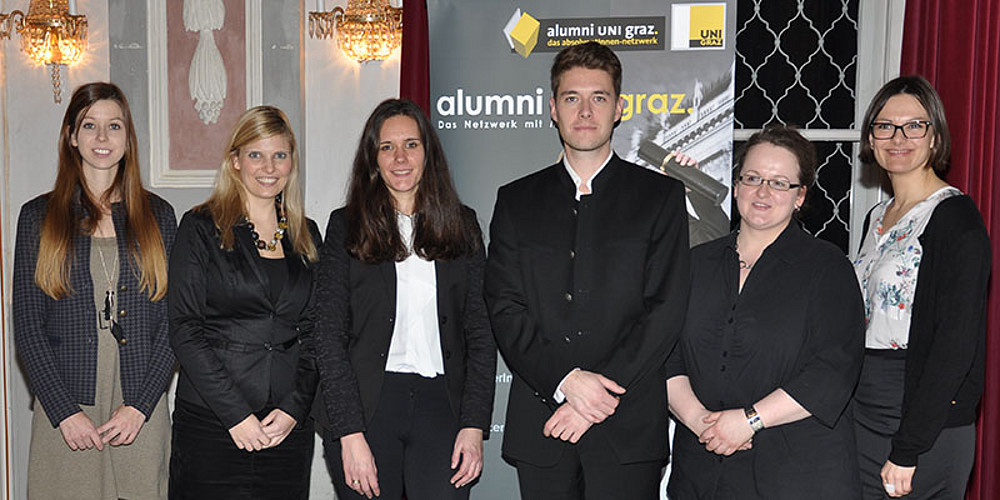
Die PreisträgerInnen (v.l.): Für Barbara Huber hat ihre Schwester Katharina die Auszeichnung entgegen genommen; Eva Klein, Dagmar Probst, Klaus-Jürgen Schaupp, Marlene Haag und Sonja Lidauer

Die PreisträgerInnen (v.l.): Für Barbara Huber hat ihre Schwester Katharina die Auszeichnung entgegen genommen; Eva Klein, Dagmar Probst, Klaus-Jürgen Schaupp, Marlene Haag und Sonja Lidauer

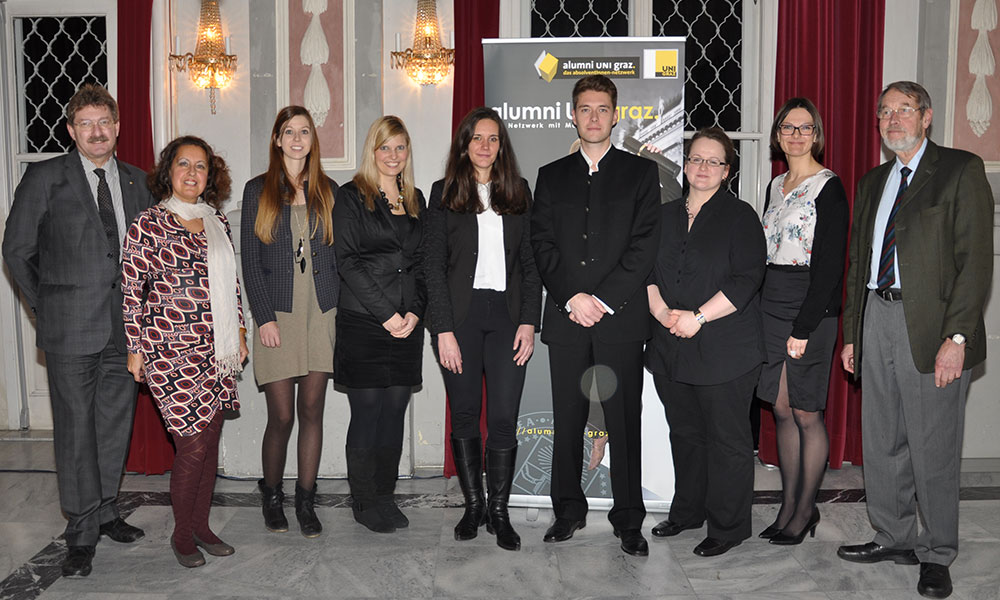
Vizerektor Peter Scherrer, Margit Stadlober und Götz Pochat (v.l.) mit den ausgezeichneten AbsolventInnen

Vizerektor Peter Scherrer, Margit Stadlober und Götz Pochat (v.l.) mit den ausgezeichneten AbsolventInnen

Herausragende Diplomarbeiten und Dissertationen aus dem Fach Kunstgeschichte wurden ausgezeichnet

Von den Anfängen der Porträtkarikatur im Barock über das Plakat in der Moderne bis zur Kunstrezeption in den Filmen Peter Greenaways spannt sich der Themenbogen der Diplomarbeiten und Dissertationen, die am 15. Jänner 2014 im Meerscheinschlössl der Uni Graz ausgezeichnet wurden. Das Institut für Kunstgeschichte der Karl-Franzens-Universität Graz prämiert seit 2008 gemeinsam mit dem Universalmuseum Joanneum und dem Land Steiermark herausragende Arbeiten junger ForscherInnen mit dem Kunstgeschichte-Leistungspreis KUGEL. 2014 kamen die „Freunde des Kunsthistorischen Instituts“, eine Sektion des alumni UNI graz unter der Leitung von Em.Univ.-Prof. Dr. Götz Pochat, als Kooperationspartner hinzu. Zusätzlich vergab das Universalmuseum Joanneum heuer einen weiteren Preis für Joanneums-relevante Abschlussarbeiten.

„Der KUGEL-Preis will durch sanften Wettbewerb Motivation, Qualität und Anwendungsbereiche des Faches Kunstgeschichte fördern“, erklärt seine Initiatorin Ao.Univ.-Prof. Dr. Margit Stadlober vom Institut für Kunstgeschichte der Uni Graz. Zugleich soll er für AbsolventInnen mit hervorragenden Leistungen ein funktionierendes Netzwerk zwischen Universität, Kulturinstitutionen und Wirtschaft entstehen lassen.


Die PreisträgerInnen 2014

Kategorie Master-/Diplomarbeit
Mag. Marlene Haag: Zum Beginn der Porträtkarikatur im Barock. Erläuterung anhand von Werken der Künstler Annibale und Agostino Carracci, Giovanni Lorenzo Bernini, Romeyn de Hooghe und Cornelis Dusart. Betreuer: Univ.-Prof. Dr. Edgar Lein

Mag. Barbara Huber: The Draughtsman, the Architect his Wife and her Lover. Kunstrezeption in den Filmen Peter Greenaways. Betreuer: Ao.Univ.-Prof. Dr. Josef Ploder

Mag. Klaus-Jürgen Schaupp: Fortune – Infortune – Fort Une. Ein Europäisches ,Gesamtkunstwerk´ der frühen Renaissance. Die Grabmäler der Stiftskirche zu Brou in ihrem kunsthistorischen und kulturpolitischen Kontext unter besonderer Berücksichtigung der burgundischen Tradition. Betreuer: Univ.-Doz. Dr. Gottfried Biedermann


Kategorie Universalmuseum Joanneum
Mag. Sonja Lidauer: Institutionskritik als Kunstpraxis. Entmystifizierung des Kunstbetriebs. Betreuer: Univ.-Doz. Dr. Arnulf Rohsmann


Kategorie Dissertation
Dr. Eva Klein: Das Plakat in der Moderne. Der Beginn des Grafikdesigns in der Steiermark im Kontext internationaler soziokultureller Entwicklungen. Betreuerin: Ao.Univ.-Prof. Dr. Margit Stadlober

Dr. Dagmar Probst: Der Einfluss des Deutschvenezianers Johann Carl Loth (1632 bis 1698) auf die österreichische Barockmalerei. Betreuerin: Em.Univ.-Prof. Dr. Götz Pochat

created by Gudrun Pichler

Related news

Commissioned by NATO: University of Graz tests high-tech textiles

As part of an international project, antimicrobial and fire-resistant fabrics with UV protection are being developed in Zagreb. Pharmacists from the University of Graz are ensuring that these fabrics are skin-friendly.

The Arctic up close: ORF special feature on the University of Graz’s research station in S

Students from the University of Graz are spending two weeks conducting research at the Univerisity of Graz research station at the Sermilik Fjord in Greenland, which has been operational for three years. They are measuring glacial runoff, tracking ice melt in real time and installing weather stations. ORF is following the expedition and will be reporting on the special feature ‘Arctic Adventure’ across its various channels from 20 July.

Medicine for ants: Caffeine prolongs the life of infected insects

Black coffee stimulates us and acts against bacteria. So, can caffeine also be good for insects? Yes, confirm biologists of the University of Graz. When ants suffer from a fungal disease, they consume more caffeine and remain active for longer.

How formulas are making medicine more personalised

When Federica Caforio talks about the heart, it doesn’t sound like an operating theatre, but rather like equations, parameters and simulations. Yet this is precisely where the medical promise of her research lies: one day, clinical data will be used to create a digital twin of the heart – a virtual model that will enable a better understanding of diseases and allow for more personalised treatment plans. She will be presenting her research at the ‘ECMTB 2026’ mathematics conference.

Begin of page section:
Additional information:

University of Graz
Universitaetsplatz 3
8010 Graz
Austria
  • Contact
  • Web Editors
  • Moodle
  • UNIGRAZonline
  • Imprint
  • Data Protection Declaration
  • Accessibility Declaration
Weatherstation
Uni Graz

End of this page section. Go to overview of page sections

End of this page section. Go to overview of page sections

Begin of page section:

End of this page section. Go to overview of page sections

