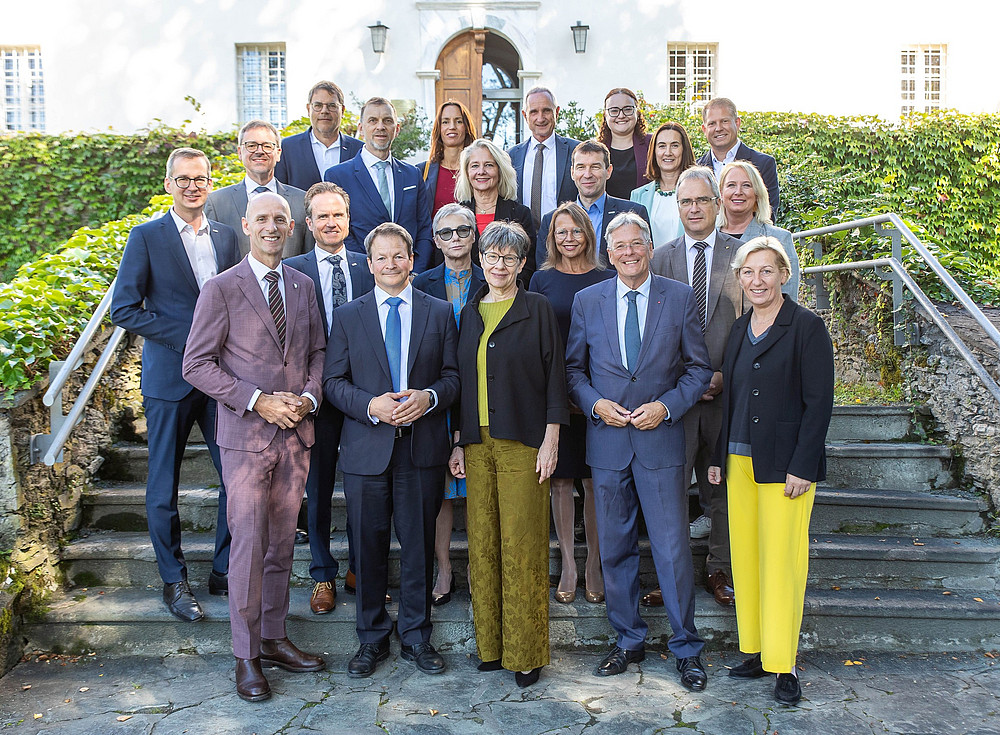
In mid-September 2025, the second meeting of the Carinthian and Styrian University Conferences took place at Maria Loretto Castle in Klagenfurt am Wörthersee. Governor Peter Kaiser, who is responsible for higher education, and Willibald Ehrenhöfer, Styrian Provincial Councilor for Economy, Science, and Research, also took part. A year ago, an initial agreement was reached on increased collaboration and cooperation between the two higher education regions of Carinthia and Styria at the Montanuniversität Leoben. In the future, the conference will meet regularly to establish a joint higher education strategy by 2030.
Governor Peter Kaiser and Sven Fisler, Chairman of the Carinthian Higher Education Conference, welcomed the members of both higher education conferences to Maria Loretto Castle. “With the completion of the Koralmbahn railway, we are entering a new era for the economy and the research and education sector in both provinces,” Kaiser emphasized, adding: "However, a newly strengthened south will only exist if a high degree of national and international visibility, further enhancement of the attractiveness of the educational area, and the internationalization of the educational location are achieved. A joint and uniform public image is therefore an important step to take." He also opened up the possibility for the conference to measure, interpret, and evaluate future developments of the educational locations in Carinthia and Styria with the help of the specially created Koralmbahn Index. This should enable the effects of the Koralmbahn on university-specific factors to be tracked on a fact-based basis. This will also make it possible to take the right further steps. “In order to raise awareness in the future, progress and offerings should be communicated more effectively to the general public at home and abroad,” said Kaiser.
Strengthening cooperation
"Styria and Carinthia have been working closely together in the fields of science and research for many years. These collaborations must be further promoted in the future, as our two provinces will grow even closer together with the completion of the Koralmbahn. Regular exchanges between the two university conferences are essential to this. This will enable us to launch new joint projects with which we also aim to increase the international visibility of the research region of southern Austria," said Willibald Ehrenhöfer, Styrian Minister of Science and Research.
The chairman of the Carinthian University Conference, Rector Sven Fisler (Carinthia University of Education), explained: “Carinthian universities have been expanding their cooperation in the Alps-Adriatic region for years and regard the future infrastructural improvements brought about by the Koralmbahn as a historic opportunity to proactively deepen cooperation with Styrian universities and establish a joint higher education area in southern Austria by 2030.”
“The Styrian University Conference sees great potential in the development of the joint university area, particularly with regard to its international appeal, but also its national positioning within Austria,” emphasized Andrea Seel, Rector of the Augustinum Private University of Education and Chair of the Styrian University Conference. “The admission of international students and the mobility of students already enrolled were addressed as specific operational issues. There are calls for the rapid implementation of a nationwide uniform pre-selection center for the admission of international students and the validity of Carinthian and Styrian climate tickets for the Koralm Tunnel,” said the rector.
Service for international students
The development of the joint Higher Education Strategy 2030 will ensure a higher degree of visibility among the general population and the target group of students, the scientific community, and the business community at home and abroad. A joint media presence is being developed for this purpose. A joint service facility is also being planned for international students, which will take into account the diversity of the 14 universities and their offerings. Political representatives once again called for the lifting of the ban on split fares at the federal level so that students can commute between Carinthia and Styria with just one Klimaticket.
Regional ties and commitment to the location are central aspects of university development that are close to the hearts of both the Carinthian and Styrian university conferences. One focus of both higher education areas is to create an optimal teaching, learning, and research environment. Strengthening the economic area and the competitiveness of the region are equally important goals. This is achieved through close coordination and cooperation between the institutions involved.
Pooling resources
On the Carinthian side, the four universities are participating in the cross-border conference: Alpen-Adria-Universität Klagenfurt, Carinthia University of Applied Sciences, Carinthia University of Education, and Gustav Mahler Private University of Music. The Styrian University Conference consists of nine universities: University of Music and Performing Arts Graz, Medical University of Graz, Graz University of Technology, Montanuniversität Leoben, University of Graz, Carinthia University of Applied Sciences, Joanneum University of Applied Sciences, University of Education Styria, and Augustinum Private University of Education.
The aim of the Carinthian and Styrian university associations is to pool resources, create synergies between the individual university locations, and strengthen the visibility of the joint education, science, and research location. With the completion of the Koralmbahn railway line, which will take 41 minutes to travel between Klagenfurt and Graz, a new conurbation will be created with around 1.1 million people, over 82,000 students, and around 257 bachelor's degree programs, 339 master's degree programs, 52 doctoral programs, and a variety of other courses and specializations. Against this backdrop, deepening cooperation to the point of creating a joint higher education area by 2030 is a declared goal of both federal states. The next joint conference is scheduled to take place in March of next year.