



Begin of page section:
Page sections:

  • Go to contents (Accesskey 1)
  • Go to position marker (Accesskey 2)
  • Go to main navigation (Accesskey 3)
  • Go to sub navigation (Accesskey 4)
  • Go to additional information (Accesskey 5)
  • Go to page settings (user/language) (Accesskey 8)
  • Go to search (Accesskey 9)

End of this page section. Go to overview of page sections

Begin of page section:
Page settings:

English en
Deutsch de
Search
Login

End of this page section. Go to overview of page sections

Begin of page section:
Search:

Search for details about Uni Graz
Close

End of this page section. Go to overview of page sections


Search

Begin of page section:
Main navigation:

Page navigation:

  • University

    University
    • About the University
    • Organisation
    • Faculties
    • Library
    • Working at University of Graz
    • Campus
    Developing solutions for the world of tomorrow - that is our mission. Our students and our researchers take on the great challenges of society and carry the knowledge out.
  • Research Profile

    Research Profile
    • Our Expertise
    • Research Questions
    • Research Portal
    • Promoting Research
    • Research Transfer
    • Ethics in Research
    • Commission for Scientific Integrity
    Scientific excellence and the courage to break new ground. Research at the University of Graz creates the foundations for making the future worth living.
  • Studies

    Studies
    • Prospective Students
    • Students
    • Registration for Study Programme (Winter semester 2026/27)
  • Community

    Community
    • International
    • Location
    • Research and Business
    • Alumni
    The University of Graz is a hub for international research and brings together scientists and business experts. Moreover, it fosters the exchange and cooperation in study and teaching.
Topics
  • Sustainable University
  • Researchers answer
  • Work for us
Close menu

End of this page section. Go to overview of page sections

Begin of page section:
You are here:

University of Graz News Kooperation und Konferenz

End of this page section. Go to overview of page sections

Monday, 10 April 2017

Kooperation und Konferenz

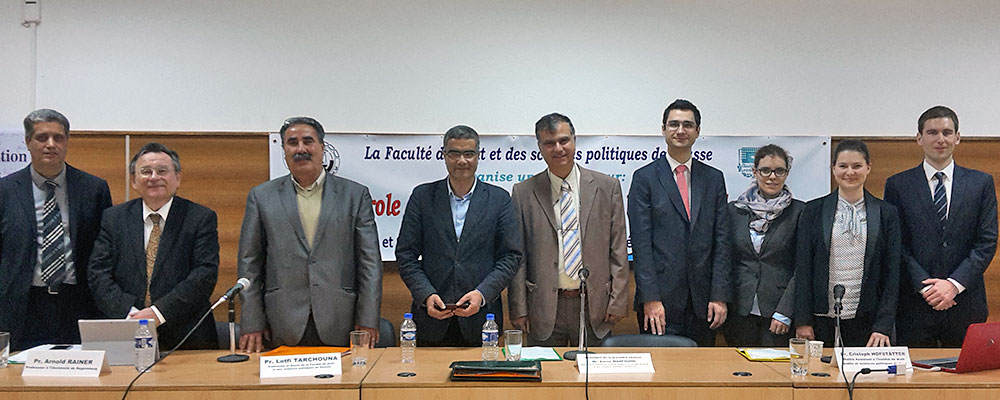
Vortragende und Organisierende der Konferenz an der Universität Sousse, rechts die Grazer TeilnehmerInnen Karl Stöger, Miriam Karl, Teresa Habjan und Christoph Hofstätter (v.l.). Foto: Stöger/Uni Graz

Vortragende und Organisierende der Konferenz an der Universität Sousse, rechts die Grazer TeilnehmerInnen Karl Stöger, Miriam Karl, Teresa Habjan und Christoph Hofstätter (v.l.). Foto: Stöger/Uni Graz

JuristInnen der Uni Graz diskutierten mit tunesischen KollegInnen über die Kontrolle der Verfassungsmäßigkeit von Gesetzen

Die Rechtswissenschaftlichen Fakultäten der Universität Graz und der Universität Sousse in Tunesien unterhalten seit 2015 eine Kooperation, in deren Rahmen bereits zwei Grazer Delegationen an Konferenzen in Sousse teilnahmen und insgesamt fünf WissenschafterInnen aus Sousse Erasmus+-Aufenthalte an der Karl-Franzens-Universität absolvierten. Bisherige Schwerpunktthemen der vom ehemaligen österreichischen Botschafter in Tunesien, Dr. Gerhard Weinberger, initiierten Kooperation waren die Gemeindeselbstverwaltung, der Menschenrechtsschutz und die Religionsfreiheit. Am 7. und 8. April 2017 fand nun eine französischsprachige Konferenz in Sousse zum Thema „Die Kontrolle der Verfassungsmäßigkeit von Gesetzen“ mit starker Grazer Beteiligung statt.

Tunesien, das einzige Land, in dem der arabische Frühling zu einer echten, wenn auch fragilen Demokratie geführt hat, steht kurz vor der Einführung eines neuen Systems der Verfassungsgerichtsbarkeit. Auch wenn der diesbezügliche politische Prozess länger als erwartet gedauert hat, ist nunmehr ein baldiger Abschluss der Bestellung der Mitglieder des neuen Verfassungsgerichts zu erwarten. Aus diesem Anlass haben VertreterInnen der Fakultäten aus Graz und Sousse, verstärkt durch Vortragende aus Deutschland und Marokko, wo unlängst ebenfalls ein neues Verfassungsgericht eingerichtet wurde, das tunesische und das österreichische Modell näher vorgestellt und analysiert. Das österreichische „Kelsen-Modell“ ist bis heute ein weltweit beachtetes Vorbild einer echten Verfassungsgerichtsbarkeit mit der Kompetenz zur Aufhebung von Gesetzen über den Einzelfall hinaus geblieben.

Die Delegation der Uni Graz bestand aus Mag. Teresa Habjan, Mag. Miriam Karl, Ass.-Prof. Dr. Christoph Hofstätter und Univ.-Prof. Dr. Karl Stöger, MJur, vom Institut für Öffentliches Recht und Politikwissenschaft. Intensive Diskussionen zwischen Lehrenden, Studierenden sowie VertreterInnen der tunesischen Gerichtsbarkeit und Anwaltschaft begleiteten die Vorträge. Unterstützt wurde die Tagung aus Mitteln der deutschen Hanns-Seidel-Stiftung. Im Rahmen der Kooperation Graz-Sousse sind weitere Aktivitäten, insbesondere auch die Möglichkeit eines Studierendenaustausches, angedacht.
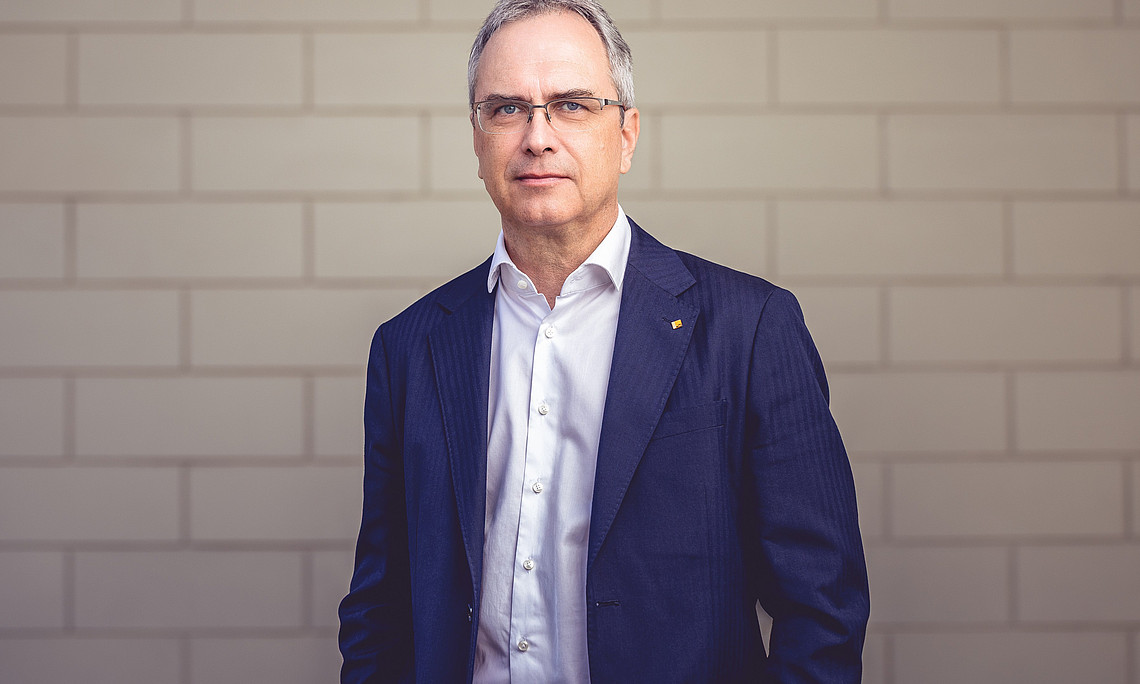

created by Karl Stöger & Gudrun Pichler

Related news

In hot water: New Report reveals record losses in glaciers, permafrost and snow cover

Climate change is driving up temperatures not only in summer. Winters are also getting warmer – with dramatic consequences for glaciers, permafrost, snow cover and the freezing of lakes. The recently published cryosphere report provides specific figures for Austria. “Our monitoring shows a clear trend with record losses of ice and snow,” says project leader Wolfgang Schöner from the University of Graz.

Theologian at the University of Graz: What the excommunication of the Society of St Pius X

Following the schism involving the Society of St Pius X, there is a need for discussion. Bernd Hillebrand from the University of Graz explains why the Vatican took this step, what role anti-democratic tendencies play, and why the Society’s sacraments are no longer recognised as valid under canon law for Catholics with immediate effect.

“HeinrichBiCool”: University of Graz demonstrates the effects of green facades and roofs

The University of Graz has launched a pioneering project at the University Centre for Theology. Its name, “HeinrichBiCool”, says it all: a comprehensive system of green facades and roof will cool the building at Heinrichstraße 80 during the summer. At the same time, this will create a new habitat for plants and animals, helping to increase biodiversity. The accompanying monitoring programme will provide detailed data on the impact of the measures on indoor climate, energy consumption and biodiversity. The findings will lay a scientifically sound foundation for further projects aimed at making cities sustainable, climate-resilient and liveable. The partners in this project, funded by the Austrian Research Promotion Agency (FFG), are AEE INTEC – Institute for Sustainable Technologies, Technisches Büro Siegfried Stark, the landscape architecture and urban planning firm “studio boden”, and Ökoteam Graz.

When stress melts away in your mouth: nicotine pouches are widespread among Styrian students

Sociologists at the University of Graz, in collaboration with VIVID – the Centre for Addiction Prevention, have carried out a survey involving more than 600 participants. Around a quarter of them use these products. The ability to use them discreetly and flexibly is a key motivation.

Begin of page section:
Additional information:

University of Graz
Universitaetsplatz 3
8010 Graz
Austria
  • Contact
  • Web Editors
  • Moodle
  • UNIGRAZonline
  • Imprint
  • Data Protection Declaration
  • Accessibility Declaration
Weatherstation
Uni Graz

End of this page section. Go to overview of page sections

End of this page section. Go to overview of page sections

Begin of page section:

End of this page section. Go to overview of page sections

