Begin of page section:
Page sections:

  • Go to contents (Accesskey 1)
  • Go to position marker (Accesskey 2)
  • Go to main navigation (Accesskey 3)
  • Go to sub navigation (Accesskey 4)
  • Go to additional information (Accesskey 5)
  • Go to page settings (user/language) (Accesskey 8)
  • Go to search (Accesskey 9)

End of this page section. Go to overview of page sections

Begin of page section:
Page settings:

English en
Deutsch de
Search
Login

End of this page section. Go to overview of page sections

Begin of page section:
Search:

Search for details about Uni Graz
Close

End of this page section. Go to overview of page sections


Search

Begin of page section:
Main navigation:

Page navigation:

  • University

    University
    • About the University
    • Organisation
    • Faculties
    • Library
    • Working at University of Graz
    • Campus
    Developing solutions for the world of tomorrow - that is our mission. Our students and our researchers take on the great challenges of society and carry the knowledge out.
  • Research Profile

    Research Profile
    • Our Expertise
    • Research Questions
    • Research Portal
    • Promoting Research
    • Research Transfer
    • Ethics in Research
    Scientific excellence and the courage to break new ground. Research at the University of Graz creates the foundations for making the future worth living.
  • Studies

    Studies
    • Prospective Students
    • Students
  • Community

    Community
    • International
    • Location
    • Research and Business
    • Alumni
    The University of Graz is a hub for international research and brings together scientists and business experts. Moreover, it fosters the exchange and cooperation in study and teaching.
  • Spotlight
Topics
  • Sustainable University
  • Researchers answer
  • Work for us
Close menu

End of this page section. Go to overview of page sections

Begin of page section:
You are here:

University of Graz News Konzert-Flügel

End of this page section. Go to overview of page sections

Thursday, 06 May 2021

Konzert-Flügel

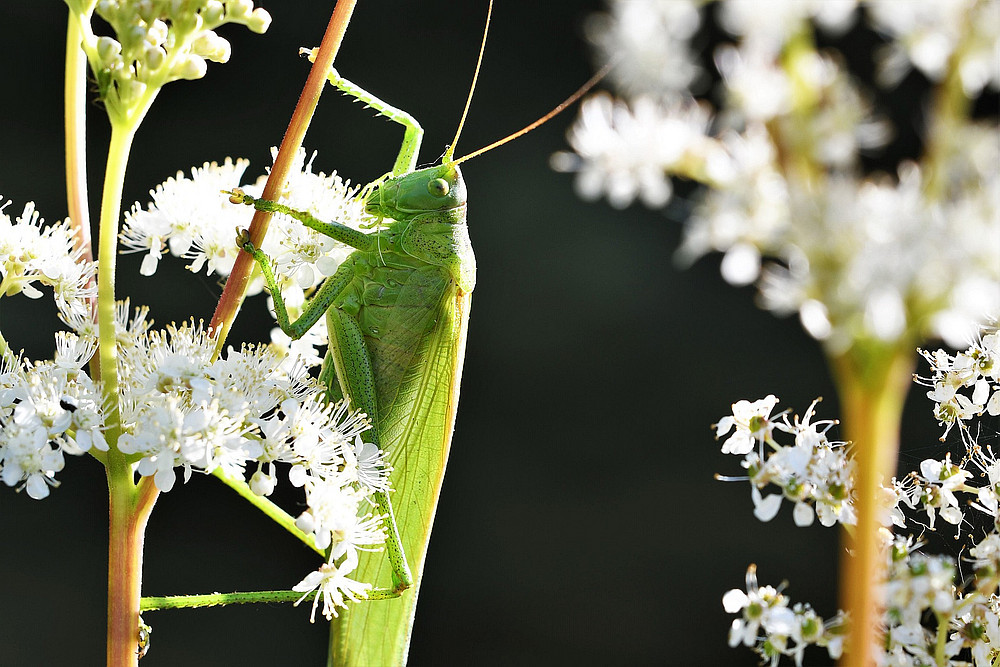
 Laubheuschrecken „singen“ oft im für Menschen nicht hörbaren Ultraschallbereich wie die Fledermäuse. Foto: Nature-Pix - Pixabay

Laubheuschrecken „singen“ oft im für Menschen nicht hörbaren Ultraschallbereich wie die Fledermäuse. Foto: Nature-Pix - Pixabay

Tierischer Song-Contest: Uni-Graz-ForscherInnen wissen, warum Grillen und Heuschrecken unterschiedlich singen

Die Wiese wird zur Gesangsbühne, wenn Grillen zirpen. Doch auch die Laubheuschrecken, die häufigsten Vertreterinnen der Heuschrecken in Österreich, „singen“ – fürs menschliche Gehör aufgrund der hohen Frequenzen aber oft kaum wahrnehmbar. Warum die miteinander eng verwandten Insekten in unterschiedlichen Tonlagen „musizieren“, hat ein ZoologInnen-Team mit Beteiligung der Universität Graz nun geklärt: Um sich im „Liebeswerben“ abzuheben, werden im tierischen Konzert die Grillen zu Tenören, Laubheuschrecken zu Sopranisten.

SängerInnen und MusikerInnen fliegen oft die Herzen zu. In der Tierwelt ist es nicht viel anders. Auch die Männchen der Grillen und Laubheuschrecken machen „Musik“, um Weibchen zu beeindrucken. Nicht mit der Stimme, sondern mit den Flügeln. Obwohl die beiden zur selben Insektenordnung gehören, bewerkstelligen sie das akustische Werben auf ganz unterschiedliche Weise, in unterschiedlicher Tonlage, wie ForscherInnen an der Universitäten Graz (A), Lincoln und Bristol (beide Großbritannien) bestätigen.

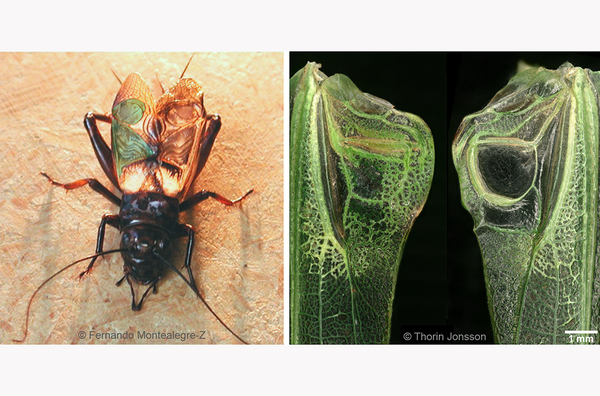
„Grillen benutzen zwei symmetrische Flügel als Lautsprecher, um ihre Gesänge zu erzeugen.  Die Laubheuschrecken hingegen haben im Zuge der Evolution ungleiche Flügel entwickelt, wovon nur einer als Lautsprecher dient“, schildert Thorin Jonsson, Wissenschafter am Institut für Biologie der Universität Graz. „Sie konnten damit im Konzertreigen der musizierenden Insekten die freie Nische der höheren Tonlagen besetzen, um Partnerinnen anzulocken. Sie singen sogar oft im für Menschen nicht hörbaren Ultraschallbereich wie die Fledermäuse“, beschreibt Jonsson.

Die meisten Grillenarten hingegen beschränken sich auf relativ tiefe Gesänge, so Jonsson, Inhaber einer Marie Skłodowska-Curie Fellowship der Europäischen Union. Dieses Zirpen entsteht durch das Aneinanderreiben der beiden symmetrischen Flügel, die sie allerdings leicht asynchron bewegen. „Die kurze zeitliche Verschiebung der Vibrationen zwischen linkem und rechtem Flügel“, erklärt der Zoologe, „würde bei höheren Frequenzen grundsätzlich die Lautstärke reduzieren. Diese verändert sich aber kaum, da die Frequenz des Gesangs relativ niedrig ist.“ Die Laubheuschrecke umgeht dieses Problem mit ihrem ungleichen Flügelbau, der höhere Frequenzen ermöglicht und akustische Überlagerung von Gesängen verhindert. Damit werden, wie das internationale Forschungsteam im Fachjournal „Frontiers in Ecology and Evolution” festgestellt hat, die Grillen zu Tenören und die Laubheuschrecken zu Sopranisten.
>> Zur Publikation


Links: „Singende“ Grille, rechts: Heuschreckenflügel
Links: „singende“ Grille, rechts: Heuschreckenflügel
created by Andreas Schweiger

Related news

Cosmetics in the environment: University of Graz proves danger to ants

Titanium dioxide, which is found in cosmetics, for example, is increasingly entering the environment in the form of nanoparticles. This could also put insects at risk. If ants ingest the substance in combination with the pesticide glyphosate, it disturbs the development of their offspring. Scientists at the University of Graz are drawing attention to the negative consequences of this toxic cocktail.

How are tech companies changing democracy? Uni Graz designs exhibition for schools

Filtered information, conspiracy theories, fake news – certain groups and corporations are using social media and algorithms to try to influence public opinion in their favour. Their goal: to weaken fundamental rights and diversity of opinion and seize power. In a new exhibition, researchers at the University of Graz are working with pupils to explore the impact of social media and AI on democracy. In accompanying workshops, the scientists want to encourage young people to develop their own ideas for a socially and ecologically viable future and to actively help shape it. The exhibition, designed as a travelling exhibition for schools, will open on 9 March 2026 at the Dreihackengasse Gymnasium in Graz.

Step by step: What motivates Mireille van Poppel as a scientist and vice-rector

Improving people's health and eliminating inequalities: Mireille van Poppel pursues these goals both as a public health researcher and as vice-rector for Internationalisation and Equality. In both roles, she pays particular attention to individual needs.

Master's degree in psychotherapy in Graz: registration opens in March

Graz is becoming a hotspot for psychotherapy: from 2026, the University of Graz and the Medical University of Graz will jointly offer the new master's programme. Registration for the admission procedure for the 140 study places will start in March.

Begin of page section:
Additional information:

University of Graz
Universitaetsplatz 3
8010 Graz
Austria
  • Contact
  • Web Editors
  • Moodle
  • UNIGRAZonline
  • Imprint
  • Data Protection Declaration
  • Accessibility Declaration
Weatherstation
Uni Graz

End of this page section. Go to overview of page sections

End of this page section. Go to overview of page sections

Begin of page section:

End of this page section. Go to overview of page sections