Begin of page section:
Page sections:

  • Go to contents (Accesskey 1)
  • Go to position marker (Accesskey 2)
  • Go to main navigation (Accesskey 3)
  • Go to sub navigation (Accesskey 4)
  • Go to additional information (Accesskey 5)
  • Go to page settings (user/language) (Accesskey 8)
  • Go to search (Accesskey 9)

End of this page section. Go to overview of page sections

Begin of page section:
Page settings:

English en
Deutsch de
Search
Login

End of this page section. Go to overview of page sections

Begin of page section:
Search:

Search for details about Uni Graz
Close

End of this page section. Go to overview of page sections


Search

Begin of page section:
Main navigation:

Page navigation:

  • University

    University
    • About the University
    • Organisation
    • Faculties
    • Library
    • Working at University of Graz
    • Campus
    Developing solutions for the world of tomorrow - that is our mission. Our students and our researchers take on the great challenges of society and carry the knowledge out.
  • Research Profile

    Research Profile
    • Our Expertise
    • Research Questions
    • Research Portal
    • Promoting Research
    • Research Transfer
    • Ethics in Research
    • Commission for Scientific Integrity
    Scientific excellence and the courage to break new ground. Research at the University of Graz creates the foundations for making the future worth living.
  • Studies

    Studies
    • Prospective Students
    • Students
    • Registration for Study Programme (Winter semester 2026/27)
  • Community

    Community
    • International
    • Location
    • Research and Business
    • Alumni
    The University of Graz is a hub for international research and brings together scientists and business experts. Moreover, it fosters the exchange and cooperation in study and teaching.
Topics
  • Sustainable University
  • Researchers answer
  • Work for us
Close menu

End of this page section. Go to overview of page sections

Begin of page section:
You are here:

University of Graz News Klein, schnell, sparsam

End of this page section. Go to overview of page sections

Wednesday, 08 July 2015

Klein, schnell, sparsam

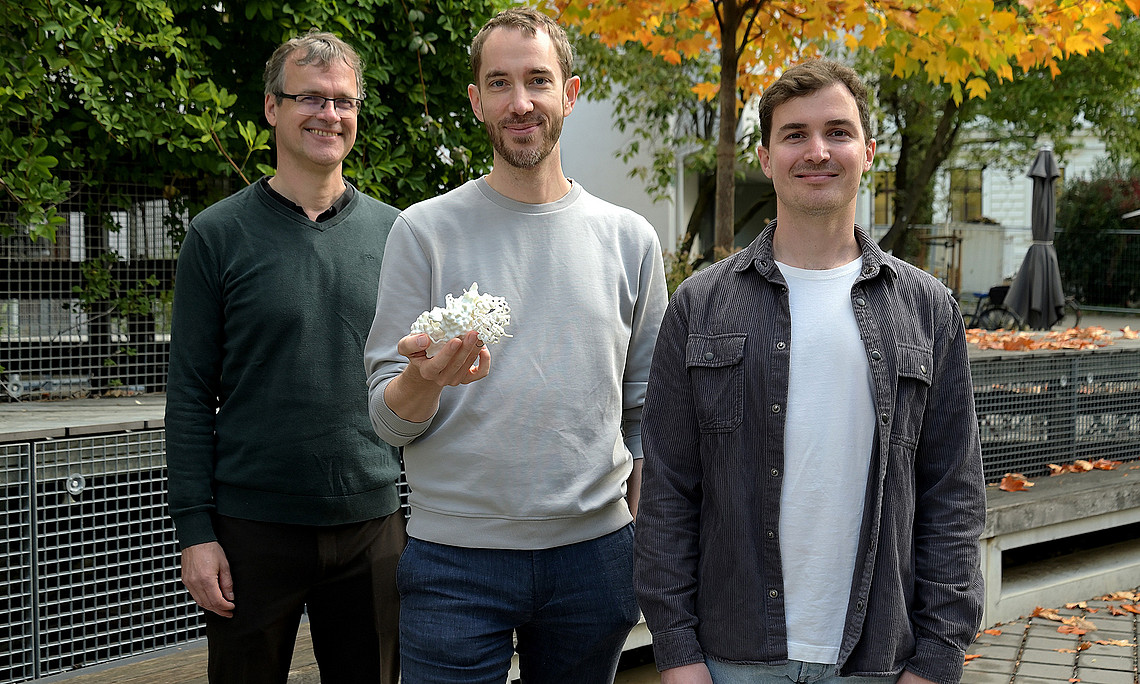
Biegsame, leitfähige Nanodrähte konnte Leonhard Grill mit seinem Team erstmals herstellen. Foto: Uni Graz/Grill

Biegsame, leitfähige Nanodrähte konnte Leonhard Grill mit seinem Team erstmals herstellen. Foto: Uni Graz/Grill

Forscher der Uni Graz entwickeln flexible molekulare Drähte

Ladungen müssen in allen elektrischen Geräten unseres Alltags transportiert werden. Dabei fließen typischerweise Elektronen über Kupferdrähte zwischen Bauteilen wie Schaltern oder Transistoren. Extrem kleine Schaltkreise lassen hohe Operationsgeschwindigkeiten zu, senken die Kosten und minimieren den Energieverbrauch. „Wir versuchen daher, die elektronischen Funktionen in einzelne Moleküle zu packen. Flexible molekulare Drähte mit hoher Leitfähigkeit herzustellen und auch noch auf der Ebene einzelner Moleküle zu charakterisieren, ist allerdings eine große Herausforderung“, erklärt Univ.-Prof. Dr. Leonhard Grill vom Institut für Chemie der Uni Graz. Mit einem erfolgreichen Experiment sind die WissenschafterInnen einen großen Schritt weitergekommen. Die Ergebnisse wurden soeben in der Juli-Ausgabe des renommierten Fachmagazins „Nature Communications“ publiziert.

Mit seiner Arbeitsgruppe hat Grill bereits verschiedene funktionale Moleküle wie Schalter oder Drähte analysiert. In einer internationalen Kooperation gelang es den WissenschafterInnen nun durch die Verwendung spezieller chemischer Zusammensetzung, molekulare Drähte mit hoher Leitfähigkeit und gleichzeitig großer mechanischer Biegsamkeit herzustellen. Dabei wurden diese gezielt auf Goldoberflächen zusammengebaut und hinsichtlich ihrer elektronischen Struktur charakterisiert. Anschließend wurde ein einzelner Draht mit einer feinen Metallspitze hochgezogen. „In diesem anspruchsvollen Experiment lassen sich sowohl die elektronischen als auch die mechanischen Eigenschaften in Echtzeit bestimmen“, schildert Grills Mitarbeiter Dr. Christophe Nacci. Die beiden Wissenschafter sind überzeugt, dass die überraschenden und bedeutenden Resultate neuartige Designs molekularer Drähte ermöglichen.

Diese Studie wurde im Rahmen des EU-Projekts AtMol („Atomic Scale and single Molecule Logic gate Technologies“) in einer internationalen Zusammenarbeit mit WissenschafterInnen der Humboldt-Universität zu Berlin sowie dem französischen Centre National de la Recherche Scientifique in Toulouse und dem Institute of Materials Research and Engineering in Singapore durchgeführt.

Link zur Publikation

created by Dagmar Eklaude

Related news

Sport beyond the World Cup: the TV channel “Welt der Wunder” features diabetes research from the University of Graz

Keeping blood sugar levels in check during physical exertion is a particular challenge for people with type 1 diabetes. Othmar Moser examines how those affected manage to balance physical activity, sport and their metabolic disorder.

"Mathematics explains the world"

How can life be quantified? And what can science reveal that remains hidden from the naked eye? The 14th European Conference on Mathematical and Theoretical Biology at the University of Graz is dedicated to these questions. From 13 to 17 July, around 1,300 researchers from all over the world will gather on campus to discuss models, biological processes and the future of data-driven medicine. Klemens Fellner, Dean of the Faculty of Natural Sciences and Mathematics and a mathematician, talks about the language that explains the world

Internationally up-to-date: University of Graz offers new degree programmes in art studies

From the Old Masters to AI art – three newly designed degree programmes offer students at the University of Graz fresh perspectives on artistic production. In addition to historical art, the programmes place a greater emphasis on contemporary and global developments. The registration period is open.

The Nazi elite school Napola: Historian seeks memories and personal documents

They were to be brought up to become the future elite of National Socialism: boys and girls aged ten and over who, following the ‘Anschluss’ of Austria to the German Reich, attended a so-called Napola (short for Nationalpolitische Lehranstalt; also known as NPEA, Nationalpolitische Erziehungsanstalt). There were nine such institutions in what is now Austria between 1939 and 1945.

Begin of page section:
Additional information:

University of Graz
Universitaetsplatz 3
8010 Graz
Austria
  • Contact
  • Web Editors
  • Moodle
  • UNIGRAZonline
  • Imprint
  • Data Protection Declaration
  • Accessibility Declaration
Weatherstation
Uni Graz

End of this page section. Go to overview of page sections

End of this page section. Go to overview of page sections

Begin of page section:

End of this page section. Go to overview of page sections