Begin of page section:
Page sections:

  • Go to contents (Accesskey 1)
  • Go to position marker (Accesskey 2)
  • Go to main navigation (Accesskey 3)
  • Go to sub navigation (Accesskey 4)
  • Go to additional information (Accesskey 5)
  • Go to page settings (user/language) (Accesskey 8)
  • Go to search (Accesskey 9)

End of this page section. Go to overview of page sections

Begin of page section:
Page settings:

English en
Deutsch de
Search
Login

End of this page section. Go to overview of page sections

Begin of page section:
Search:

Search for details about Uni Graz
Close

End of this page section. Go to overview of page sections


Search

Begin of page section:
Main navigation:

Page navigation:

  • University

    University
    • About the University
    • Organisation
    • Faculties
    • Library
    • Working at University of Graz
    • Campus
    Developing solutions for the world of tomorrow - that is our mission. Our students and our researchers take on the great challenges of society and carry the knowledge out.
  • Research Profile

    Research Profile
    • Our Expertise
    • Research Questions
    • Research Portal
    • Promoting Research
    • Research Transfer
    • Ethics in Research
    Scientific excellence and the courage to break new ground. Research at the University of Graz creates the foundations for making the future worth living.
  • Studies

    Studies
    • Prospective Students
    • Students
  • Community

    Community
    • International
    • Location
    • Research and Business
    • Alumni
    The University of Graz is a hub for international research and brings together scientists and business experts. Moreover, it fosters the exchange and cooperation in study and teaching.
  • Spotlight
Topics
  • Sustainable University
  • Researchers answer
  • Work for us
Close menu

End of this page section. Go to overview of page sections

Begin of page section:
You are here:

University of Graz News Keine Katharsis

End of this page section. Go to overview of page sections

Wednesday, 02 December 2020

Keine Katharsis

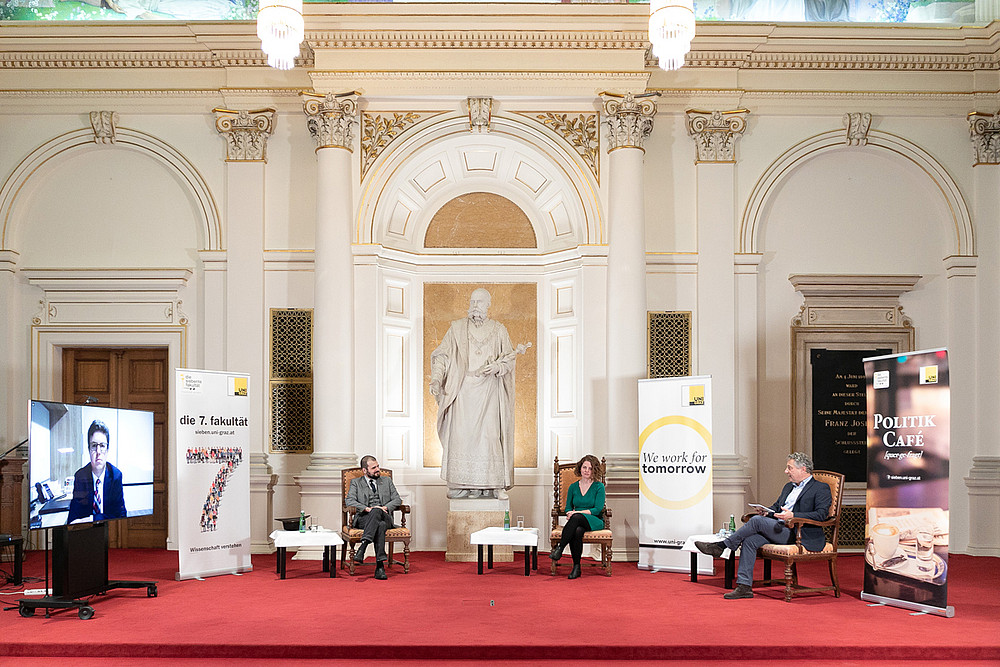
Markus Steppan (rechts) lud an die Uni Graz. Live vor Ort waren Caitlin Ahern (Mitte) und Stefan Rabitsch. Peter Rough war per Video zugeschaltet. Das Publikum konnte wieder online an der Diskussion teilnehmen. Foto: Oliver Wolf

Markus Steppan (rechts) lud an die Uni Graz. Live vor Ort waren Caitlin Ahern (Mitte) und Stefan Rabitsch. Peter Rough war per Video zugeschaltet. Das Publikum konnte wieder online an der Diskussion teilnehmen. Foto: Oliver Wolf

Politik Café zum Thema USA. ExpertInnen waren sich einig: Politisches Klima ist rau und ruppig

Auf der einen Seite Donald-Trump-Fans, auf der anderen die WählerInnen Joe Bidens. In der Mitte ein Amerika-Experte. In diesem Setting trafen sich am Montagabend Peter Rough, Caitlin Ahern und Stefan Rabitsch als Gäste von Rechtswissenschafter Markus Steppan zu einer neuen Ausgabe des beliebten Diskussionsformats „Politik Café“. Thema des Abends war, wie im Titel „USA – die gespaltene Nation“ angeteasert, die Wahl des neuen USA-Präsidenten Joe Biden. Der Demokrat wird im Jänner der 46. Präsident der Vereinigten Staaten und übt somit das mächtigste politische Amt der Welt aus. Und obwohl Joe Biden am 20. Jänner 2021 vereidigt werden soll, Trumps politisches Wirken wird noch über diesen Tag hinaus spürbar bleiben. Denn die Gräben in der Gesellschaft und Politik sind zu tief.

Wirtschaft versus Menschenleben?
"Die amerikanische Landschaft verschiebt sich, es ist unmöglich zu sagen wohin", meinte der Republikaner Peter Rough zu Beginn der Diskussion, die über das Portal Youtube live aus der Aula der Universität Graz übertragen wurde. Grundsätzlich vertritt der Rough die Meinung, dass die Wirtschaft unter der Präsidentschaft Donald Trumps floriert sei. Die Demokratin Caitlin Ahern entgegnete: "Es gibt mehr als nur das Wirtschaftswachstum. Was ist mit den 50.000 Menschen, die gestorben sind wegen der schlechten Maßnahmen von Trump? Wir müssen das Gesamtsystem sehen. Vielleicht geht es den Menschen am Konto besser, aber viele sind jetzt verunsichert während der Pandemie."

Doch wie geht es nun weiter? Amerikanist Stefan Rabitsch: "Ich sehe keine nationale Katharsis. Die Nation steht vor dem 'unfinished business'. Die Ausgangslage ist für Biden nicht ideal." Demokratin Caitlin Ahern hielt fest: „Viele Frauen, junge Leute oder Minderheiten werden sich in einer Machtposition sehen. Ich glaube, dass diese Leute in den nächsten vier Jahren ermutigt werden. Wir werden viel von ihnen hören. „Eine weniger optimistische Sichtweise äußerte Politikberater Peter Rough: "Ich befürchte, dass Biden in den Lagerkämpfen der demokratischen Partei zerrieben wird. Die haben bis jetzt nicht stattgefunden, weil man sich geeint gegen Trump gestellt hat. Es gibt innerhalb des Kongress und innerhalb der Partei so viele unterschiedliche Gruppen, die Biden nicht alle bedienen können wird."

Die Spezialausgabe "Politik Café" kann auf Youtube nachgeschaut werden:

USA-die gespaltene Nation


Diese Veranstaltung wurde in Kooperation mit der US Botschaft in Wien und der Österreichisch-Amerikanischen Gesellschaft Steiermark durchgeführt.

created by Konstantin Tzivanopoulos

Related news

Cosmetics in the environment: University of Graz proves danger to ants

Titanium dioxide, which is found in cosmetics, for example, is increasingly entering the environment in the form of nanoparticles. This could also put insects at risk. If ants ingest the substance in combination with the pesticide glyphosate, it disturbs the development of their offspring. Scientists at the University of Graz are drawing attention to the negative consequences of this toxic cocktail.

How are tech companies changing democracy? Uni Graz designs exhibition for schools

Filtered information, conspiracy theories, fake news – certain groups and corporations are using social media and algorithms to try to influence public opinion in their favour. Their goal: to weaken fundamental rights and diversity of opinion and seize power. In a new exhibition, researchers at the University of Graz are working with pupils to explore the impact of social media and AI on democracy. In accompanying workshops, the scientists want to encourage young people to develop their own ideas for a socially and ecologically viable future and to actively help shape it. The exhibition, designed as a travelling exhibition for schools, will open on 9 March 2026 at the Dreihackengasse Gymnasium in Graz.

Step by step: What motivates Mireille van Poppel as a scientist and vice-rector

Improving people's health and eliminating inequalities: Mireille van Poppel pursues these goals both as a public health researcher and as vice-rector for Internationalisation and Equality. In both roles, she pays particular attention to individual needs.

Master's degree in psychotherapy in Graz: registration opens in March

Graz is becoming a hotspot for psychotherapy: from 2026, the University of Graz and the Medical University of Graz will jointly offer the new master's programme. Registration for the admission procedure for the 140 study places will start in March.

Begin of page section:
Additional information:

University of Graz
Universitaetsplatz 3
8010 Graz
Austria
  • Contact
  • Web Editors
  • Moodle
  • UNIGRAZonline
  • Imprint
  • Data Protection Declaration
  • Accessibility Declaration
Weatherstation
Uni Graz

End of this page section. Go to overview of page sections

End of this page section. Go to overview of page sections

Begin of page section:

End of this page section. Go to overview of page sections