



Begin of page section:
Page sections:

  • Go to contents (Accesskey 1)
  • Go to position marker (Accesskey 2)
  • Go to main navigation (Accesskey 3)
  • Go to sub navigation (Accesskey 4)
  • Go to additional information (Accesskey 5)
  • Go to page settings (user/language) (Accesskey 8)
  • Go to search (Accesskey 9)

End of this page section. Go to overview of page sections

Begin of page section:
Page settings:

English en
Deutsch de
Search
Login

End of this page section. Go to overview of page sections

Begin of page section:
Search:

Search for details about Uni Graz
Close

End of this page section. Go to overview of page sections


Search

Begin of page section:
Main navigation:

Page navigation:

  • University

    University
    • About the University
    • Organisation
    • Faculties
    • Library
    • Working at University of Graz
    • Campus
    Developing solutions for the world of tomorrow - that is our mission. Our students and our researchers take on the great challenges of society and carry the knowledge out.
  • Research Profile

    Research Profile
    • Our Expertise
    • Research Questions
    • Research Portal
    • Promoting Research
    • Research Transfer
    • Ethics in Research
    • Commission for Scientific Integrity
    Scientific excellence and the courage to break new ground. Research at the University of Graz creates the foundations for making the future worth living.
  • Studies

    Studies
    • Prospective Students
    • Students
    • Welcome Weeks for First Year Students
  • Community

    Community
    • International
    • Location
    • Research and Business
    • Alumni
    The University of Graz is a hub for international research and brings together scientists and business experts. Moreover, it fosters the exchange and cooperation in study and teaching.
Topics
  • Sustainable University
  • Researchers answer
  • Work for us
Close menu

End of this page section. Go to overview of page sections

Begin of page section:
You are here:

University of Graz News Jungforscherin der Uni Graz für ihre Arbeit zum Thema "Sonnenwinde" ausgezeichnet

End of this page section. Go to overview of page sections

Thursday, 24 May 2012

Jungforscherin der Uni Graz für ihre Arbeit zum Thema "Sonnenwinde" ausgezeichnet

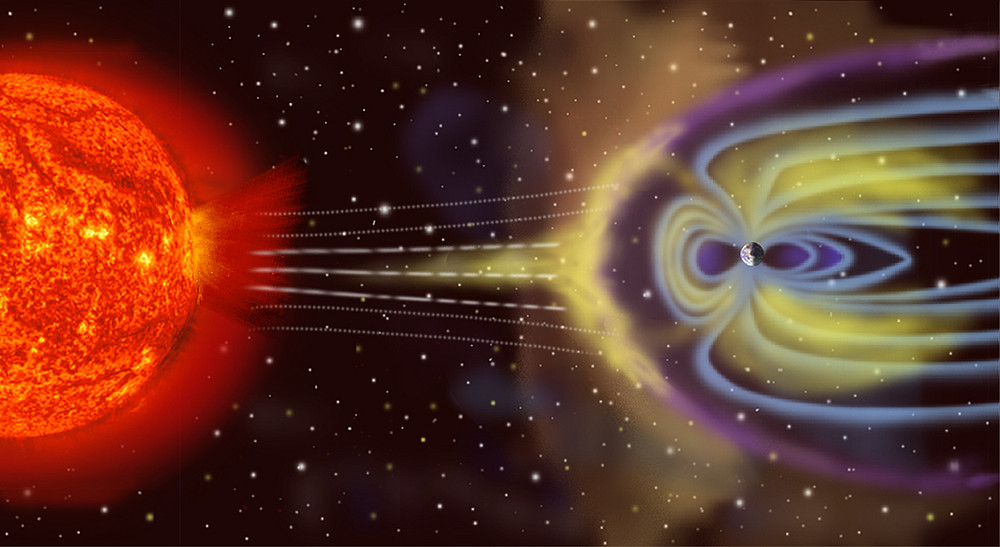
Sonnenwinde stehen im Zentrum von Gressls Diplomarbeit.

Sonnenwinde stehen im Zentrum von Gressls Diplomarbeit. Foto: NASA.

Die junge Uni Graz-Physikerin Mag. Corinna Gressl hat für ihre Diplomarbeit im Bereich Astrophysik den Studierenden-Forschungs-Wettbewerb des Community Coordinated Modeling Center (CCMC) der NASA und der US National Science Foundation (NSF) gewonnen. Der Preis besteht aus einer Einladung inklusive Übernahme der gesamten Kosten zur Teilnahme an der "2012 SHINE" Konferenz in Maui, Hawaii, vom 25. bis 29. Juni 2012, wo sie ihre Arbeit und Resultate der breiten, internationalen Wissenschaftscommunity in einem Vortrag vorstellen wird.

In ihrer Arbeit mit dem Titel "Vergleiche von MHD Simulationen des Sonnenwindes mit in-situ gemessenen Plasma- und Magnetfeld-Parametern bei 1 AU" behandelt die Nachwuchsforscherin das Thema "Space Weather". "Die Sonne ist ein aktiver Stern mit einem elfjährigen Aktivitätszyklus. Alle elf Jahre ist die Sonnenaktivität besonders groß. Die Sonnenaktivität ist in den letzten Monaten gestiegen und das nächste Aktivitätsmaximum steht unmittelbar bevor", erklärt Gressl. Unter „Sonnenaktivität“ versteht man eine Vielzahl von Phänomenen: Sonnenflecke, erhöhte Radio-, UV- und Röntgenstrahlung und auch spektakuläre Events wie Koronale Massenauswürfe (CMEs – „coronal mass ejections“) und Flares, bei denen es in kurzer Zeit zu enormer Energiefreisetzung kommt.

Die Auswirkungen der Sonnenaktivität auf die Erde und den erdnahen Weltraum wird unter dem Begriff „Weltraumwetter“ oder „Space Weather“ zusammengefasst. "Die Erde wird ständig von einem Teilchenstrom, hauptsächlich Protonen und Elektronen, von der Sonne, dem sogenannten Sonnenwind, getroffen", erzählt die Forscherin. Die Teilchen des Sonnenwindes stammen aus der Sonnenkorona und erreichen die Erde in durchschnittlich 4 Tagen. Das Magnetfeld der Erde lenkt die Teilchen ab, sodass sie seitlich an der Erde vorbeiströmen und ist somit ein wichtiger Schutz für die Erde. Bei hoher Sonnenaktivität kann die Geschwindigkeit des Sonnenwindes bis zu 2000 km/s erreichen. Sonnenstürme, die eine Auswirkung auf die Erde haben, werden als „geoeffektiv“ bezeichnet und stören das Erdmagnetfeld teils erheblich. Es treten Polarlichter auf, bei starken Stürmen können Satelliten ausfallen, der Funkverkehr kann gestört werden und in seltenen Fällen kann es auch zu Stromausfällen kommen. Ganz besonders betroffen ist die Raumfahrt, da sich Satelliten mit empfindlichen Messgeräten oder sogar Astronauten außerhalb des schützenden Erdmagnetfeldes befinden.

Um sich auf bevorstehendes „ungemütliches“ Weltraumwetter vorbereiten zu können braucht man eine verlässliche Weltraumwetter-Vorhersage. Der tatsächliche Zustand des Sonnenwindes kann nur mittels Satelliten gemessen werden. "Während der Arbeit an meiner Diplomarbeit war es meine Aufgabe, Sonnenwindmodelle auf ihre Zuverlässigkeit zu überprüfen. Dies hatte einerseits den Zweck, als Feedback für die Modell-Entwickler zu dienen und herauszufinden, wo bei den verschiedenen Modellen Verbesserungsmöglichkeiten liegen und wo bereits gute Resultate erzielt werden. Zum anderen galt es herauszufinden, welches Sonnenwindmodell die besten Vorhersagen liefert um zu entscheiden, welches Modell für die zukünftige europäische Weltraumwettervorhersagestation verwendet zu werden soll", sagt Gressl, die derzeit ihr Doktorat am Institut für Physik betreibt.

Infos zum Contest >>Hier
created by Konstantinos Tzivanopoulos

Related news

Austria’s emissions rose in 2025: University of Graz researchers analyse the causes

The Environment Agency Austria has today published the figures for the country’s greenhouse gas emissions in 2025. While emissions fell sharply year on year from 2022 to 2024, they rose again by just under 0.7 per cent in 2025. Researchers at the University of Graz have analysed how much of this increase was due to structural changes in the economy and how much was attributable to external factors over which there is little control. “In 2025, the colder winter compared with 2024 increased emissions by 0.81 per cent, while the weak economy reduced them by 0.38 per cent. If we factor out these influences, we find an underlying increase of 0.26 per cent compared with the previous year,” reports economist Karl Steininger. “This clearly means that Austria is not on track to meet its climate targets, which require a substantial reduction in emissions by 2030.”

Electrifying: Researchers film the first moments on the way from light to electricity

Physicists at the University of Graz (Austria), in collaboration with colleagues from Marburg University and Forschungszentrum Jülich (Germany), have achieved a scientific breakthrough. For the first time, the generation of electrical energy from light has been filmed and described theoretically. This work is of far-reaching significance, not least for optimising sustainable energy production from photovoltaics. This is because it provides fundamental building blocks for understanding the physical processes that take place, for example, in organic solar cells. The paper was published in the journal Physical Review X, one of the world’s most prestigious physics journals.

University of Graz: Working together to make Styria a sustainable centre of learning

Round table calls for sustainable funding for the 2028–2030 performance agreement period between the five Styrian universities and the federal government.

How can we teach using YouTube and AI? The University of Graz is strengthening media education in schools

A journey through the blood vessels using VR headsets brings biology lessons to life. An interactive quiz brings physics to life. The YouTube video explains the First World War. Whilst mobile phones are increasingly being banned from the classroom, social media platforms, apps and AI are playing an ever-greater role in knowledge transfer at school. But how can teaching with media be made even more effective? What are the challenges in media-based teaching? At the University of Graz, researchers are discussing these issues at a conference being held in Austria for the first time.

Begin of page section:
Additional information:

University of Graz
Universitaetsplatz 3
8010 Graz
Austria
  • Contact
  • Web Editors
  • Moodle
  • UNIGRAZonline
  • Imprint
  • Data Protection Declaration
  • Accessibility Declaration
Weatherstation
Uni Graz

End of this page section. Go to overview of page sections

End of this page section. Go to overview of page sections

Begin of page section:

End of this page section. Go to overview of page sections


