Begin of page section:
Page sections:

  • Go to contents (Accesskey 1)
  • Go to position marker (Accesskey 2)
  • Go to main navigation (Accesskey 3)
  • Go to sub navigation (Accesskey 4)
  • Go to additional information (Accesskey 5)
  • Go to page settings (user/language) (Accesskey 8)
  • Go to search (Accesskey 9)

End of this page section. Go to overview of page sections

Begin of page section:
Page settings:

English en
Deutsch de
Search
Login

End of this page section. Go to overview of page sections

Begin of page section:
Search:

Search for details about Uni Graz
Close

End of this page section. Go to overview of page sections


Search

Begin of page section:
Main navigation:

Page navigation:

  • University

    University
    • About the University
    • Organisation
    • Faculties
    • Library
    • Working at University of Graz
    • Campus
    Developing solutions for the world of tomorrow - that is our mission. Our students and our researchers take on the great challenges of society and carry the knowledge out.
  • Research Profile

    Research Profile
    • Our Expertise
    • Research Questions
    • Research Portal
    • Promoting Research
    • Research Transfer
    • Ethics in Research
    Scientific excellence and the courage to break new ground. Research at the University of Graz creates the foundations for making the future worth living.
  • Studies

    Studies
    • Prospective Students
    • Students
  • Community

    Community
    • International
    • Location
    • Research and Business
    • Alumni
    The University of Graz is a hub for international research and brings together scientists and business experts. Moreover, it fosters the exchange and cooperation in study and teaching.
  • Spotlight
Topics
  • Our digital Advent calendar
  • Sustainable University
  • Researchers answer
  • Work for us
Close menu

End of this page section. Go to overview of page sections

Begin of page section:
You are here:

University of Graz News Is diabetes treatable?

End of this page section. Go to overview of page sections

Tuesday, 26 April 2022

Is diabetes treatable?

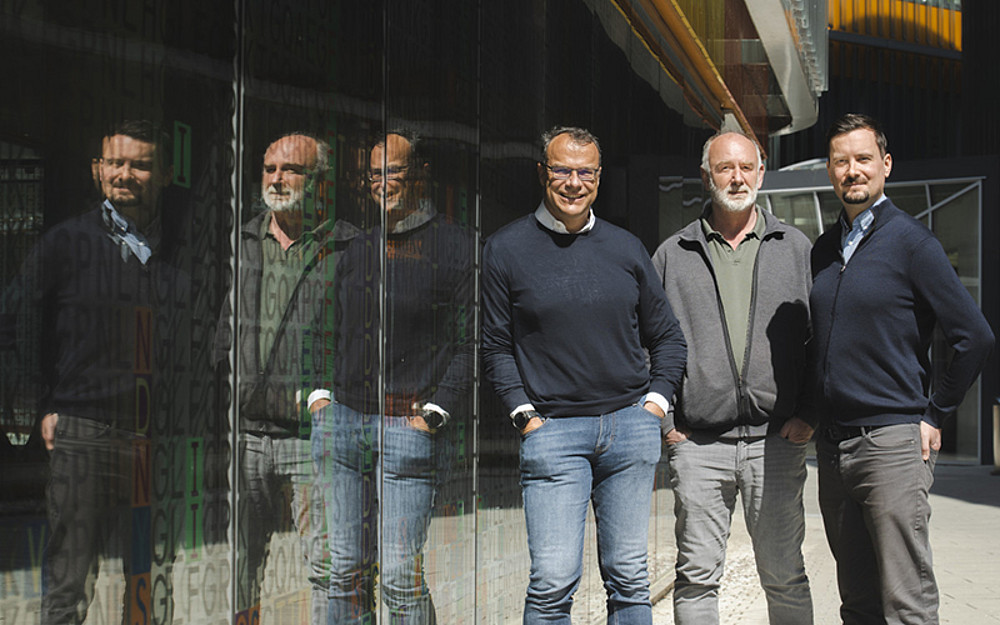
Rolf Breinbauer (TU Graz), Robert Zimmermann and Gernot Grabner (both Uni Graz, from left to right) have laid the foundation for drugs against diabetes, fatty liver and cardiac insufficiency with their research. Photo: Uni Graz/Tzivanopoulos.

Rolf Breinbauer (TU Graz), Robert Zimmermann and Gernot Grabner (both Uni Graz, from left to right) have laid the foundation for drugs against diabetes, fatty liver and cardiac insufficiency with their research. Photo: Uni Graz/Tzivanopoulos.

Graz researchers lay the foundation for medications to treat diabetes, fatty liver disease and heart failure

Many illnesses, such as type 2 diabetes, non-alcoholic fatty liver disease and heart problems are the result of an elevated level of fatty acids in the blood. Five years ago Graz researchers developed a drug treatment which reduces the level of fatty acids in a model organism. Now Robert Zimmermann (University of Graz) and Rolf Breinbauer (Graz University of Technology) are taking this research a step further. In a recently published paper they present a variation of the drug Atglistatin, which can now also be used in humans. This lays the foundation for the development of medications to treat lipid metabolism disorders such as type 2 diabetes, non-alcoholic fatty liver disease and heart failure.

A crucial enzyme

A key role in lipid metabolism is played by the enzyme ATGL (short for adipose triglyceride lipase). This mobilises fatty acids in the blood, which is the cause of many illnesses. “So the objective is to block ATGL in such a way that this suppression does not disrupt other processes in the body,” explains Robert Zimmerman (Uni Graz), describing this ingenious intervention in what is a highly sensitive system. He and Rolf Breinbauer (TU Graz) and their teams spent five years working meticulously to refine an ATGL inhibitor which can be used in humans. The starting point was the agent Atglistatin which they had previously synthesised. Its molecular structure was adjusted until the optimal variation was found. This is called NG-497 and has been shown to deactivate human ATGL. Rolf Breinbauer verifies this: “In the cell culture model we are able to inhibit ATGL completely and have so far not seen any harmful side-effects of this intervention.”

Market-ready research

The research work was part of a programme by Research Studios Austria (RSA-Atglistatin), which was awarded funding of 1.2 million euros from the Austrian Research Promotion Agency (FFG). In the near future the ATGL inhibitors created by this team will be developed further as part of a wings4innovation project, and tested in preclinical studies for their effectiveness and any side-effects. As well as exemplifying the successful collaboration between the University of Graz and Graz University of Technology in the natural sciences, this also demonstrates how university basic research can be of interest to high-tech pharma companies.

The research is part of the Field of Excellence BioHealth at the University of Graz.

Publication: Gernot F. Grabner […] Rolf Breinbauer* und Robert Zimmermann*, Small-Molecule Inhibitors Targeting Lipolysis in Human Adipocytes. Journal of the American Chemical Society. 2022, 144, 14, 6237–6250, https://doi.org/10.1021/jacs.1c10836

created by Gerhild Leljak

Related news

Semester abroad without barriers: University of Graz wins award for promoting inclusion

The University of Graz has been awarded the Internationalization Award for its new inclusion initiative. Students with fewer opportunities now also receive financial support for their semester abroad outside Europe.

Fair distribution: Researchers determine just greenhouse gas budgets for all EU regions

Ten years ago, on 12 December 2015, the Paris Climate Agreement was signed at the UN Climate Conference. In order to limit global warming to well below two degrees, only a certain amount of CO2 may be emitted worldwide. While the focus was originally on national emission targets, more than 200 subnational regions and almost 300 cities have now adopted their own targets. But how many emissions are they fairly entitled to? Researchers at the University of Graz have now developed transparent criteria for fair distribution at the subnational level for the first time and determined corresponding greenhouse gas budgets for all European regions. The paper was published today in the scientific journal Nature Communications.

Chemical Christmas show at the University of Graz: An explosive evening at the Schauspielh

At the beginning of December, the University of Graz transformed the theater into a laboratory: as part of “Chemical Life,” teacher training students staged a chemical Christmas show for Styrian school classes—complete with ethanol rockets, nitrogen snow, and glowing effects. An evening designed to inspire interest in studying chemistry.

Train by train: Koralm railway accelerates exchange between the Universities

Lectures at the University of Klagenfurt in the morning, seminars at the University of Graz in the afternoon: Austria's longest tunnel and a journey time of around 45 minutes make it easy. The Koralm railway increases the speed of networking between the two university locations. The collaboration builds on existing cooperation - for example in the areas of teacher training, Slavic studies and as employers, the universities are well coordinated.

Begin of page section:
Additional information:

University of Graz
Universitaetsplatz 3
8010 Graz
Austria
  • Contact
  • Web Editors
  • Moodle
  • UNIGRAZonline
  • Imprint
  • Data Protection Declaration
  • Accessibility Declaration
Weatherstation
Uni Graz

End of this page section. Go to overview of page sections

End of this page section. Go to overview of page sections

Begin of page section:

End of this page section. Go to overview of page sections