Begin of page section:
Page sections:

  • Go to contents (Accesskey 1)
  • Go to position marker (Accesskey 2)
  • Go to main navigation (Accesskey 3)
  • Go to sub navigation (Accesskey 4)
  • Go to additional information (Accesskey 5)
  • Go to page settings (user/language) (Accesskey 8)
  • Go to search (Accesskey 9)

End of this page section. Go to overview of page sections

Begin of page section:
Page settings:

English en
Deutsch de
Search
Login

End of this page section. Go to overview of page sections

Begin of page section:
Search:

Search for details about Uni Graz
Close

End of this page section. Go to overview of page sections


Search

Begin of page section:
Main navigation:

Page navigation:

  • University

    University
    • About the University
    • Organisation
    • Faculties
    • Library
    • Working at University of Graz
    • Campus
    Developing solutions for the world of tomorrow - that is our mission. Our students and our researchers take on the great challenges of society and carry the knowledge out.
  • Research Profile

    Research Profile
    • Our Expertise
    • Research Questions
    • Research Portal
    • Promoting Research
    • Research Transfer
    • Ethics in Research
    • Commission for Scientific Integrity
    Scientific excellence and the courage to break new ground. Research at the University of Graz creates the foundations for making the future worth living.
  • Studies

    Studies
    • Prospective Students
    • Students
  • Community

    Community
    • International
    • Location
    • Research and Business
    • Alumni
    The University of Graz is a hub for international research and brings together scientists and business experts. Moreover, it fosters the exchange and cooperation in study and teaching.
  • Spotlight
Topics
  • Sustainable University
  • Researchers answer
  • Work for us
Close menu

End of this page section. Go to overview of page sections

Begin of page section:
You are here:

University of Graz News Intelligenz-Zelle

End of this page section. Go to overview of page sections

Tuesday, 28 July 2015

Intelligenz-Zelle
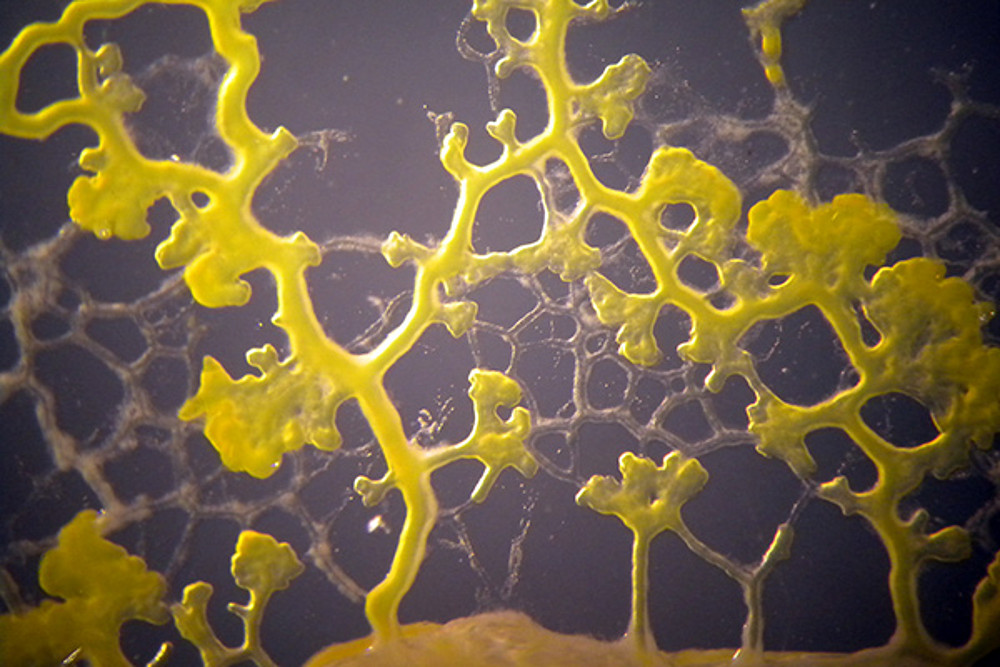
Das Netzwerk eines Schleimpilzes: Der Einzeller breitet guerilla-artig Arme aus, um die nächste Futterquelle zu finden. Foto: Uni Graz/Grube

Das Netzwerk eines Schleimpilzes: Der Einzeller breitet guerilla-artig Arme aus, um die nächste Futterquelle zu finden. Foto: Uni Graz/Grube
Ein simpler Pilz könnte als Bio-Computer eingesetzt werden: Er findet rasch und selbstorganisiert die besten Routen zu seinen Nahrungsquellen.

Was sind ideale Transportwege in Krisenregionen? Wie optimieren sich Gefäße in einem Tumor? Um die besten Routen innerhalb eines Netzwerks zu berechnen, arbeiten OptimiererInnen mit komplexen Computermodellen. PflanzenwissenschafterInnen nutzen nun einen völlig neuen Zugang: Sie überlassen diese Arbeit einem Schleimpilz, der zu den gewünschten Punkten wächst.
Der Volksmund kennt ihn bei uns als Hexenbutter, und er tritt als gelber Schleimfleck aus den Böden unserer Wälder. Insgesamt gibt es rund 800 Schleimpilzarten, nur wenige davon wurden bis jetzt kultiviert. ForscherInnen um Martin Grube haben am Institut für Pflanzenwissenschaften eigens ein Biophysik-Labor eingerichtet, in dem die Nahrungs- und Suchstrategien dieser netzwerkenden Organismen erforscht werden. „Das Faszinierende an diesem Lebewesen ist, dass es selbstorganisiert und dezentral seine Ressourcen – sprich Nahrungsquellen – erfasst und dabei ein Netzwerk an Verästelungen aufbaut, das wir kaum besser berechnen könnten“, erklärt Grube. Britisch-japanische ForscherInnen haben das bereits mit einem Experiment gezeigt: Sie verteilten Haferflocken auf einer Unterlage analog zu den Bahnhöfen im Ballungsraum von Tokio. Die Wege, die der Schleimpilz zu diesen Futterquellen fand, waren praktisch deckungsgleich mit dem Schienennetz der japanischen Metropole.
Da die Pilze vor allem im Dunkeln wachsen, kann man durch Beleuchtung ihre Richtung beeinflussen. „Helle Orte vermeiden sie gänzlich, zu pulsierendem Licht wachsen sie langsamer. So lassen sich beispielsweise Landschaften simulieren“, schildert der Pflanzenwissenschafter. Er sieht es als realistisch an, dass diese Organismen tatsächlich Computern Arbeit abnehmen können. Die Forschungen sind in den Schwerpunkt Modelle und Simulation eingebunden.

created by Dagmar Eklaude

Related news

Mild Research Night: Around 750 visitors travelled around the world at the university

Lovely weather and a wide range of research topics drew visitors to the University of Graz last Friday. Highlights included a journey around the globe in eight stops, a ‘speed-dating’ session with books, insights into Alfred Wegener’s Greenland expedition, and guided tours of the democracy exhibition at the UniGraz@Museum.

Career Booster: How the Research Careers Campus supports researchers

They are innovative, creative and productive – researchers who have not yet been appointed to a professorship make a massive contribution to a university’s research output. To provide them with even better support on their career path, the University of Graz has established the Research Careers Campus. The official launch took place on 22 April 2026 with a ‘festival’.

Greenery on the rise: over 500 new flowers, perennials and shrubs on campus

Bright blooms and fresh greenery make our hearts beat faster in spring. But it is not just us humans who delight in this colourful growth. For many animals, this splendour provides, above all, food and habitat. There has recently been an increase in this on the University of Graz campus. More than 500 native flowers, perennials and shrubs have been planted on strips of fallow land around Universitätsplatz 2.

Building biological bridges: Chemist discovers an ecological tool for the pharmaceutical industry

Building a relationship on a solid foundation is also important in chemistry. To produce medicines, disinfectants or plant protection products, stable bonds between carbon atoms must be formed. Conventional chemical methods rely on environmentally harmful reagents and solvents to carry out the desired reaction. This process also produces unusable by-products. Chemist Lilla Gal has discovered an enzyme that enables the same process to take place efficiently and sustainably. The results of her research were recently published in the prestigious journal Angewandte Chemie.

Begin of page section:
Additional information:

University of Graz
Universitaetsplatz 3
8010 Graz
Austria
  • Contact
  • Web Editors
  • Moodle
  • UNIGRAZonline
  • Imprint
  • Data Protection Declaration
  • Accessibility Declaration
Weatherstation
Uni Graz

End of this page section. Go to overview of page sections

End of this page section. Go to overview of page sections

Begin of page section:

End of this page section. Go to overview of page sections