Begin of page section:
Page sections:

  • Go to contents (Accesskey 1)
  • Go to position marker (Accesskey 2)
  • Go to main navigation (Accesskey 3)
  • Go to sub navigation (Accesskey 4)
  • Go to additional information (Accesskey 5)
  • Go to page settings (user/language) (Accesskey 8)
  • Go to search (Accesskey 9)

End of this page section. Go to overview of page sections

Begin of page section:
Page settings:

English en
Deutsch de
Search
Login

End of this page section. Go to overview of page sections

Begin of page section:
Search:

Search for details about Uni Graz
Close

End of this page section. Go to overview of page sections


Search

Begin of page section:
Main navigation:

Page navigation:

  • University

    University
    • About the University
    • Organisation
    • Faculties
    • Library
    • Working at University of Graz
    • Campus
    Developing solutions for the world of tomorrow - that is our mission. Our students and our researchers take on the great challenges of society and carry the knowledge out.
  • Research Profile

    Research Profile
    • Our Expertise
    • Research Questions
    • Research Portal
    • Promoting Research
    • Research Transfer
    • Ethics in Research
    Scientific excellence and the courage to break new ground. Research at the University of Graz creates the foundations for making the future worth living.
  • Studies

    Studies
    • Prospective Students
    • Students
  • Community

    Community
    • International
    • Location
    • Research and Business
    • Alumni
    The University of Graz is a hub for international research and brings together scientists and business experts. Moreover, it fosters the exchange and cooperation in study and teaching.
  • Spotlight
Topics
  • Our digital Advent calendar
  • Sustainable University
  • Researchers answer
  • Work for us
Close menu

End of this page section. Go to overview of page sections

Begin of page section:
You are here:

University of Graz News Ins Gespräch kommen

End of this page section. Go to overview of page sections

Friday, 09 May 2014

Ins Gespräch kommen

Keynote speaker Markus Weil, URBI-Dekanin Barbara Gasteiger-Klicpera, Moderator Rudolf Egger und Vizerektor Martin Polaschek eröffnet den URBI-Talk.

Keynote speaker Markus Weil, URBI-Dekanin Barbara Gasteiger-Klicpera, Moderator Rudolf Egger und Vizerektor Martin Polaschek eröffnet den URBI-Talk.

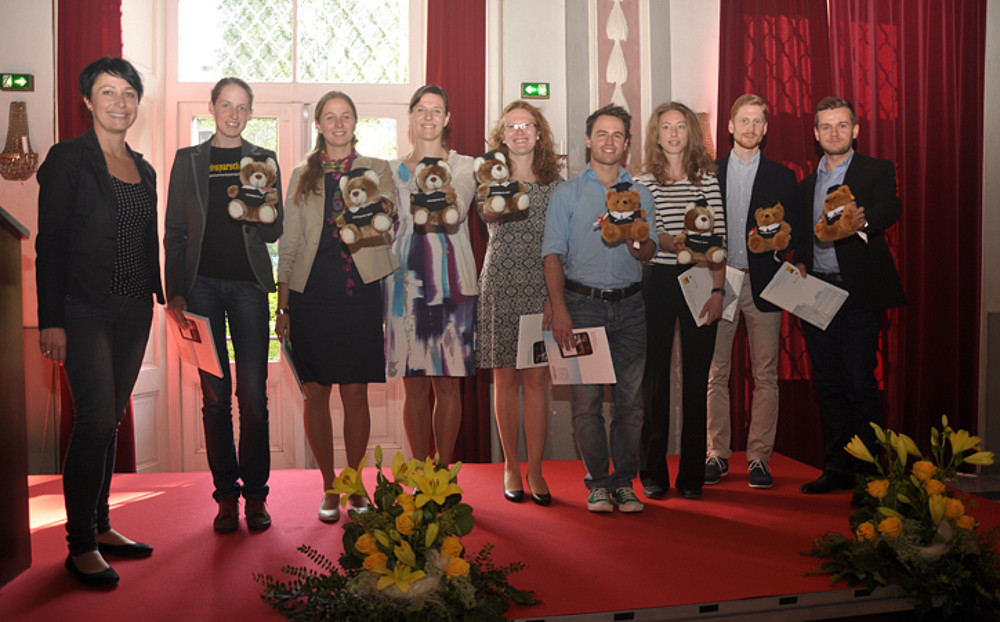
Bürgermeisterstellvertreterin Martina Schröck (ganz links) übergab die Preise für die ausgezeichneten Diplom- und Masterarbeiten an Stefanie Pessenteiner, Elisabeth Grabner, Irene Martina Weiermair, Bettina Theresia Mandl, Michael Bodner, Stefanie Hat

Bürgermeisterstellvertreterin Martina Schröck (ganz links) übergab die Preise für die ausgezeichneten Diplom- und Masterarbeiten an Stefanie Pessenteiner, Elisabeth Grabner, Irene Martina Weiermair, Bettina Theresia Mandl, Michael Bodner, Stefanie Hatzl, Patrick Josef Fasching und Christoph Wenger (v.l.).

Vortrag, Diskussionen und Prämierungen am URBI-Talk

"Fakultätstage sind meist eine sehr offizielle Angelegenheit  - als jüngste Fakultät der Uni Graz wollen wir unseren in diesem Jahr etwas unkonventioneller gestalten", verriet URBI-Dekanin Univ.-Prof. Dr. Barbara Gasteiger-Klicpera bei der Eröffnung des gestrigen "URBI-Talk". Prägnant und schlank präsentierte sich auch das Programm, durch das Univ.-Prof. Dr. Rudolf Egger vom Institut für Erziehungs- und Bildungswissenschaft führte. Martin Polaschek, Vizerektor für Studium und Lehre, unterstrich in seiner Begrüßung die ständig wachsende Zahl der StudienanfängerInnen an der Umwelt-, Regional- und Bildungswissenschaftlichen Fakultät und dankte allen Angehörigen für ihr Engagement.


Als Austauschplattform für WissenschafterInnen, Lehrende und Studierende diente der Nachmittag, an dem zahlreiche VertreterInnen aller Wissenschaftszweige teilnahmen. Das Generalthema lautete "Lehre, Internationalität, Studierende", in das sich auch der Vortrag von Prof. Dr. Markus Weil, Fachhochschule Nordwestschweiz, mit dem Titel "Deutschsprachige und Englischsprachige Studierende - eine didaktische Herausforderung" einreihte. Nach der anschließenden Diskussion folgte die Prämierung ausgezeichneter Diplom- bzw. Masterarbeiten ab dem Studienjahr 2012/2013, die von der Stadt Graz gefördert wurde. Bürgermeisterstellvertreterin Dr. Martina Schröck übergab die Preise an jeweils zwei Studierende pro Wissenschaftszweig:


Erziehungswissenschaft:

Mag. Elisabeth Grabner, Bakk.
Irene Martina Weiermair, MSc


Geographie:

Bettina Theresia Mandl, BSc MSc MSc
Michael Bodner, BSC MSc


Sportwissenschaft:

Patrick Josef Fasching, BSc MSc
Christoph Wenger, BSc MSc


Umweltsystemwissenschaft:

Mag. Stefanie Hatzl, Bakk.
Mag. Stefanie Pessenteiner, Bakk.


created by Gerhild Kastrun

Related news

Preserving knowledge: Book sponsorship success story cracks the 100,000 euro mark

The special collections of Graz University Library comprise around 300,000 valuable objects from the 16th to the 19th century: Papyri, manuscripts, incunabula, maps and printed books. The sensational find from 2023 is also kept here: the Graz Mummy Book, the world's oldest known book fragment in codex form.

Semester abroad without barriers: University of Graz wins award for promoting inclusion

The University of Graz has been awarded the Internationalization Award for its new inclusion initiative. Students with fewer opportunities now also receive financial support for their semester abroad outside Europe.

Fair distribution: Researchers determine just greenhouse gas budgets for all EU regions

Ten years ago, on 12 December 2015, the Paris Climate Agreement was signed at the UN Climate Conference. In order to limit global warming to well below two degrees, only a certain amount of CO2 may be emitted worldwide. While the focus was originally on national emission targets, more than 200 subnational regions and almost 300 cities have now adopted their own targets. But how many emissions are they fairly entitled to? Researchers at the University of Graz have now developed transparent criteria for fair distribution at the subnational level for the first time and determined corresponding greenhouse gas budgets for all European regions. The paper was published today in the scientific journal Nature Communications.

Chemical Christmas show at the University of Graz: An explosive evening at the Schauspielh

At the beginning of December, the University of Graz transformed the theater into a laboratory: as part of “Chemical Life,” teacher training students staged a chemical Christmas show for Styrian school classes—complete with ethanol rockets, nitrogen snow, and glowing effects. An evening designed to inspire interest in studying chemistry.

Begin of page section:
Additional information:

University of Graz
Universitaetsplatz 3
8010 Graz
Austria
  • Contact
  • Web Editors
  • Moodle
  • UNIGRAZonline
  • Imprint
  • Data Protection Declaration
  • Accessibility Declaration
Weatherstation
Uni Graz

End of this page section. Go to overview of page sections

End of this page section. Go to overview of page sections

Begin of page section:

End of this page section. Go to overview of page sections