



Begin of page section:
Page sections:

  • Go to contents (Accesskey 1)
  • Go to position marker (Accesskey 2)
  • Go to main navigation (Accesskey 3)
  • Go to sub navigation (Accesskey 4)
  • Go to additional information (Accesskey 5)
  • Go to page settings (user/language) (Accesskey 8)
  • Go to search (Accesskey 9)

End of this page section. Go to overview of page sections

Begin of page section:
Page settings:

English en
Deutsch de
Search
Login

End of this page section. Go to overview of page sections

Begin of page section:
Search:

Search for details about Uni Graz
Close

End of this page section. Go to overview of page sections


Search

Begin of page section:
Main navigation:

Page navigation:

  • University

    University
    • About the University
    • Organisation
    • Faculties
    • Library
    • Working at University of Graz
    • Campus
    Developing solutions for the world of tomorrow - that is our mission. Our students and our researchers take on the great challenges of society and carry the knowledge out.
  • Research Profile

    Research Profile
    • Our Expertise
    • Research Questions
    • Research Portal
    • Promoting Research
    • Research Transfer
    • Ethics in Research
    • Commission for Scientific Integrity
    Scientific excellence and the courage to break new ground. Research at the University of Graz creates the foundations for making the future worth living.
  • Studies

    Studies
    • Prospective Students
    • Students
  • Community

    Community
    • International
    • Location
    • Research and Business
    • Alumni
    The University of Graz is a hub for international research and brings together scientists and business experts. Moreover, it fosters the exchange and cooperation in study and teaching.
  • Spotlight
Topics
  • Sustainable University
  • Researchers answer
  • Work for us
Close menu

End of this page section. Go to overview of page sections

Begin of page section:
You are here:

University of Graz News Neu gedacht

End of this page section. Go to overview of page sections

Monday, 13 May 2019

Neu gedacht

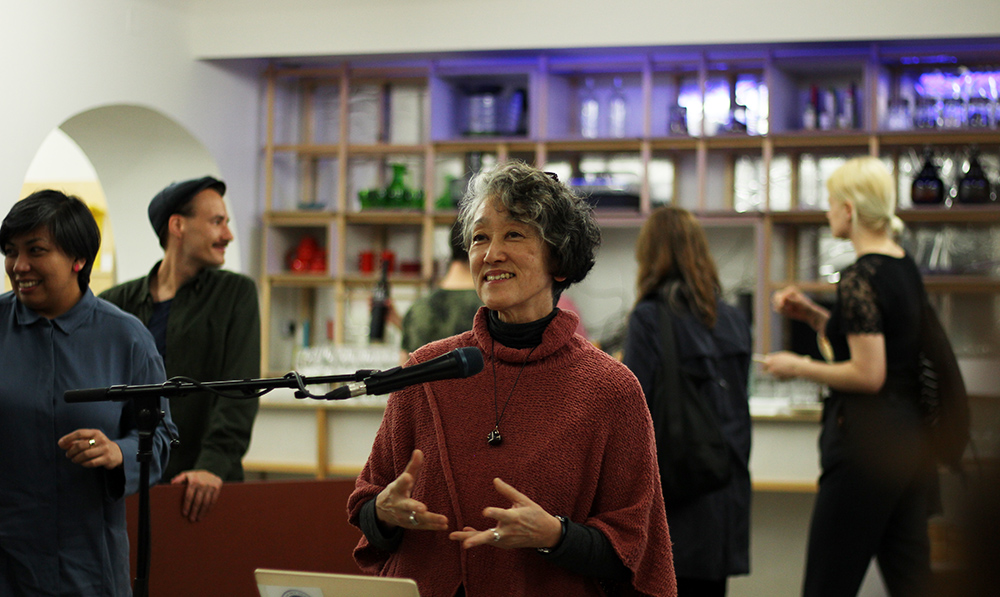
Karen Tei Yamashita, renommierte Schriftstellerin und Professorin an der University of California, referierte in Graz. Foto: Markus Diepold.

Karen Tei Yamashita, renommierte Schriftstellerin und Professorin an der University of California, referierte in Graz. Foto: Markus Diepold.

Tagung untersucht, wie Migration durch Kunst vermittelt wird

Im Rahmen der internationalen Tagung, „Forms of Migration: Literature. Performance. The World“, haben am 2. und 3. Mai 2018 WissenschafterInnen, KünstlerInnen und AktivistInnen aus mehr als zwölf Ländern und fünf Kontinenten künstlerische Positionen zum Thema Migration diskutiert. Die Tagung ist Teil eines vom österreichischen Wissenschaftsfonds FWF finanzierten und in die Arbeitschwerpunkte des Instituts für Amerikanistik der Universität Graz eingebetteten Forschungsprojekts, das zeitgenössische Literatur und deren vielfältige ästhetische Ausdrucksformen zum Thema Migration, Flucht, und Asyl analysiert.

Unter der Leitung von Jennifer Reimer, FWF Lise-Meitner Senior Postdoc Fellow, und Silvia Schultermandl, assoziierte Professorin am Institut für Amerikanistik, wurde mit dieser Tagung der Grundstein für ein Netzwerk von internationalen ExpertInnen rund um das Thema „Forms of Migration“ gelegt. Im Mittelpunkt der Tagung standen künstlerische Positionen, die der Frage nachgehen, wie Migration durch Prozesse der Ästhetisierung vermittelt werden kann. „Phänomene wie der Facebook-Roman und Autobiographien mit mehreren Erzählstimmen verdeutlichen, dass sich Migration nicht in komplexen Handlungsverläufen, sondern auch in innovativen literarischen Ausdrucksformen manifestiert“, erklärt Silvia Schultermandl. In wieweit sich diese Prozesse der Ästhetisierung mit etablierten Kulturtheorien erfassen lassen, war ebenso im Fokus vieler Beträge wie auch die Frage, welche literarischen Gattungen global wie eingesetzt werden, um Fragen von kultureller Zugehörigkeit aufzuwerfen.

Die Tagung bot gleichermaßen Raum für wissenschaftliche Beiträge und künstlerische Positionen. Die Verschränkung der beiden soll auch in Nachfolgeprojekten beibehalten werden. Auch die Themen der Hauptvorträge und deren Referentinnen und Referenten sind hier richtungsweisend:

•    Karen Tei Yamashita, international renommierte Schriftstellerin und Professorin für Literatur an der University of California, reflektierte über das Potential, durch den Einsatz mehrerer Erzählstimmen komplexe gesellschaftliche Dynamiken abzubilden.

•    J. Michael Martinez, international ausgezeichneter Lyriker und Professor an der St. Lawrence University, ging auf die Frage ein, in wieweit AutorInnen mit Migrationerfahrung wegen ihres kulturellen Anders-seins und in wieweit sie wegen ihrer poetischen Ausdrucksformen rezipiert werden.

•    David Savran, Professor an der City University of New York und Jurymitglied für den Pulitzer-Preis für Theater, analysierte die kulturelle Mobilität des Broadway Musicals.

Ausklang fand die Veranstaltung bei einem Lese- und Performance Abend im Grazer Kunstverein, wo neben Karen Tei Yamashita und J. Michael Martinez auch die Dramatikerin Teresa Veramendi (USA/Spanien) aus ihren rezenten Werken las und das Künstlerduo Gregory Carlock (USA/Berlin/Syrien) und Stefan Maneval (Berlin) eine multimediale Performance des Gedichts „To A Syrian Prisoner of Conscience“ vorstellten. Am Tag nach der Tagung leiteten J.Michael Martinez und Jennifer Reimer eine Schreibwerkstatt, in der neue Textentwürfe abgeleitet aus dem Tagungsthema entstanden.

Weitere Einblicke in die Tagung gibt es auf Twitter, Facebook und der Tagungshomepage: https://formsofmigration.uni-graz.at/en/

 

created by Silvia Schultermandl & Gerhild Leljak

Related news

Higher Education Strategy 2040: Austria’s universities on course for the future

Austria has 77 higher education institutions, which is above the EU average – but does this really make sense? The new Higher Education Strategy 2040 focuses on cooperation rather than mergers. As one of the six largest universities in Austria, the University of Graz plays a central role in this.

Climate research in Greenland: Old data provides new insights

The polar explorer and University of Graz professor Alfred Wegener left behind a unique collection of climate data from Greenland. A research team from the University of Graz is now analysing this 100-year-old treasure trove of data and comparing it with current measurements.

Diversity in nature and science: How we talk about plants and each other

Ginkgo, kiwi, hemp: they exist as male and female plants. Anyone who paid attention in biology class will confirm this. But is this categorisation, established by Carl von Linné almost 300 years ago, still valid today? An interdisciplinary team at the University of Graz is questioning these attributions and using this as a starting point to provide food for thought for gender-sensitive interaction between students, scientific and teaching staff.

Around the world in eight stops: the Long Night of Research at the University of Graz

On 24 April from 5 pm, you can take a short trip around the globe at the University of Graz, discovering pecularities of foreign countries or new local features in the entrance hall of the University Library. The itinerary takes you through introduced animal species, political attitudes and the omnipotence of algorithms. There will also be a programme in the historic reading hall, as well as at the UniGraz@Museum and the University Archive.

Begin of page section:
Additional information:

University of Graz
Universitaetsplatz 3
8010 Graz
Austria
  • Contact
  • Web Editors
  • Moodle
  • UNIGRAZonline
  • Imprint
  • Data Protection Declaration
  • Accessibility Declaration
Weatherstation
Uni Graz

End of this page section. Go to overview of page sections

End of this page section. Go to overview of page sections

Begin of page section:

End of this page section. Go to overview of page sections

