



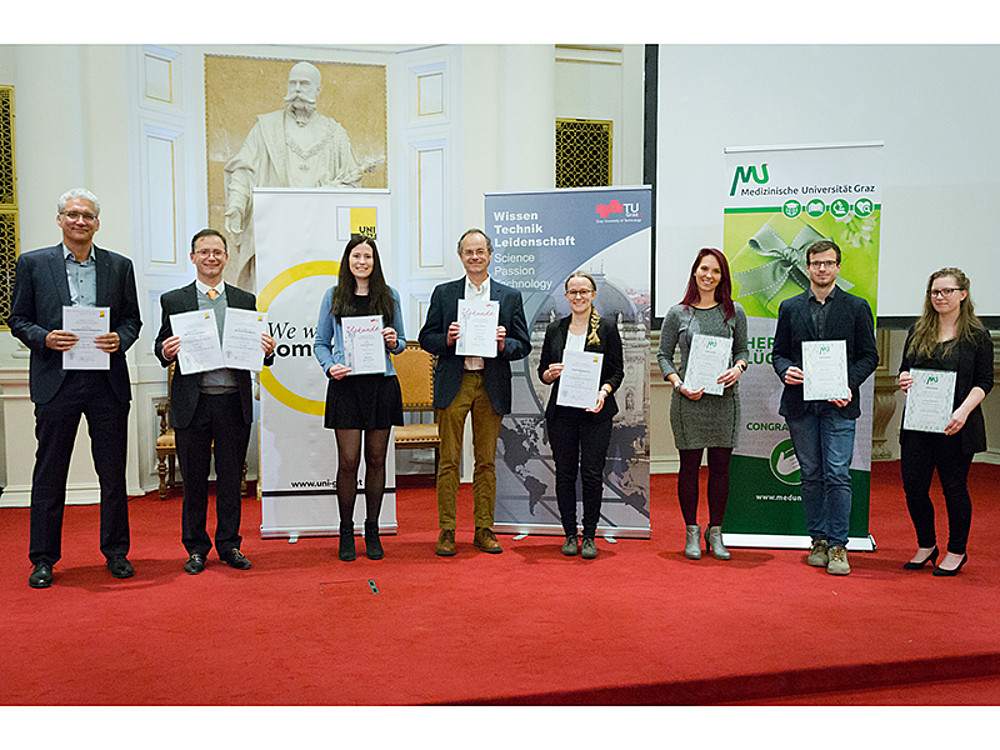
Universitäre Forschung ist Impulsgeber für Innovationen. Seit 2015 würdigen die Universität Graz, die Medizinische Universität Graz und die Technische Universität Graz alle zwei Jahre WissenschafterInnen aus ihrem Hause, die auf Basis vielversprechender neuer Erkenntnisse den Weg in Richtung Anwendung eingeschlagen haben. Am 9. November 2021 wurden in der Aula der Uni Graz unter Einhaltung der geltenden Sicherheitsmaßnahmen ForscherInnen der drei Universitäten für ihre Erfindungen geehrt. 125 der insgesamt 239 Eingeladenen waren anwesend. Um den Forschungs- und Technologietransfer zu fördern, unterstützen ExpertInnen an allen drei Institutionen WissenschafterInnen bei der Verwertung ihrer Ergebnisse. 146 Erfindungsmeldungen und 100 Patentanmeldungen haben sie seit Juli 2019 verzeichnet.
Harald Kainz (Rektor der TU Graz), Martin Polaschek (Rektor der Uni Graz) und Hellmut Samonigg (Rektor der Med Uni Graz) unterstrichen in ihren Grußworten die Bedeutung der Universitäten für den Wissenschafts- und Wirtschaftsstandort Steiermark: „An Erfindungen und Patenten lässt sich die Innovationskraft der Forschung messen. Über Kooperationen verschafft sie ansässigen Unternehmen einen Wettbewerbsvorteil. Neue Anwendungen und Technologien treiben den Fortschritt weiter voran und kommen der Gesellschaft auf vielfältige Weise zugute.“
Vorzeigeprojekte
Als Beispiele für den gelungenen Transfer von der Wissenschaft zur Innovation präsentierten ForscherInnen jeder Universität jeweils ein besonders erfolgreiches Projekt:
Robert Zimmermann und sein Team vom Institut für Molekulare Biowissenschaften der Uni Graz entwickeln Hemmstoffe für ein von ihnen neu entdecktes Enzym namens ATGL zur Anwendung in Medikamenten. Diese sollen künftig etwa zur Behandlung von Herzinsuffizienz und Fettlebererkrankung eingesetzt werden. Mit dem Translational Research Center „wings4innovation“ ist ein potenter Kooperationspartner an Bord. Außerdem arbeitet die Universität Graz bei diesen Forschungen mit der TU Graz zusammen.
An der Medizinischen Universität Graz haben Christian Hill, Gerhard Prossliner und ihr Team im Rahmen des Projekts „Light Matters“ die nun patentierte „Opto Fluidic Force Induction-Technologie“ (kurz OF2i®) entwickelt, um die Konzentration, Größe und Form von Nanopartikeln in Flüssigkeiten zu bestimmen. Daraus ist das Start-up BRAVE Analytics entstanden, das sich der Weiterentwicklung der Technologie bzw. der Entwicklung von Sensoren zur Charakterisierung der Nanopartikel widmet.
Die Efficient Energy Technology GmbH (EET) ist ein Spin-off der TU Graz, gegründet von Christoph Grimmer. Aus seiner Messtechnik-Erfindung wurde das Produkt SOLMATE, mit dem jede und jeder am Balkon eigenen Strom produzieren und diesen netzunabhängig speichern und verbrauchen kann.
Verleihung der Nikola-Tesla-Medaille
Im Rahmen der Veranstaltung wurde Anton Glieder vom Institut für Molekulare Biotechnologie der TU Graz mit der Nikola-Tesla-Medaille gewürdigt. Die Auszeichnung ist benannt nach dem genialen Erfinder, der an der Technischen Universität Graz studierte, und wird für besonders herausragende, anwendungsnahe Forschungsleistungen an jene Person der TU Graz verliehen, für deren Erfindungen in den vergangenen fünf Jahren die meisten Patente erteilt wurden.
Glieder konnte im Zeitraum von 2016 bis 2020 sieben weltweite Patente für chemische und biotechnologische Innovationen verbuchen. Seine Entwicklungen werden von Firmen aus verschiedensten Branchen genutzt, wie er beispielhaft erklärt: „Menschen, die schon einmal Medikamente zur Prävention eines Herzinfarkts oder Schlaganfalls eingenommen haben, sind mit unseren Patenten genauso in Berührung gekommen wie jene, die mit dem Auto unterwegs sind oder Biotreibstoff tanken.“ Der Biotechnologe ist nach Dieter Schmalstieg (Institut für Maschinelles Sehen und Darstellen, 2017) und Gernot Kubin (Institut für Signalverarbeitung und Sprachkommunikation, 2015) der dritte Preisträger, der die Nikola-Tesla-Medaille erhalten hat.
Für ihre Erfindungen der letzten zwei Jahre wurden folgende WissenschafterInnen geehrt:
Universität Graz
Anastasiia AFANASENKO, Katalin BARTA WEISSERT, Sarah BIERBAUMER, David CANTILLO, Didac CARMONA-GUTIERREZ, Bálint FRIDRICH, Walter GÖSSLER, Karl GRUBER, Manfred HARTBAUER, Markus HOCHEGGER, Sebastian HOFER, Michael HOFFELNER, Valentina JURKAŠ, Katharina KAINZ, C. Oliver KAPPE, Konstantinos KOSTARAKOS, Wolfgang KROUTIL, Andreas KUNGL, Frank MADEO, Patrick MISKULNIG, Lía MARTÍNEZ MONTERO, Eva ROBLEGG, Jörg SCHRITTWIESER, Werner SEEBACHER, Florian WEISSENSTEINER, Christoph WINKLER, Andreas ZIMMER, Andreas ZIMMERMANN
Med Uni Graz
Mahmoud ABDELLATIF, Benjamin BOURGEOIS, Nicole GOLOB-SCHWARZL, Ellen HEITZER, Christian HILL, Angela HORVATH, Tobias MADL, Gernot PLANK, Markus PLASS, Gerhard PROSSLINER, Robert REIHS, Julia RIEGER, Ingo RUSS, Reinhold SCHMIDT, Daniel SCHNEDITZ, Simon SEDEJ, Michael SPEICHER, Emil SPREITZER, Vanessa STADLBAUER-KÖLLNER, Ivo STEINMETZ, Peter ULZ, Lisa-Marie WAGENTHALER, Gabriel WAGNER-LICHTENEGGER, Peter WOLF, Kurt ZATLOUKAL
TU Graz
Qamar ABBAS, Taler ABU ALI, Taher ABU ALI, Mohammad Reza AHMADI, Luigi AIELLO, Raimund ALMBAUER, Clemens ARTH, Patrick ASCHAUER, Michael BADER, Markus BAINSCHAB, Wolfgang BAUER, Georg BAUMANN, Christian BAUMGARTNER, Thomas BENNINGER, Alexander BERGMANN, Martin BLODER, Sergey BORISOV, Rolf BREINBAUER, Günter BRENN, Gottfried BRUNBAUER, Helmut BRUNNER, Armin BUCHROITHNER, Max BURIAN, Elia CALDERINI, Viktor-Stavros CHRISTOPOULOS, Anna Maria COCLITE, Cyrill GRENGG, Sergio DE TRAGLIA AMANCIO FILHO, Jürgen DOBAJ, Ivana DRIENOVSKA, Rene ECKHART, Jörg EDLER, Pedro EFFERTZ, Andreas EGGER, Melissa EGGER, Bernd EICHBERGER, Philipp Simon EISELE, Christian ELLERSDORFER, Martin ERKINGER, Sara FATHOLLAHI, Florian FEIST, Lothar FICKERT, Peter FISCHER, Friedrich FRAUNDORFER, Stefan FREUNBERGER, Bernhard FREYTAG, Alexander FUCHS, Daniel FÜRHAPTER, Michael Ernst GADRINGER, Georg GESCHEIDT-DEMNER, Tobija Sören GLAWOGGER, Anton GLIEDER, Annika GRAFSCHAFTER, Matthias GREINER, Andreas GRUBERBAUER, Gregor GSTREIN, Nikolaus GUTTENBERGER, Franz HAAS, Michael HAMPALI, Shreyas HAMAPLI SHIVAKUMAR, Thomas HARTER, Christoph HEIL, Hannes HINTERBICHLER, Ulrich HIRN, Mario HIRZ, Mathias HOBISCH, Christoph HOCHENAUER, Christian HOLLY, Michael Peter HUBER, Stephan Anton JANDL, Lukas JANTSCHER, Joachim JUHART, Johannes KHINAST, Thomas KICKENWEIZ, Marlene KIENBERGER, Roland KIRCHBERGER, Ingo KLIMANT, Desiree KOFLER, Samir KOPACIC, Robert KOURIST, Georgi KOVACHEV, Markus KRÜGER, Gernot KUBIN, Eric KURZ, Lukas LADENSTEIN, Mike Alexander LAGLER, Christian LANDSCHÜTZER, Michael LANG, Stefan LEITNER, Vincent LEPETIT, Werner LIENHART, Christiane LULEY, Susanne LUX, Georg MACHER, Daniel MANDLEZ, Roman MARTE, Elmar MESSNER, Michael MICHELITSCH, Anna Katharina MIGGLAUTSCH-SULZER, Florian MITTERMAYR, Daniel MLAKAR, Christoph MONSBERGER, Christian MOSER, Eléonore MOURAD, Bernhard MÜLLER, Mario MÜLLER, Demin NALIC, Robert NEUBAUER, Viet Tue NGUYEN, Bernd NIDETZKY, Kay Domenico NOVAK, Franz PERNKOPF, Jesus PESTANA PUERTA, David PFEIFER, Martin PHILIPP, Harald PICHLER, Thomas PICHLER, Ingo Hans PILL, Julian PILZ, Goncalo Filipe PINA CIPRIANO, Carole PLANCHETTE, Harald PLANK, Christian PREHAL, Rupert PRESSMAIR, Jakob PUSTERHOFER, Mahdi RAD, Stefan RADL, Tanja RAPPITSCH, Thomas RATH, Matthias Julian REBHAN, Markus REICHHARTINGER, Christoph REISINGER, Felix RESSI, Daniel RETTENWANDER, Martin RIEGER, Johanna ROCK, Bernhard ROSSEGGER, Wolfgang ROTH, Georg RUDELSTORFER, Ognjen RUDIC, Jürgen SATTELKOW, Thornthan SAWANGWAN, Michael SCHEDLER, Werner SCHLEMMER, Max SCHMALLEGGER, Dieter SCHMALSTIEG, Johannes SCHMID, Thomas SCHMID, Alexander SCHOSSMANN, Helmut SCHREIBER, Jörg SCHRÖTTNER, Robert SCHÜRHUBER, Helmut SCHWAB, Wolfgang SINZ, Mateusz SKALON, Lutz SPAROWITZ, Stefan SPIRK, Pascal STADLBAUER, Stefan STADLBAUER, Eduard STADLER, Christoph STAUDINGER, Markus STEINBERGER, Sinisa STEKOVIC, Harald STÜGER, Lukas STURMBERGER, Wolfgang TATZGERN, Martin TAZREITER, Mario THEISSL, Stefan TRABESINGER, Lukas TRIBUSER, Gregor TRIMMEL, Franz TSCHUCHNIGG, Frank UHLIG, Birgit UNGERBÖCK, Thomas VOGL, Philip VOGLREITER, Michael VORDERDERFLER, Bernhard WALZEL, Astrid WENINGER, Tanja WIESNER, Madeleine WINKLER, Robert WINKLER, Franz WOTAWA, Angelika Michaela ZACHL



