Begin of page section:
Page sections:

  • Go to contents (Accesskey 1)
  • Go to position marker (Accesskey 2)
  • Go to main navigation (Accesskey 3)
  • Go to sub navigation (Accesskey 4)
  • Go to additional information (Accesskey 5)
  • Go to page settings (user/language) (Accesskey 8)
  • Go to search (Accesskey 9)

End of this page section. Go to overview of page sections

Begin of page section:
Page settings:

English en
Deutsch de
Search
Login

End of this page section. Go to overview of page sections

Begin of page section:
Search:

Search for details about Uni Graz
Close

End of this page section. Go to overview of page sections


Search

Begin of page section:
Main navigation:

Page navigation:

  • University

    University
    • About the University
    • Organisation
    • Faculties
    • Library
    • Working at University of Graz
    • Campus
    Developing solutions for the world of tomorrow - that is our mission. Our students and our researchers take on the great challenges of society and carry the knowledge out.
  • Research Profile

    Research Profile
    • Our Expertise
    • Research Questions
    • Research Portal
    • Promoting Research
    • Research Transfer
    • Ethics in Research
    Scientific excellence and the courage to break new ground. Research at the University of Graz creates the foundations for making the future worth living.
  • Studies

    Studies
    • Prospective Students
    • Students
  • Community

    Community
    • International
    • Location
    • Research and Business
    • Alumni
    The University of Graz is a hub for international research and brings together scientists and business experts. Moreover, it fosters the exchange and cooperation in study and teaching.
  • Spotlight
Topics
  • Our digital Advent calendar
  • Sustainable University
  • Researchers answer
  • Work for us
Close menu

End of this page section. Go to overview of page sections

Begin of page section:
You are here:

University of Graz News Innovation im Fluss

End of this page section. Go to overview of page sections

Monday, 22 October 2018

Innovation im Fluss
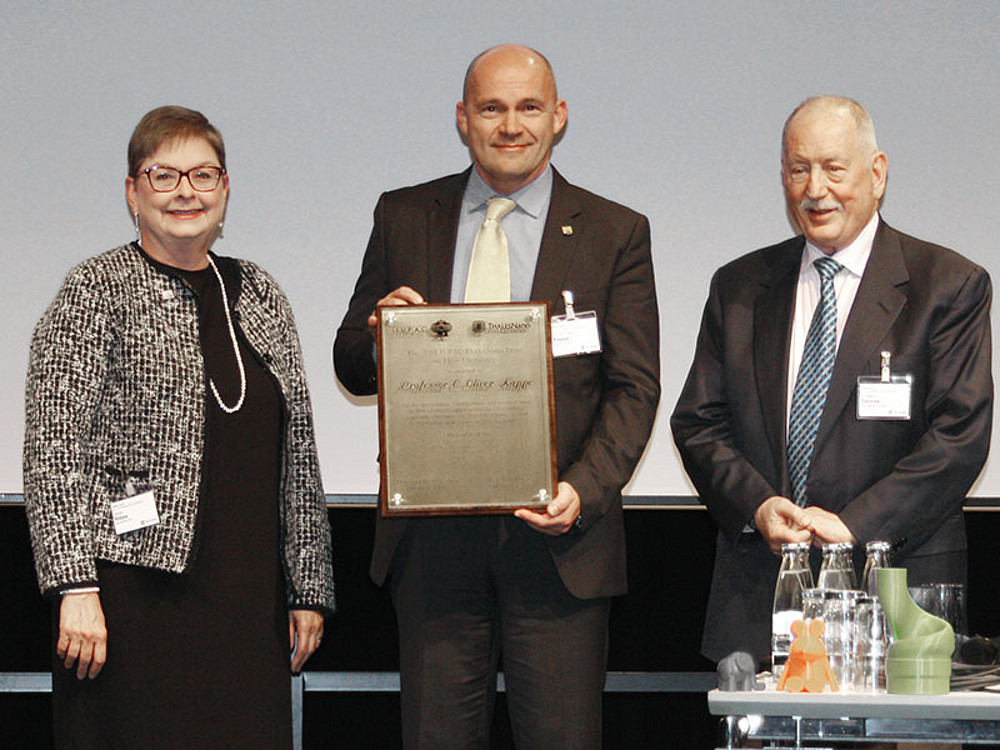
Carolyn Ribes von der IUPAC und Ferenc Darvas, Vorsitzender der ThalesNano and Flow Chemistry Society (r.), überreichten C. Oliver Kappe in Karlsruhe den IUPAC-ThalesNano Prize for Flow Chemistry. Foto: IUPAC

Carolyn Ribes von der IUPAC und Ferenc Darvas, Vorsitzender der ThalesNano and Flow Chemistry Society (r.), überreichten C. Oliver Kappe in Karlsruhe den IUPAC-ThalesNano Prize for Flow Chemistry. Foto: IUPAC

Oliver Kappe erhält internationale Auszeichnung für seine herausragenden Leistungen in der Flow-Chemie

Mit seinen Arbeiten in der Flow-Chemie zählt C. Oliver Kappe international zu den führenden WissenschafterInnen auf diesem Gebiet. Dafür hat die International Union of Pure and Applied Chemistry (IUPAC) dem Forscher der Universität Graz den ThalesNano-Preis 2018 verliehen. Die mit 10 000 US Dollar, knapp 8 700 Euro, dotierte Auszeichnung wurde Kappe am 21. Oktober bei der International Conference on Micro Reaction Technology (IMRET) in Karlsruhe überreicht.

Die Flow-Chemie ist ein Synthese-Verfahren, das im Vergleich zu herkömmlichen Methoden Zeit und Kosten spart und darüber hinaus auch umweltfreundlicher ist. Die für eine chemische Synthese benötigten Substanzen werden durch Reaktionskammern im Milliliterbereich gepumpt, in denen die einzelnen Prozesse kontinuierlich nacheinander ablaufen. Extreme Temperatur- und Druckbedingungen beschleunigen die Reaktionen, und zwischen den einzelnen Schritten fallen keine Abfallprodukte an.

C. Oliver Kappe ist Professor für Chemie an der Universität Graz und wissenschaftlicher Leiter des Center for Continuous Flow Synthesis and Processing (CC FLOW) am Research Center Pharmaceutical Engineering GmbH (RCPE). Der IUPAC-ThalesNano-Preis würdigt Kappes außerordentlich großen Beitrag zur Entwicklung der Flow-Chemie sowie dazu, dass kontinuierliche Verfahren weltweit Anwendung in der Feinchemie und Pharma-Industrie finden.
Kappe ist seit 2010 Vorstandsmitglied der Flow Chemistry Society und Chefredakteur des Journal of Flow Chemistry, das er 2011 begründete. Pionierarbeit leistete der Forscher zuvor auch in der Mikrowellen-Chemie.

Als Träger des Preises, der vom ungarischen Technologie-Unternehmen ThalesNano gestiftet und heuer zum vierten Mal verliehen wurde, ist Kappe der erste Forscher im deutschsprachigen Raum, der diese Auszeichnung erhielt, nach Kollegen des MIT/USA, der University of Cambridge/UK und der TU Eindhoven/NL.

created by Gudrun Pichler

Related news

Semester abroad without barriers: University of Graz wins award for promoting inclusion

The University of Graz has been awarded the Internationalization Award for its new inclusion initiative. Students with fewer opportunities now also receive financial support for their semester abroad outside Europe.

Fair distribution: Researchers determine just greenhouse gas budgets for all EU regions

Ten years ago, on 12 December 2015, the Paris Climate Agreement was signed at the UN Climate Conference. In order to limit global warming to well below two degrees, only a certain amount of CO2 may be emitted worldwide. While the focus was originally on national emission targets, more than 200 subnational regions and almost 300 cities have now adopted their own targets. But how many emissions are they fairly entitled to? Researchers at the University of Graz have now developed transparent criteria for fair distribution at the subnational level for the first time and determined corresponding greenhouse gas budgets for all European regions. The paper was published today in the scientific journal Nature Communications.

Chemical Christmas show at the University of Graz: An explosive evening at the Schauspielh

At the beginning of December, the University of Graz transformed the theater into a laboratory: as part of “Chemical Life,” teacher training students staged a chemical Christmas show for Styrian school classes—complete with ethanol rockets, nitrogen snow, and glowing effects. An evening designed to inspire interest in studying chemistry.

Train by train: Koralm railway accelerates exchange between the Universities

Lectures at the University of Klagenfurt in the morning, seminars at the University of Graz in the afternoon: Austria's longest tunnel and a journey time of around 45 minutes make it easy. The Koralm railway increases the speed of networking between the two university locations. The collaboration builds on existing cooperation - for example in the areas of teacher training, Slavic studies and as employers, the universities are well coordinated.

Begin of page section:
Additional information:

University of Graz
Universitaetsplatz 3
8010 Graz
Austria
  • Contact
  • Web Editors
  • Moodle
  • UNIGRAZonline
  • Imprint
  • Data Protection Declaration
  • Accessibility Declaration
Weatherstation
Uni Graz

End of this page section. Go to overview of page sections

End of this page section. Go to overview of page sections

Begin of page section:

End of this page section. Go to overview of page sections