iHub Graz aims to guide academic spin-offs into the next stage of funding, bridge the gap between spin-off and the entry of venture capitalists, and raise the profile of promising Graz-based spin-offs among international investors.
iHub: At the forefront of the existing innovation and technology transfer system
iHub has been deliberately conceived as a focal point in Graz’s established innovation ecosystem. It picks up where research ideas have already given rise to initial entrepreneurial initiatives – for example, following programmes such as the Start-up Garage, which supports students and researchers in their start-up ventures at an early stage, and incubation facilities such as Science Park Graz or Unicorn Graz, which support start-ups emerging from the university environment. The aim is to bring together the best university start-ups into iHub and to prepare them specifically for investment.
iHub marks the first time a shared, clearly visible interface to the outside world has been created. In future, investors and other external partners will no longer negotiate with individual universities, but with a central body. At the same time, close links with the universities are maintained. Clear feedback mechanisms to all three organisations are planned.
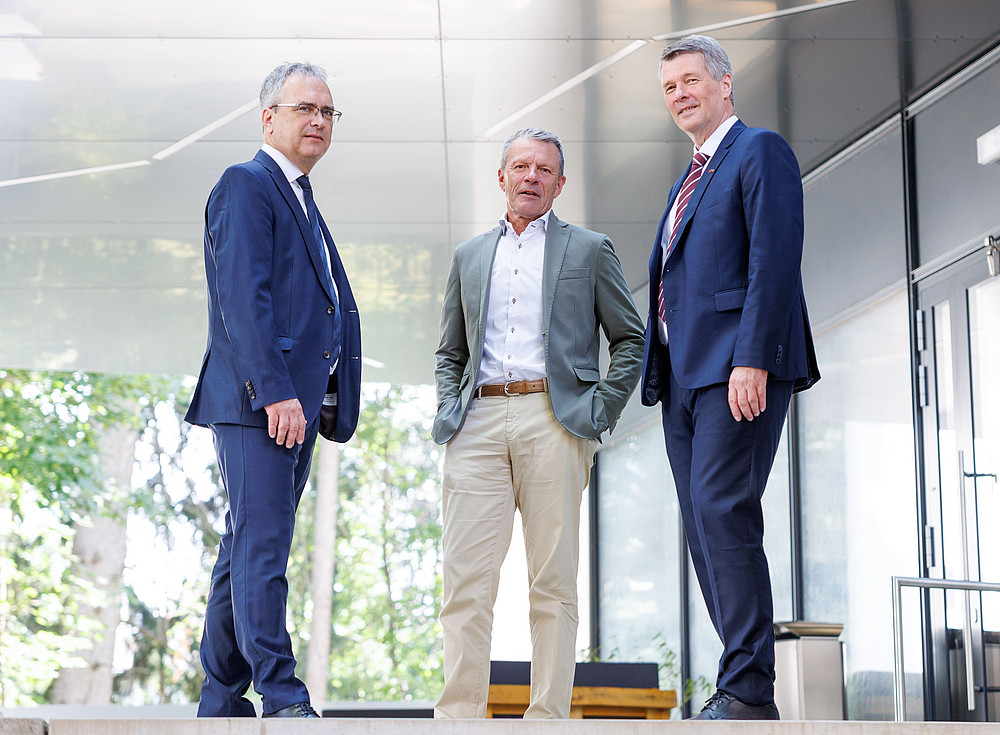
“Through iHub, we, the universities of Graz, are making a joint commitment. We will bring the best ideas to market more quickly, pool resources, offer investors a single point of contact based on the “one-stop shop” principle, and enhance investment readiness – with a clear-cut impact on society, the economy and the region. “Results are our yardstick – not areas of responsibility,” said Horst Bischof, Rector of Graz University of Technology (TU Graz), Peter Riedler, Rector of the University of Graz, and Alexander Rosenkranz, Vice-Rector of the Medical University of Graz, with one voice.
Start-up phase, funding and leadership
The roll-out of iHub is now beginning with a defined initial phase. The three universities each hold a one-third stake in the transfer company and are providing iHub with around six million euros over the next seven years to enable it to quickly develop into a fully operational organisation. At the same time, the position of managing director is being advertised internationally. We are looking for an individual with proven experience in setting up similar innovation and technology transfer centres, who will strategically develop the innovation hub in its early years, regardless of short-term funding debates.
“With iHub a central platform will be created for academic spin-offs, offering professional IP and investment management, well-defined processes and direct access to funding bodies, infrastructure and investor networks. Our unambiguous objective is a seamless transition from funding to participation and financing, thereby generating greater value from our research. At a time when universities are facing an increasingly tight budgetary situation, we expect to see a commensurate return on investment in a few years’ time,” the university management teams said in a statement.
On the path to venture capital
iHub is adopting a streamlined structure with a management team that is highly effective in operational terms. At the universities themselves, there are scouts who identify high-potential projects and spin-offs at an early stage and prepare them for transfer to the technology transfer company in accordance with defined criteria such as IP maturity, staffing structure or market potential. The Innovation Hub supports qualified spin-offs as they develop, providing mentoring and professional IP management on behalf of the universities. Shortly before or after the company is founded, the transfer company raises capital from funding and partner sources, enabling spin-offs to continue operating for 12 to 18 months until venture capitalists come on board. After that, the transfer company will withdraw from day-to-day operations but will remain involved as a passive shareholder. The advantage is that, thanks to this combined support and standardised processes, the spin-offs’ negotiating positions with venture capitalists are strengthened, leading to better terms and valuations.
Great potential among spin-offs from the three universities in Graz
For the three universities in Graz, the start-up culture has become a key driver of innovation, and iHub is intended to further strengthen this momentum. The start-ups emerging from the three universities are proof that the Styrian innovation ecosystem is working. Over the past ten years, they have produced around 200 spin-offs, which create highly skilled jobs and bring research findings to market quickly. Particularly strong sectors include life sciences and medtech (e.g. Innophore, PureSurf, Cycuria, BRAVE Analytics, elyte diagnostics, smaXtec), AI and cybersecurity (e.g. TACEO, Leftshift One), and green tech (e.g. Easelink, ProtectLIB).
Fresh capital for innovative start-ups
The State’s Department of Economic Affairs and Raiffeisen Landesbank Steiermark are supporting Styrian start-ups with their own capital initiative. A total of ten million euros is available to help start-ups grow. The initiative is aimed at start-ups and scale-ups that are less than 10 years old, have successfully demonstrated ‘proof of market’ or are already on a growth trajectory.
So whilst iHub Graz guides promising academic spin-offs from Graz’s three universities to investment readiness, this latest capital initiative by the State of Styria, in partnership with the bank, complements this by providing targeted funding for the growth phase – funding that is ideally suited to the growth of the companies at iHub Graz.
Significant impact on the local area
iHub Graz will help retain start-ups in Graz’s innovation ecosystem and create further jobs in the region. At the same time, through iHub, the Medical University of Graz, TU Graz and the University of Graz are establishing Styria as a serious venture capital hub for deep tech and life sciences in the international venture capital community.
Once again, the universities in Graz are demonstrating their strength and innovative power as lying in their culture of collaboration. They do not operate as isolated units, but as a coordinated structure with distinct profiles and shared development goals. Partnerships such as BioTechMed-Graz and NAWI Graz are further examples of successful collaborative models in Graz. This benefits not only the universities themselves but also the local area.
The University of Graz, TU Graz and the Med Uni Graz are already collaborating as ‘BioTechMed-Graz’
Since 2013, the BioTechMed-Graz research collaboration has been bringing together cutting-edge biomedical research from the University of Graz, TU Graz and the Med Uni Graz at the interface between basic research, technology and medical applications. The focus is on joint research into key health issues, the promotion of early-career researchers and the shared use of research infrastructure. Furthermore, BioTechMed-Graz strengthens the exchange between science and society through networking initiatives and public events.