Begin of page section:
Page sections:

  • Go to contents (Accesskey 1)
  • Go to position marker (Accesskey 2)
  • Go to main navigation (Accesskey 3)
  • Go to sub navigation (Accesskey 4)
  • Go to additional information (Accesskey 5)
  • Go to page settings (user/language) (Accesskey 8)
  • Go to search (Accesskey 9)

End of this page section. Go to overview of page sections

Begin of page section:
Page settings:

English en
Deutsch de
Search
Login

End of this page section. Go to overview of page sections

Begin of page section:
Search:

Search for details about Uni Graz
Close

End of this page section. Go to overview of page sections


Search

Begin of page section:
Main navigation:

Page navigation:

  • University

    University
    • About the University
    • Organisation
    • Faculties
    • Library
    • Working at University of Graz
    • Campus
    Developing solutions for the world of tomorrow - that is our mission. Our students and our researchers take on the great challenges of society and carry the knowledge out.
  • Research Profile

    Research Profile
    • Our Expertise
    • Research Questions
    • Research Portal
    • Promoting Research
    • Research Transfer
    • Ethics in Research
    • Commission for Scientific Integrity
    Scientific excellence and the courage to break new ground. Research at the University of Graz creates the foundations for making the future worth living.
  • Studies

    Studies
    • Prospective Students
    • Students
    • Welcome Weeks for First Year Students
  • Community

    Community
    • International
    • Location
    • Research and Business
    • Alumni
    The University of Graz is a hub for international research and brings together scientists and business experts. Moreover, it fosters the exchange and cooperation in study and teaching.
Topics
  • Sustainable University
  • Researchers answer
  • Work for us
Close menu

End of this page section. Go to overview of page sections

Begin of page section:
You are here:

University of Graz News In Bewegung

End of this page section. Go to overview of page sections

Friday, 22 May 2015

In Bewegung

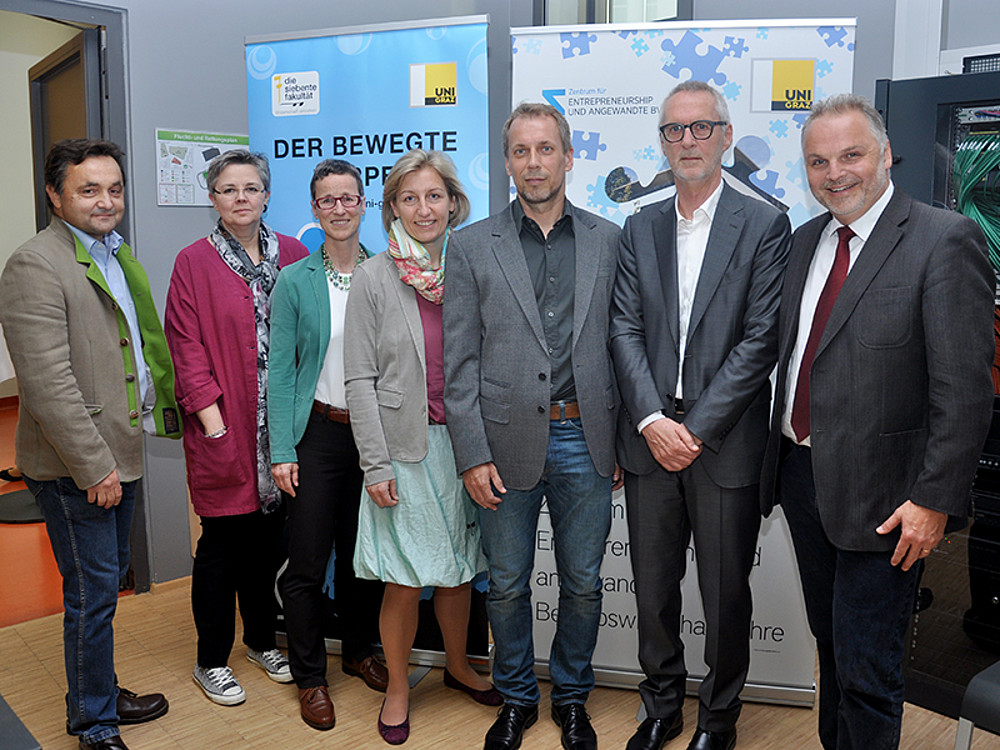
Symbiose von Sport, Gesellschaft und Politik: Alfred Gutschelhofer, Vizerektorin Renate Dworczak, Sylvia Titze, Kristina Edlinger-Ploder, Gerhard Tschakert, Kurt Völkl und Gernot Brunner (v.l.) Foto: Uni Graz/Schweiger

Symbiose von Sport, Gesellschaft und Politik: Alfred Gutschelhofer, Vizerektorin Renate Dworczak, Sylvia Titze, Kristina Edlinger-Ploder, Gerhard Tschakert, Kurt Völkl und Gernot Brunner (v.l.) Foto: Uni Graz/Schweiger

Gesellschaft krankt am ungesunden System: Grazer Wirtschaftsgespräche

Public Health zählt aktuell zu den Top-Themen unserer Gesellschaft. Wie es um die Volksgesundheit bestellt? Wie krank ist das System? Und was jeder selbst dafür tun? Diesen und weiteren Fragen ging im Rahmen der Uni-Graz-Reihe „Grazer Wirtschaftsgespräche“ am 19. Mai 2015 ein prominent besetztes Podium nach.

Gastgeber und Wirtschaftswissenschafter Alfred Gutschelhofer zeigte zu Beginn den Zwiespalt auf: „Einerseits will unsere Gesellschaft mündige Menschen mit Eigenverantwortung fürs eigene Leben, andererseits wird schnell der Ruf nach politische Verantwortung laut.“
Sylvia Titze, Sportwissenschafterin an der Uni Graz, wies vor allem auf den Unterschied von drei oft vermischten Begriffen Sport, Training und Bewegung hin. 150 Minuten pro Woche mit mittlerer Intensität oder 75 Minuten mit höherer Intensität – so lautet die österreichische Bewegungsempfehlung. „Wichtig ist es sich selbst zu beobachten, um sein Verhalten zu ändern und zu schauen welche Bewegung macht Spaß“, appellierte Titze.
Viele positive Effekte von körperlicher Aktivität führte Sportwissenschafter-Kollege Gerhard Tschakert ins Treffen: „Es wird zum Beispiel Insulin-Resistenz reduziert und die Entstehung von Tumoren verringert.“ Vor allem kurze Intervalle mit hoher Belastung hätten einen hohen Wirkungsgrad gezeigt.
„Wenn man das Verhalten beeinflussen will, muss man die Menschen in kleinen Schritten zur Änderung bringen“, betonte Gernot Brunner, ärztlicher Direktor des LKH-Univ.-Klinikum Graz. Der Mediziner bestätigte zugleich einen Wandel im System, in dem der Patient zur Gesundung selbst viel beitragen könne.

Kristina Edlinger-Ploder, Vizerektorin der Med Uni Graz und langjährige Gesundheitspolitikerin, erklärte das Versorgungssystem mit der langen Tradition des Siechentums: „Österreich ist nach wie vor Weltmeister in der stationären Behandlung. Das wird jedoch unserer heutigen Gesellschaft nicht mehr gerecht.“ Sie bestätigte zudem den Zusammenhang zwischen Bildung und Gesundheit.
Den mit elf Prozent des BIP hohen Anteil an Ausgaben für Gesundheit hob Kurt Völkl, Generaldirektor der Versicherungsanstalt für Eisenbahn und Bergbau, hervor: „Wir müssen vor allem bei den gesunden Lebensjahren im Alter enorm aufholen. In Österreich liegt der Schnitt unter 60 Jahre.“

Nächste Ausgabe mit Peter Filzmaier

In der nächsten Ausgabe der „Grazer Wirtschaftsgespräche“ ist Politikwissenschafter Peter Filzmaier zu Gast. Er wird aus aktuellem Anlass die Ergebnisse, Wählerströme und Motive der steirischen Landtagswahl analysieren.
WANN: Dienstag, 1. Juni 2015, 16 Uhr
WO: RESOWI Zentrum, SZ 15.22, Bauteil G, 2. Stock, Universitätsstraße 15, 8010 Graz

Der Eintritt ist frei, um Anmeldung wird gebeten:
E-Mail: entrepreneurship(at)uni-graz.at
Tel.: 0316 380-7351


created by Andreas Schweiger

Related news

Jurassic Sounds: Biologist reconstructs insect songs from 165 million years ago

It was apparently not just the roars of the dinosaurs that made up the soundscape of the animal world during the Jurassic period. Crickets and grasshoppers communicated through a variety of songs and high-pitched sounds, as Thorin Jonsson from the Institute of Biology at the University of Graz discovered together with colleagues from the universities of Lincoln, Bristol (UK), Beijing (China) and Tempe (USA). The findings on what are so far the oldest traces of sound on Earth have just been published in the journal PNAS.

EU funding boosts international exchange between universities

The University of Graz is further expanding its international study opportunities through the European university alliance Arqus and is taking the lead in two key projects. In future, students will benefit from even more joint degree programmes and from simplified recognition of academic achievements through the Joint European Degree Label.

Rescue and risks: Researchers have surveyed public perceptions of AI

The use of artificial intelligence has had to be made transparent since 2 August 2026. The EU’s AI Act, which has been in force since then, also sets out how risky an application is and which security measures apply as a result. However, the assessment of risks by the legislation differs in some cases significantly from the perceptions of the Austrian public. This is the finding of a representative study carried out by data scientist Stefan Thalmann from the University of Graz and his team.

The Healing Sea: Researchers discover new approaches to treating chronic inflammation in sponges

Chronic inflammation plays a key role in many diseases, ranging from metabolic disorders and cardiovascular diseases to tissue damage following injuries or infections. “Normally, the body is able to resolve inflammation on its own. If this process becomes unbalanced, immune cells remain permanently active and continue to drive negative changes in the tissue,” explains Andreas Koeberle, a pharmacist at the University of Graz.

Begin of page section:
Additional information:

University of Graz
Universitaetsplatz 3
8010 Graz
Austria
  • Contact
  • Web Editors
  • Moodle
  • UNIGRAZonline
  • Imprint
  • Data Protection Declaration
  • Accessibility Declaration
Weatherstation
Uni Graz

End of this page section. Go to overview of page sections

End of this page section. Go to overview of page sections

Begin of page section:

End of this page section. Go to overview of page sections