



Begin of page section:
Page sections:

  • Go to contents (Accesskey 1)
  • Go to position marker (Accesskey 2)
  • Go to main navigation (Accesskey 3)
  • Go to sub navigation (Accesskey 4)
  • Go to additional information (Accesskey 5)
  • Go to page settings (user/language) (Accesskey 8)
  • Go to search (Accesskey 9)

End of this page section. Go to overview of page sections

Begin of page section:
Page settings:

English en
Deutsch de
Search
Login

End of this page section. Go to overview of page sections

Begin of page section:
Search:

Search for details about Uni Graz
Close

End of this page section. Go to overview of page sections


Search

Begin of page section:
Main navigation:

Page navigation:

  • University

    University
    • About the University
    • Organisation
    • Faculties
    • Library
    • Working at University of Graz
    • Campus
    Developing solutions for the world of tomorrow - that is our mission. Our students and our researchers take on the great challenges of society and carry the knowledge out.
  • Research Profile

    Research Profile
    • Our Expertise
    • Research Questions
    • Research Portal
    • Promoting Research
    • Research Transfer
    • Ethics in Research
    • Commission for Scientific Integrity
    Scientific excellence and the courage to break new ground. Research at the University of Graz creates the foundations for making the future worth living.
  • Studies

    Studies
    • Prospective Students
    • Students
    • Welcome Weeks for First Year Students
  • Community

    Community
    • International
    • Location
    • Research and Business
    • Alumni
    The University of Graz is a hub for international research and brings together scientists and business experts. Moreover, it fosters the exchange and cooperation in study and teaching.
Topics
  • Sustainable University
  • Researchers answer
  • Work for us
Close menu

End of this page section. Go to overview of page sections

Begin of page section:
You are here:

University of Graz News In Bewegung

End of this page section. Go to overview of page sections

Friday, 28 May 2021

In Bewegung

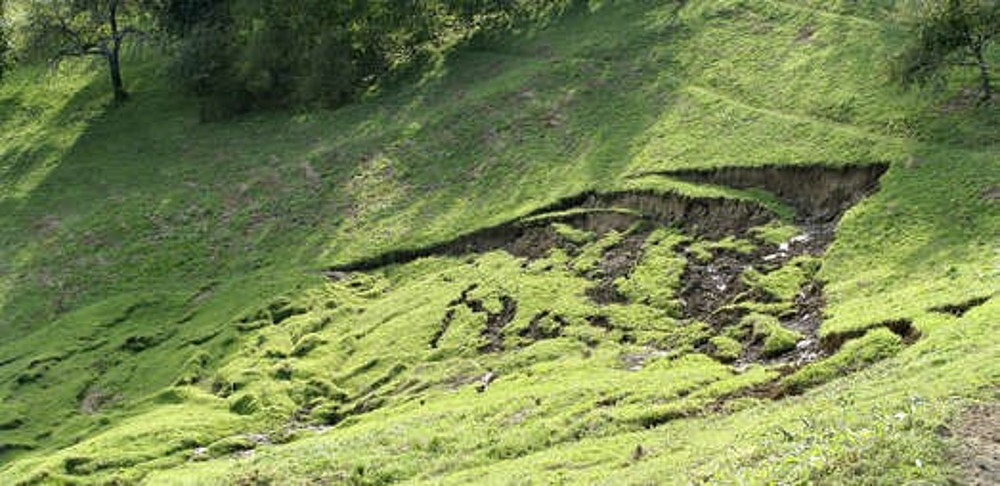
Welchen Einfluss hat der Klimawandel auf Hangrutschungen? Eine aktuelle Ausstellung im Naturkundemuseum liefert Fakten dazu. Foto: Institut für Militärisches Geowesen

Welchen Einfluss hat der Klimawandel auf Hangrutschungen? Eine aktuelle Ausstellung im Naturkundemuseum liefert Fakten dazu. Foto: Institut für Militärisches Geowesen

Ausstellung im Naturkundemuseum zeigt ab 28. Mai Forschungsergebnisse zu Hangrutschungen. Uni Graz liefert wissenschaftliche Fakten

Inwiefern beeinflusst der menschengemachte Klimawandel die Wahrscheinlichkeit von Hangrutschungen? Welche Rolle spielen Landnutzungsänderungen? Wie kann man sich vor solchen Ereignissen schützen? Diesen Forschungsfragen widmete sich eine Studie unter der Leitung des Wegener Centers für Klima und Globalen Wandel der Universität Graz. Die Ergebnisse dieser Studie werden in der Sonderausstellung Boden in Bewegung. Hangrutschungen im Klimawandel von 28. Mai 2021 bis 9. Jänner 2022 im Steiermark-Relief-Raum des Naturkundemuseums gezeigt.

Im Jahr 2009 ereigneten sich in der Südoststeiermark innerhalb weniger Tage über 3.000 Hangrutschungen, ausgelöst durch starke Regenfälle. Dabei entstanden Schäden an Häusern, Straßen, Wiesen und Äckern in der Höhe von mehr als 10 Millionen Euro. "Es hat sich herausgestellt, dass der Einfluss des Klimawandels auf die Hangrutschungen im Jahr 2009 zwar noch schwach, aber nachweisbar war. Sollte die Erderwärmung ungebremst voranschreiten, könnten mehrere Entwicklungen eintreten", betont der Kurator der Ausstellung und Uni-Graz-Forscher Douglas Maraun. Diese reichen von einer deutlichen Verringerung der Gefahr von Hangrutschungen bei einem viel trockeneren Boden (jedoch mit den daraus resultierenden negativen Folgen für die Landwirtschaft) bis zu einer drastisch erhöhten Gefahr bei starker Zunahme des Regens. Gelingt es jedoch, die im Pariser Klimaziel vereinbarte starke Begrenzung der globalen Erwärmung zu erreichen, würde sich die Gefahr von Hangrutschungen nur geringfügig erhöhen.

Die Ausstellung gibt Einblicke in das komplexe Zusammenspiel verschiedener Faktoren, die hier wirksam sind. Sie zeigt auf, durch welche Maßnahmen die Gefahr von Hangrutschungen reduziert werden kann, verdeutlicht aber auch, dass Klimaschutz und Naturschutz durchaus unterschiedliche Ziele verfolgen können. Auf die Bedeutung einer ganzheitlichen Betrachtung wird daher hingewiesen. Eine fotografische Dokumentation, eine multimediale Projektion auf das Steiermark-Relief, Audio-Interviews mit Betroffenen und ein Blick in einen Brunnen während einer Hangrutschung ergänzen und illustrieren die Studienergebnisse.


Boden in Bewegung. Hangrutschungen und Klimawandel
In Kooperation mit dem Wegener Center für Klima und Globalen Wandel der Universität Graz
Wo? Naturkundemuseum, Joanneumsviertel, 8010 Graz
Wann? Laufzeit: 28.05.2021–09.01.2022
Infos unter: www.naturkunde.at

 

created by Konstantin Tzivanopoulos & Universalmuseum Joanneum

Related news

Electrifying: Researchers film the first moments on the way from light to electricity

Physicists at the University of Graz (Austria), in collaboration with colleagues from Marburg University and Forschungszentrum Jülich (Germany), have achieved a scientific breakthrough. For the first time, the generation of electrical energy from light has been filmed and described theoretically. This work is of far-reaching significance, not least for optimising sustainable energy production from photovoltaics. This is because it provides fundamental building blocks for understanding the physical processes that take place, for example, in organic solar cells. The paper was published in the journal Physical Review X, one of the world’s most prestigious physics journals.

University of Graz: Working together to make Styria a sustainable centre of learning

Round table calls for sustainable funding for the 2028–2030 performance agreement period between the five Styrian universities and the federal government.

How can we teach using YouTube and AI? The University of Graz is strengthening media education in schools

A journey through the blood vessels using VR headsets brings biology lessons to life. An interactive quiz brings physics to life. The YouTube video explains the First World War. Whilst mobile phones are increasingly being banned from the classroom, social media platforms, apps and AI are playing an ever-greater role in knowledge transfer at school. But how can teaching with media be made even more effective? What are the challenges in media-based teaching? At the University of Graz, researchers are discussing these issues at a conference being held in Austria for the first time.

Jurassic Sounds: Biologist reconstructs insect songs from 165 million years ago

It was apparently not just the roars of the dinosaurs that made up the soundscape of the animal world during the Jurassic period. Crickets and grasshoppers communicated through a variety of songs and high-pitched sounds, as Thorin Jonsson from the Institute of Biology at the University of Graz discovered together with colleagues from the universities of Lincoln, Bristol (UK), Beijing (China) and Tempe (USA). The findings on what are so far the oldest traces of sound on Earth have just been published in the journal PNAS.

Begin of page section:
Additional information:

University of Graz
Universitaetsplatz 3
8010 Graz
Austria
  • Contact
  • Web Editors
  • Moodle
  • UNIGRAZonline
  • Imprint
  • Data Protection Declaration
  • Accessibility Declaration
Weatherstation
Uni Graz

End of this page section. Go to overview of page sections

End of this page section. Go to overview of page sections

Begin of page section:

End of this page section. Go to overview of page sections

