



Begin of page section:
Page sections:

  • Go to contents (Accesskey 1)
  • Go to position marker (Accesskey 2)
  • Go to main navigation (Accesskey 3)
  • Go to sub navigation (Accesskey 4)
  • Go to additional information (Accesskey 5)
  • Go to page settings (user/language) (Accesskey 8)
  • Go to search (Accesskey 9)

End of this page section. Go to overview of page sections

Begin of page section:
Page settings:

English en
Deutsch de
Search
Login

End of this page section. Go to overview of page sections

Begin of page section:
Search:

Search for details about Uni Graz
Close

End of this page section. Go to overview of page sections


Search

Begin of page section:
Main navigation:

Page navigation:

  • University

    University
    • About the University
    • Organisation
    • Faculties
    • Library
    • Working at University of Graz
    • Campus
    Developing solutions for the world of tomorrow - that is our mission. Our students and our researchers take on the great challenges of society and carry the knowledge out.
  • Research Profile

    Research Profile
    • Our Expertise
    • Research Questions
    • Research Portal
    • Promoting Research
    • Research Transfer
    • Ethics in Research
    • Commission for Scientific Integrity
    Scientific excellence and the courage to break new ground. Research at the University of Graz creates the foundations for making the future worth living.
  • Studies

    Studies
    • Prospective Students
    • Students
  • Community

    Community
    • International
    • Location
    • Research and Business
    • Alumni
    The University of Graz is a hub for international research and brings together scientists and business experts. Moreover, it fosters the exchange and cooperation in study and teaching.
  • Spotlight
Topics
  • Sustainable University
  • Researchers answer
  • Work for us
Close menu

End of this page section. Go to overview of page sections

Begin of page section:
You are here:

University of Graz News Im Zeitplan

End of this page section. Go to overview of page sections

Friday, 10 January 2014

Im Zeitplan

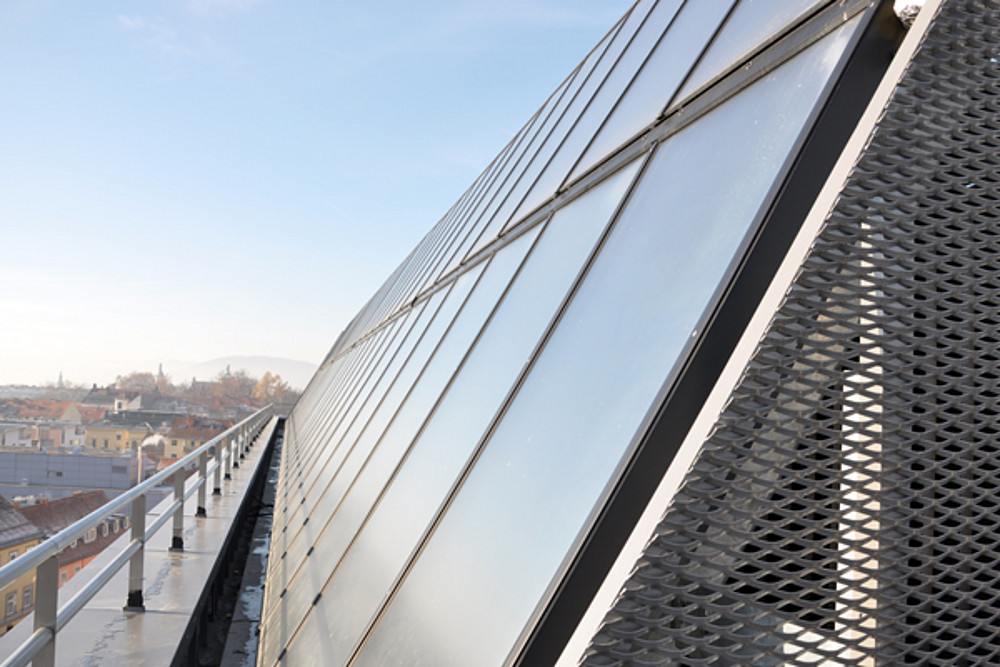
Herzstück des neuen der Chemie Neu ist die Solarthermie. Bezugsfertig ist das neue Laborgebäude bereits Ende Jänner.

Herzstück des neuen der Chemie Neu ist die Solarthermie. Bezugsfertig ist das neue Laborgebäude bereits Ende Jänner.

Ende Jänner ist das moderne und nachhaltig konzipierte Laborgebäude am Universitätsplatz 1 bezugsfertig!

Auf mehr als 10.000 Quadratmeter wird Ende Jänner am Campus der Universität Graz eines der modernsten und nachhaltigsten Labor-Gebäude bezugsfertig: Die „Chemie Neu“ am Universitätsplatz 1 ist mit Top-Infrastruktur, Lernplätzen und neuester Technologie ausgestattet und wird nach rund 22-monatiger Bauzeit planmäßig an den Lehr- und Forschungsbetrieb übergeben. Herzstück ist die Solarthermie-Anlage, die sich am Dach des Zubaus auf 600 Quadratmetern erstreckt und das Gebäude im Sinne der ökologischen Nachhaltigkeit mit Wärme bestückt.


Mit einer Leistung von 290.000 KW/H pro Jahr erzeugt die Anlage nicht nur Warm- und Heizwasser für das Gebäude selbst, sondern versorgt darüber hinaus auch die Mensa und das Studierendenheim mit Energie. Die Wärme – vor allem in den Sommermonaten – wird als solare Kühlung für die Lüftungsanlage in den Laborräumen genutzt. Diese erste Anlage dieser Art in Österreich liefert somit einen entscheidenden Beitrag zur Senkung der Betriebskosten und zugleich zur Nachhaltigkeit des Projektes. 

Alles neu
Das „Chemie Gebäude“ am Sonnenfelsplatz wurde in den letzten Monaten total entkernt, innen vollkommen neu gestaltet und mit einer neuen Fassade versehen. Insgesamt entstehen rund 3400 Quadratmeter neue Laborflächen, die ideale Bedingungen für internationale Spitzenforschung sowie für einen modernen Lehr- und Lernbetrieb an der Uni Graz bieten werden. Auch der Altbau wurde gemäß den geltenden Bestimmungen und Auflagen des Bundesdenkmalamtes generalsaniert, mit einer neuen Lüftungsanlage ausgestattet und an die aktuellen technischen Standards angepasst.

created by Konstantinos Tzivanopoulos

Related news

Long Night of Research: How many languages are there in the world?

From a linguistic perspective, there are worlds of difference between Bern, Berlin and Vienna. A dialect impersonator will demonstrate live just how varied German can sound. How many languages are there in the world? What are their distinctive features? Which of these are spoken in Austria? These and other questions will be answered during the Long Night of Research at the University of Graz: on Friday, 24 April 2025, from 5 pm to 11 pm, in the University Library. Visitors can immerse themselves in the diversity of languages without travelling far by taking part in a quiz at the station.

Dual role: Researchers show that platelets can worsen disease

Platelets are best known as rapid responders in the event of injury. They stop bleeding and are indispensable for wound healing. “However, thrombocytes can also aggravate diseases, especially when inflammatory processes are involved,” explains Marion Mußbacher, a pharmacist at the University of Graz. She investigated the “dual role” of platelets in relation to fatty liver disease, a condition closely linked to obesity and type 2 diabetes.

Forscher:innen entdecken natürlichen Wirkstoff zum Schutz vor Lebererkrankungen

Die Leber leidet still. „Fetteinlagerungen, strukturelle Zerstörung des Gewebes oder mutierende Tumorzellen – all das fliegt eine Weile unter dem Radar. Begleitet werden diese Veränderungen oft von leichten, jedoch chronischen Entzündungen“, erklärt Andreas Koeberle, Pharmazeut an der Universität Graz. Er hat mit seinem Team und Kolleg:innen der Universität Innsbruck den Wirkstoff Mitrephoron B untersucht, der neue Behandlungsansätze ermöglicht. Die Ergebnisse der Studie wurden kürzlich in der Open-Access-Fachzeitschrift „Theranostics“ veröffentlicht.

Climate at the cliffs: Researchers unravel the evolution of the Greenland ice margin

Vertical ice walls, up to 40 metres high: in "Game of Thrones" they were dramatised as fortifications; during the Cold War, they were studied with great interest. How these imposing walls along Greenland’s 80,000-kilometre-long ice margin formed, how they are evolving, and what impact they have on the climate is not yet fully understood. Researchers from the Universities of Graz and Innsbruck have come one step closer to solving the mystery. The results of their latest study have been published in the journal The Cryosphere.

Begin of page section:
Additional information:

University of Graz
Universitaetsplatz 3
8010 Graz
Austria
  • Contact
  • Web Editors
  • Moodle
  • UNIGRAZonline
  • Imprint
  • Data Protection Declaration
  • Accessibility Declaration
Weatherstation
Uni Graz

End of this page section. Go to overview of page sections

End of this page section. Go to overview of page sections

Begin of page section:

End of this page section. Go to overview of page sections