Begin of page section:
Page sections:

  • Go to contents (Accesskey 1)
  • Go to position marker (Accesskey 2)
  • Go to main navigation (Accesskey 3)
  • Go to sub navigation (Accesskey 4)
  • Go to additional information (Accesskey 5)
  • Go to page settings (user/language) (Accesskey 8)
  • Go to search (Accesskey 9)

End of this page section. Go to overview of page sections

Begin of page section:
Page settings:

English en
Deutsch de
Search
Login

End of this page section. Go to overview of page sections

Begin of page section:
Search:

Search for details about Uni Graz
Close

End of this page section. Go to overview of page sections


Search

Begin of page section:
Main navigation:

Page navigation:

  • University

    University
    • About the University
    • Organisation
    • Faculties
    • Library
    • Working at University of Graz
    • Campus
    Developing solutions for the world of tomorrow - that is our mission. Our students and our researchers take on the great challenges of society and carry the knowledge out.
  • Research Profile

    Research Profile
    • Our Expertise
    • Research Questions
    • Research Portal
    • Promoting Research
    • Research Transfer
    • Ethics in Research
    Scientific excellence and the courage to break new ground. Research at the University of Graz creates the foundations for making the future worth living.
  • Studies

    Studies
    • Prospective Students
    • Students
  • Community

    Community
    • International
    • Location
    • Research and Business
    • Alumni
    The University of Graz is a hub for international research and brings together scientists and business experts. Moreover, it fosters the exchange and cooperation in study and teaching.
  • Spotlight
Topics
  • Our digital Advent calendar
  • Sustainable University
  • Researchers answer
  • Work for us
Close menu

End of this page section. Go to overview of page sections

Begin of page section:
You are here:

University of Graz News In the Shadow of the (Holy) Wisdom

End of this page section. Go to overview of page sections

Monday, 27 July 2020

In the Shadow of the (Holy) Wisdom

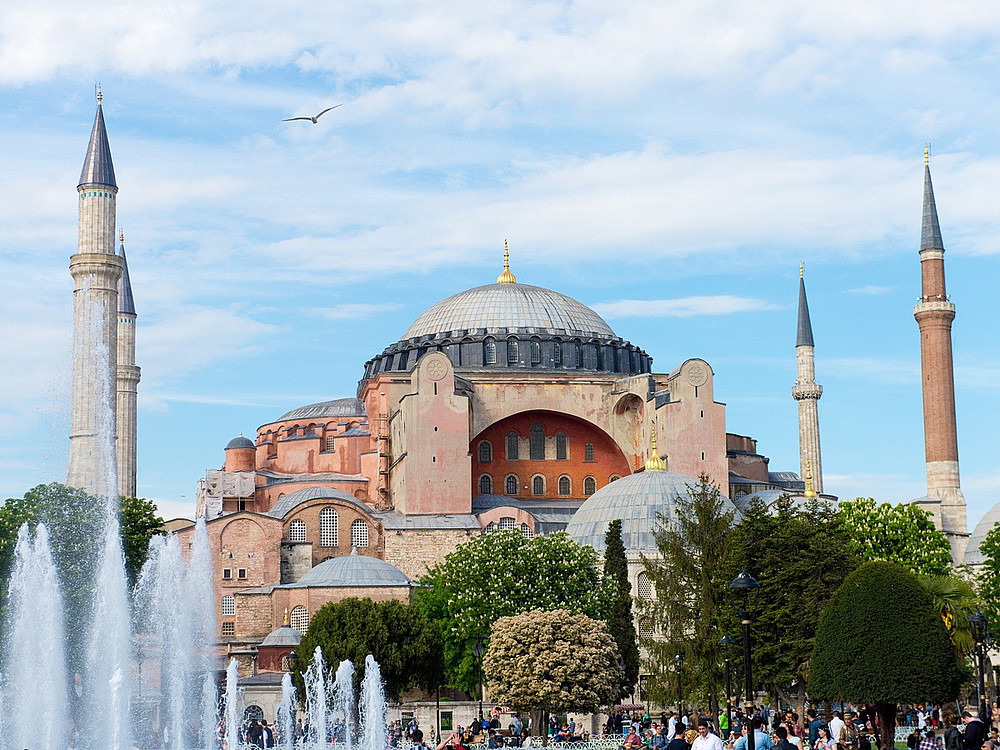
The Hagia Sophia - holy wisdom - in Istanbul is the symbolical gate to the Orient. Die former byzantinic chirch was transformed into a museum and is now used as a mosque. Photo: Pixabay

The Hagia Sophia - holy wisdom - in Istanbul is the symbolical gate to the Orient. Die former byzantinic chirch was transformed into a museum and is now used as a mosque. Photo: Pixabay

The transformation of holy places like the Hagia Sophia has been a common practice, says Pablo Argárate, Professor for Ecumenical Theology, Eastern Orthodoxy and Patristic Studies

Religions are (almost) always connected to certain places. Special loci are perceived as topoi, where the Holy is particularly present and active. Within religions and even confessions there are competing appropriations of loci sancti. In times of war it was consequential that the Gods of the defeated had to yield to those Gods who had proved more powerful in victory. The conquerors destroyed the holy places of the defeated or adopted them for their own religion.  Such was not only common in Islam, but also in Christianity. Heathen temples (like Baalbek or the Pantheon in Rome) and even mosques like the one of Córdoba were converted into churches.
Building an important temple of a religion is never neutral, but always part of a bigger political programme. This is also true for the (East)Roman emperors Constantine and Justinian, who ordered the construction and reconstruction of the Church of the Holy Wisdom (Hagia Sophia). After the Turkish conquest in 1453 Mehmet II consequently had it transformed into a mosque.
There are, however, two important historical exceptions of such transformation processes. Caliph Umar refused to set foot in the Church of the Holy Sepulchre (the most important church of Christianity) to keep it from being adopted by Muslims. In 1934 Attatürk turned the mosque Ayasofya into a museum. His intention was not to create a place of dialogue for different cultures and religions, but rather to restrain the power of religion. 86 years later Erdoğan now acts in an equally political way – although in the opposite direction. Neither then nor now religion was or is in the foreground. Erdoğan’s autocratic decision (the court of justice let him have his will – for whatever reason) is part of his aggressive politics: demonstration of power, distraction from the vast financial crisis and inner repression. It is also one step ahead in his provocation of the West, especially of the Greece, who see themselves as the successors of the Byzantines. On July 24th (the anniversary of the Treaty of Lausanne 1923) the Hagia Sophia was re-converted into a mosque. If this was inspired by (holy) wisdom, remains most questionable.


created by Pablo Argárate

Related news

Semester abroad without barriers: University of Graz wins award for promoting inclusion

The University of Graz has been awarded the Internationalization Award for its new inclusion initiative. Students with fewer opportunities now also receive financial support for their semester abroad outside Europe.

Fair distribution: Researchers determine just greenhouse gas budgets for all EU regions

Ten years ago, on 12 December 2015, the Paris Climate Agreement was signed at the UN Climate Conference. In order to limit global warming to well below two degrees, only a certain amount of CO2 may be emitted worldwide. While the focus was originally on national emission targets, more than 200 subnational regions and almost 300 cities have now adopted their own targets. But how many emissions are they fairly entitled to? Researchers at the University of Graz have now developed transparent criteria for fair distribution at the subnational level for the first time and determined corresponding greenhouse gas budgets for all European regions. The paper was published today in the scientific journal Nature Communications.

Chemical Christmas show at the University of Graz: An explosive evening at the Schauspielh

At the beginning of December, the University of Graz transformed the theater into a laboratory: as part of “Chemical Life,” teacher training students staged a chemical Christmas show for Styrian school classes—complete with ethanol rockets, nitrogen snow, and glowing effects. An evening designed to inspire interest in studying chemistry.

Train by train: Koralm railway accelerates exchange between the Universities

Lectures at the University of Klagenfurt in the morning, seminars at the University of Graz in the afternoon: Austria's longest tunnel and a journey time of around 45 minutes make it easy. The Koralm railway increases the speed of networking between the two university locations. The collaboration builds on existing cooperation - for example in the areas of teacher training, Slavic studies and as employers, the universities are well coordinated.

Begin of page section:
Additional information:

University of Graz
Universitaetsplatz 3
8010 Graz
Austria
  • Contact
  • Web Editors
  • Moodle
  • UNIGRAZonline
  • Imprint
  • Data Protection Declaration
  • Accessibility Declaration
Weatherstation
Uni Graz

End of this page section. Go to overview of page sections

End of this page section. Go to overview of page sections

Begin of page section:

End of this page section. Go to overview of page sections