Begin of page section:
Page sections:

  • Go to contents (Accesskey 1)
  • Go to position marker (Accesskey 2)
  • Go to main navigation (Accesskey 3)
  • Go to sub navigation (Accesskey 4)
  • Go to additional information (Accesskey 5)
  • Go to page settings (user/language) (Accesskey 8)
  • Go to search (Accesskey 9)

End of this page section. Go to overview of page sections

Begin of page section:
Page settings:

English en
Deutsch de
Search
Login

End of this page section. Go to overview of page sections

Begin of page section:
Search:

Search for details about Uni Graz
Close

End of this page section. Go to overview of page sections


Search

Begin of page section:
Main navigation:

Page navigation:

  • University

    University
    • About the University
    • Organisation
    • Faculties
    • Library
    • Working at University of Graz
    • Campus
    Developing solutions for the world of tomorrow - that is our mission. Our students and our researchers take on the great challenges of society and carry the knowledge out.
  • Research Profile

    Research Profile
    • Our Expertise
    • Research Questions
    • Research Portal
    • Promoting Research
    • Research Transfer
    • Ethics in Research
    Scientific excellence and the courage to break new ground. Research at the University of Graz creates the foundations for making the future worth living.
  • Studies

    Studies
    • Prospective Students
    • Students
  • Community

    Community
    • International
    • Location
    • Research and Business
    • Alumni
    The University of Graz is a hub for international research and brings together scientists and business experts. Moreover, it fosters the exchange and cooperation in study and teaching.
  • Spotlight
Topics
  • Our digital Advent calendar
  • Sustainable University
  • Researchers answer
  • Work for us
Close menu

End of this page section. Go to overview of page sections

Begin of page section:
You are here:

University of Graz News Im Rampenlicht

End of this page section. Go to overview of page sections

Wednesday, 13 May 2015

Im Rampenlicht

Rechtswissenschafterin Iris Murer mit Kuratoriumspräsident Herbert Tumpel. Alle Fotos: Christian Fischer/Theodor Körner Fonds.

Rechtswissenschafterin Iris Murer mit Kuratoriumspräsident Herbert Tumpel. Alle Fotos: Christian Fischer/Theodor Körner Fonds.

Zoologe Tobias Pfingstl empfing den Preis ebenso...

Zoologe Tobias Pfingstl empfing den Preis ebenso...

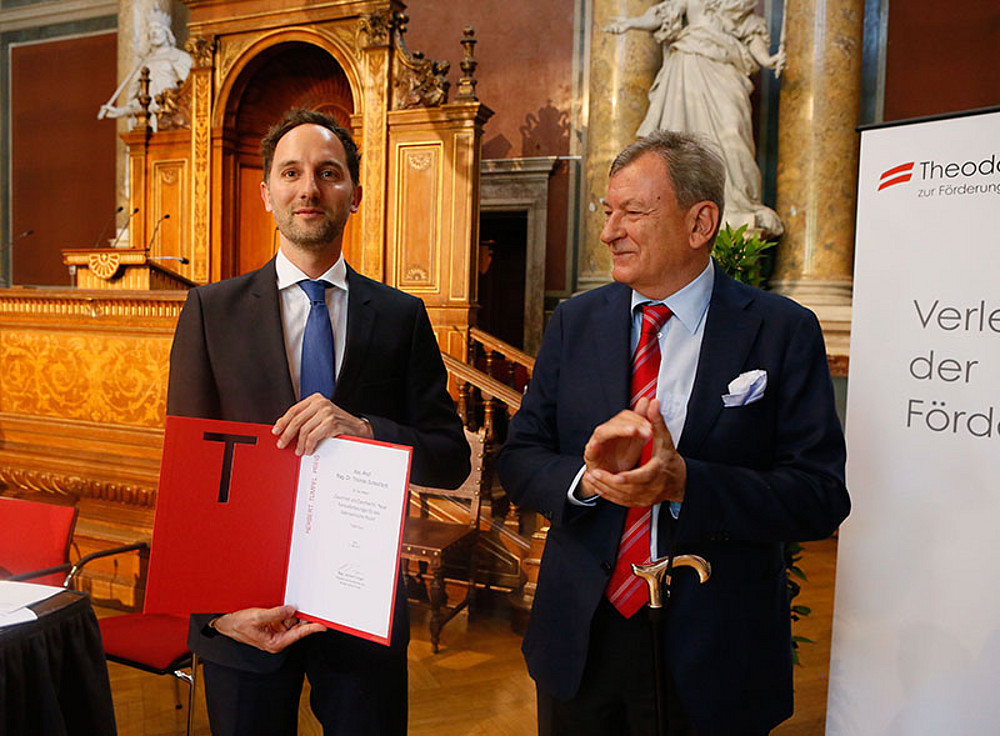
... wie Rechtswissenschafter Thomas Schoditsch und...

... wie Rechtswissenschafter Thomas Schoditsch und... (für ein weiteres Bild auf dieses Foto klicken und unten in der Galerie nach rechts navigieren).

... Historikerin Theresa Zifko.

... Historikerin Theresa Zifko.

Theodor-Körner-Preis an vier ForscherInnen der Uni Graz vergeben

Am 11. Mai 2015 wurde der diesjährige Preis des Theodor Körner Fonds zur Förderung von Wissenschaft und Kunst in Wien verliehen. Unter den 19 ausgezeichneten Personen, die sich im vergangenen Jahr in den Bereichen Bildung, Wissenschaft, Forschung und Kunst hervorgetan haben, befinden sich vier ForscherInnen der Karl-Franzens-Universität. Sie erhielten den Preis von Bundespräsident Dr. Heinz Fischer und Kuratoriumspräsident Mag. Herbert Tumpel. Ausgezeichnet wurden für ihre hervorragenden Arbeiten: 


Mag. Iris Murer: "Verfassungsrechtliche Grenzen der Reglementierung des Prostitutionswesens im Verwaltungsrecht"

Dr. Tobias Pfingstl: "Zurück ins Meer – Der Ursprung der litoralen Lebensweise von marin assoziierten Hornmilben (Acari)"

Mag. Theresa Zifko, MA: "Wem gehört das Objekt? Archäologische Sammlungen und Identitätsstiftung in transnationalen Räumen"


Den Herbert Tumpel-Preis erhielt:

Ass.-Prof. Mag. Dr. Thomas Schoditsch, Institut für Rechtsphilosophie, Rechtssoziologie und Rechtsinformatik: "Gleichheit und Geschlecht - Neue Herausforderungen für das
österreichische Recht"


Theodor Körner, von 1951 bis 1957 erster vom Volk direkt gewählter österreichischer Bundespräsident, ist der Namensstifter des ihm zu Ehren ins Leben gerufene Theodor-Körner-Fonds, dessen Preis erstmals 1954 vergeben wurde. Ziel damals wie heute war und ist die Förderung junger österreichischer WissenschafterInnen und KünstlerInnen, die hervorragende Leistungen erbringen und von denen wichtige Beiträge für ihre jeweiligen Fachdisziplinen erwartet werden können.

Die Förderungspreise sollen zur Durchführung und Fertigstellung wissenschaftlicher bzw. künstlerischer Arbeiten ermutigen. BewerberInnen sollen bei Antragstellung nicht älter als 40 Jahre alt sein. Davon ausgenommen sind Personen, die ihre akademische Ausbildung im Zuge des zweiten Bildungsweges absolviert haben, sowie BewerberInnen aus dem Bereich der nicht akademischen Forschung. Die eingereichte Arbeit darf noch nicht fertig gestellt sein. Ausschlaggebend ist ihre allgemeine wissenschaftliche/künstlerische Qualität und gesellschaftliche Relevanz.

created by Gerhild Kastrun

Related news

Chemical Christmas show at the University of Graz: An explosive evening at the Schauspielh

At the beginning of December, the University of Graz transformed the theater into a laboratory: as part of “Chemical Life,” teacher training students staged a chemical Christmas show for Styrian school classes—complete with ethanol rockets, nitrogen snow, and glowing effects. An evening designed to inspire interest in studying chemistry.

Train by train: Koralm railway accelerates exchange between the Universities

Lectures at the University of Klagenfurt in the morning, seminars at the University of Graz in the afternoon: Austria's longest tunnel and a journey time of around 45 minutes make it easy. The Koralm railway increases the speed of networking between the two university locations. The collaboration builds on existing cooperation - for example in the areas of teacher training, Slavic studies and as employers, the universities are well coordinated.

On the trail of the Big Bang: University of Graz receives 1.5 million euros for doctoral programmes

The Austrian Science Fund FWF has selected the Doctoral Programme in Theoretical Particle Physics at the University of Graz for funding from the Doc.funds. Six young scientists will be funded for 3.5 years. They will gain fundamentally new insights into the origins of the world.

From trans women and knee prostheses: sports science prizes awarded

Walking better with a prosthesis, successfully getting rid of excess weight, training more effectively, more fairness for trans people in sport: these were the topics addressed by the students at the University of Graz who were awarded the sports science prizes for their Master's theses on 3 December 2025.

Begin of page section:
Additional information:

University of Graz
Universitaetsplatz 3
8010 Graz
Austria
  • Contact
  • Web Editors
  • Moodle
  • UNIGRAZonline
  • Imprint
  • Data Protection Declaration
  • Accessibility Declaration
Weatherstation
Uni Graz

End of this page section. Go to overview of page sections

End of this page section. Go to overview of page sections

Begin of page section:

End of this page section. Go to overview of page sections