Begin of page section:
Page sections:

  • Go to contents (Accesskey 1)
  • Go to position marker (Accesskey 2)
  • Go to main navigation (Accesskey 3)
  • Go to sub navigation (Accesskey 4)
  • Go to additional information (Accesskey 5)
  • Go to page settings (user/language) (Accesskey 8)
  • Go to search (Accesskey 9)

End of this page section. Go to overview of page sections

Begin of page section:
Page settings:

English en
Deutsch de
Search
Login

End of this page section. Go to overview of page sections

Begin of page section:
Search:

Search for details about Uni Graz
Close

End of this page section. Go to overview of page sections


Search

Begin of page section:
Main navigation:

Page navigation:

  • University

    University
    • About the University
    • Organisation
    • Faculties
    • Library
    • Working at University of Graz
    • Campus
    Developing solutions for the world of tomorrow - that is our mission. Our students and our researchers take on the great challenges of society and carry the knowledge out.
  • Research Profile

    Research Profile
    • Our Expertise
    • Research Questions
    • Research Portal
    • Promoting Research
    • Research Transfer
    • Ethics in Research
    Scientific excellence and the courage to break new ground. Research at the University of Graz creates the foundations for making the future worth living.
  • Studies

    Studies
    • Prospective Students
    • Students
  • Community

    Community
    • International
    • Location
    • Research and Business
    • Alumni
    The University of Graz is a hub for international research and brings together scientists and business experts. Moreover, it fosters the exchange and cooperation in study and teaching.
  • Spotlight
Topics
  • Sustainable University
  • Researchers answer
  • Work for us
Close menu

End of this page section. Go to overview of page sections

Begin of page section:
You are here:

University of Graz News Im Märzen...

End of this page section. Go to overview of page sections

Wednesday, 09 March 2022

Im Märzen...

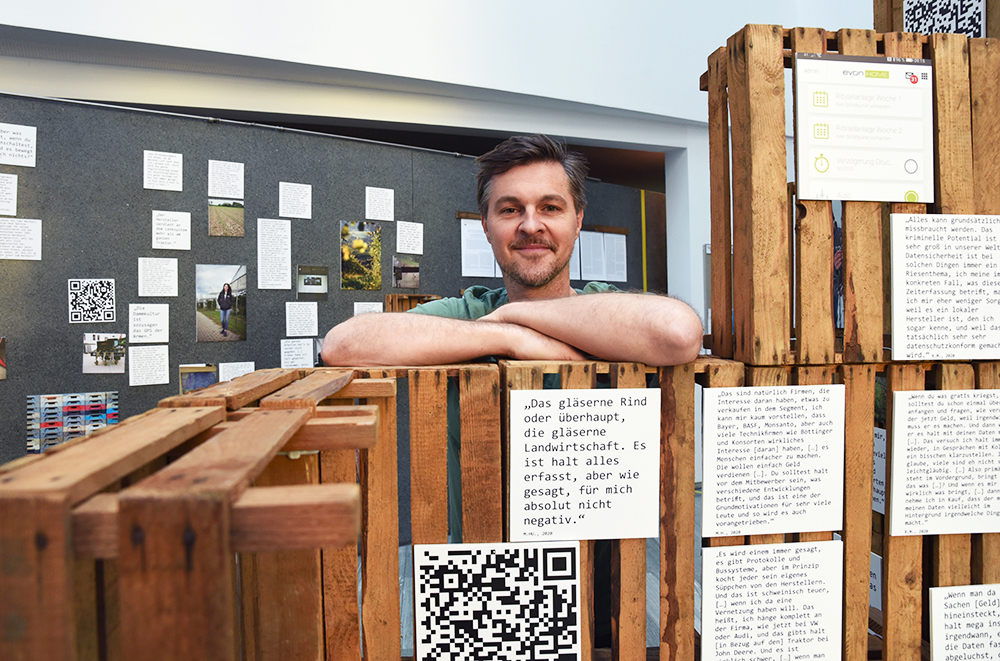
Ernst Michael Preininger schaut sich an, wie digitale Technologie die Landwirtschaft verändert. Foto: Uni Graz/Schweiger

Ernst Michael Preininger schaut sich an, wie digitale Technologie die Landwirtschaft verändert. Foto: Uni Graz/Schweiger

Handy und Heugabel: Wie baut digitales Werkzeug den Bauernhof um?

Die App für die Aussaat. Roboter im Rinderstall. Tablet am Traktor. Digitalisierung ist längst Teil der Landwirtschaft. In fast allen Bereichen: von der Messung der Bodenfeuchtigkeit über die Planung der Düngung und Fütterung der Tiere bis hin zum Verkauf der Produkte. Wie Technologie die Arbeit von LandwirtInnen in der Süd- und Südoststeiermark verändert, schauen sich GeographInnen an der Universität Graz an.

Grüne Weiden, blühende Obstplantagen, glückliche Hühner – in dieser scheinbaren Idylle wird mit digitalen Werkzeugen gearbeitet. „Fast jeder landwirtschaftliche Betrieb setzt in irgendeiner Form diese Instrumente ein“, schildert Ernst Michael Preininger vom Institut für Geographie und Raumforschung. Die Bandbreite ist groß. „Die einen haben die Steigerung der Effizienz im Blick, die anderen sehen eine Erleichterung ihrer Arbeit“, spannt Preininger den Bogen. Viel hänge von der Größe des Betriebs ab.
„Rurbane Nahrungswelten“ – unter der Federführung von Ulrich Ermann – nennt sich das Projekt, das den technologischen Wandel in der steirischen Landwirtschaft im Blick hat. Und diesen wollen weder Bauern und Bäuerinnen immer zeigen oder die KonsumentInnen gar sehen. „Denn sie macht die Ländlichkeit städtischer und stört das romantische Bild“, begründet der Wissenschafter.

Virtuelle Vernetzung
Farmmanagementsysteme, die etwa den idealen Zeitpunkt für die Aussaat oder den wirkungsvollen Einsatz von Futtermittel steuern, produzieren eine Menge an Daten. Diese virtuelle Vernetzung verunsichert LandwirtInnen, wenn sowohl das Know-how als auch das nötige Geld für die Infrastruktur fehlt. Solche Systeme verbunden mit Künstlicher Intelligenz machen jedenfalls zusätzliche Qualifikationen notwendig. „Daten zu interpretieren und Vorschläge von Software-Firmen einzuordnen, verändert den Beruf massiv“, so Preininger. Er räumt ein, dass die technologische Unterstützung den Alltag von NebenerwerbslandwirtInnen erleichtere. Digitalisierung könne außerdem die Qualität der produzierten Lebensmittel verbessern, aber auch der Einfluss von Online-AnbieterInnen das Sortiment beeinflussen.

Ausstellung
Wie sich die Digitalisierung auf die bäuerliche Arbeit auswirkt, ist Thema einer kleinen Ausstellung am Institut für Geographie und Raumforschung an der Universität Graz, Heinrichstraße 36. Interviewpassagen süd- und südoststeirischer LandwirtInnen und Fotos verdeutlichen den Wandel. „Rurbane Nahrungswelten“ ist bis 31. März 2022 bei freiem Eintritt zu sehen.

Über Ernst Michael Preininger
Lebensmittel lagen schon immer am Tablett seines Interesses. Von seinem Geographie-Studium an der Uni Graz und seiner Diplomarbeit, die er in Nepal schrieb. Über Kochbücher, einen Bauernladen mit Biogemüse. Bis hin zum eigenen Restaurant, in dem er saisonale Gerichte mit regionalen Produkten servierte. Logisch, dass er sich in seiner Forschungsarbeit im weitesten Sinne mit Essen beschäftigt.

>> über das Projekt mehr erfahren

created by Andreas Schweiger

Related news

Cosmetics in the environment: University of Graz proves danger to ants

Titanium dioxide, which is found in cosmetics, for example, is increasingly entering the environment in the form of nanoparticles. This could also put insects at risk. If ants ingest the substance in combination with the pesticide glyphosate, it disturbs the development of their offspring. Scientists at the University of Graz are drawing attention to the negative consequences of this toxic cocktail.

How are tech companies changing democracy? Uni Graz designs exhibition for schools

Filtered information, conspiracy theories, fake news – certain groups and corporations are using social media and algorithms to try to influence public opinion in their favour. Their goal: to weaken fundamental rights and diversity of opinion and seize power. In a new exhibition, researchers at the University of Graz are working with pupils to explore the impact of social media and AI on democracy. In accompanying workshops, the scientists want to encourage young people to develop their own ideas for a socially and ecologically viable future and to actively help shape it. The exhibition, designed as a travelling exhibition for schools, will open on 9 March 2026 at the Dreihackengasse Gymnasium in Graz.

Step by step: What motivates Mireille van Poppel as a scientist and vice-rector

Improving people's health and eliminating inequalities: Mireille van Poppel pursues these goals both as a public health researcher and as vice-rector for Internationalisation and Equality. In both roles, she pays particular attention to individual needs.

Master's degree in psychotherapy in Graz: registration opens in March

Graz is becoming a hotspot for psychotherapy: from 2026, the University of Graz and the Medical University of Graz will jointly offer the new master's programme. Registration for the admission procedure for the 140 study places will start in March.

Begin of page section:
Additional information:

University of Graz
Universitaetsplatz 3
8010 Graz
Austria
  • Contact
  • Web Editors
  • Moodle
  • UNIGRAZonline
  • Imprint
  • Data Protection Declaration
  • Accessibility Declaration
Weatherstation
Uni Graz

End of this page section. Go to overview of page sections

End of this page section. Go to overview of page sections

Begin of page section:

End of this page section. Go to overview of page sections