



Begin of page section:
Page sections:

  • Go to contents (Accesskey 1)
  • Go to position marker (Accesskey 2)
  • Go to main navigation (Accesskey 3)
  • Go to sub navigation (Accesskey 4)
  • Go to additional information (Accesskey 5)
  • Go to page settings (user/language) (Accesskey 8)
  • Go to search (Accesskey 9)

End of this page section. Go to overview of page sections

Begin of page section:
Page settings:

English en
Deutsch de
Search
Login

End of this page section. Go to overview of page sections

Begin of page section:
Search:

Search for details about Uni Graz
Close

End of this page section. Go to overview of page sections


Search

Begin of page section:
Main navigation:

Page navigation:

  • University

    University
    • About the University
    • Organisation
    • Faculties
    • Library
    • Working at University of Graz
    • Campus
    Developing solutions for the world of tomorrow - that is our mission. Our students and our researchers take on the great challenges of society and carry the knowledge out.
  • Research Profile

    Research Profile
    • Our Expertise
    • Research Questions
    • Research Portal
    • Promoting Research
    • Research Transfer
    • Ethics in Research
    • Commission for Scientific Integrity
    Scientific excellence and the courage to break new ground. Research at the University of Graz creates the foundations for making the future worth living.
  • Studies

    Studies
    • Prospective Students
    • Students
    • Registration for Study Programme (Winter semester 2026/27)
    • Study Days 22-26 June 2026
  • Community

    Community
    • International
    • Location
    • Research and Business
    • Alumni
    The University of Graz is a hub for international research and brings together scientists and business experts. Moreover, it fosters the exchange and cooperation in study and teaching.
Topics
  • Sustainable University
  • Researchers answer
  • Work for us
Close menu

End of this page section. Go to overview of page sections

Begin of page section:
You are here:

University of Graz News Hitzepol Österreich

End of this page section. Go to overview of page sections

Friday, 26 February 2016

Hitzepol Österreich

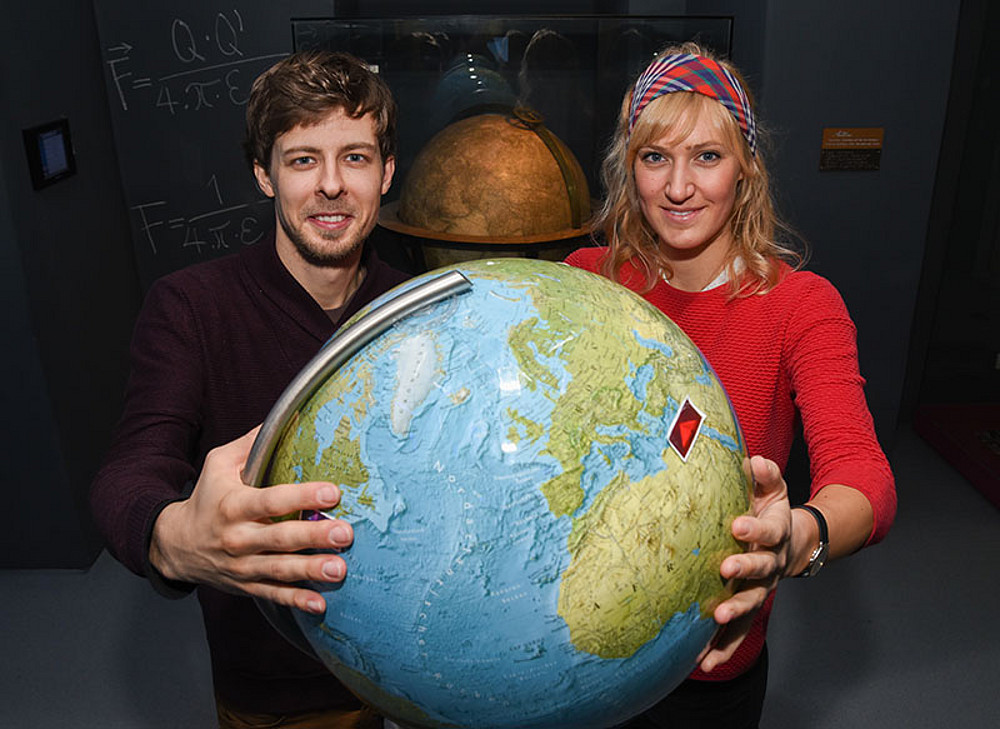
Die Doktoratsstudierenden Matthias Damert und Katharina Schröer laden zur Ausstellung „KliMacht|CliMatters“ ein. Foto: Uni Graz/Tzivanopoulos.

Die Doktoratsstudierenden Matthias Damert und Katharina Schröer laden zur Ausstellung „KliMacht|CliMatters“ ein. Foto: Uni Graz/Tzivanopoulos.

Einzigartige Ausstellung zeigt mögliche Konsequenzen des Klimawandels

„Das ist der wärmste Monat seit Beginn der Aufzeichnungen.“ Ein in Medienberichten oft gebrauchter und teilweise inflationär wahrgenommener Zusatz – doch diese Aussage ist ein deutlicher Hinweis auf den Klimawandel. Die Statistik zeigt: Seit der zweiten Hälfte des 19. Jahrhunderts ist die durchschnittliche Temperatur auf der Erdoberfläche um etwa ein Grad gestiegen. In Österreich war das Jahr 2014 sogar das wärmste in der 247-jährigen Messgeschichte. Und derzeit ist kein Ende der Hitzekurve in Sicht. Was bedeutet diese Entwicklung? Wie beeinflusst sie die Lebensumstände in Graz und Österreich? Was trägt jedeR Einzelne zum Klimawandel bei, wie könnte man ihn bremsen? Oder ist es schon zu spät dafür?


Antworten auf diese Fragen geben NachwuchsforscherInnen des vom österreichischen Wissenschaftsfonds FWF geförderten Doktoratskollegs „Climate Change“ der Uni Graz in der Ausstellung „KliMacht|CliMatters“. Mit interaktiven Spielen, Ausstellungsstücken und Postern erklären sie die Grundlagen, Ursachen und Folgen des Klimawandels anhand von zwei plausiblen Zukunftsszenarien bis 2100. Die Ausstellung wird am Donnerstag, 3. März 2016, um 19 Uhr im UniGraz@Museum im Hauptgebäude eröffnet. Der Eintritt ist bei der Eröffnung frei.


„Als roter Faden zieht sich das Thema der Verantwortung durch die Schau“, erklärt die Koordinatorin des Doktoratskollegs, Dr. Bettina Lackner, den Titel. „Wir zeigen auf, was auf unterschiedlichen Ebenen unternommen werden kann, damit unsere Welt auch in der Zukunft lebenswert bleibt. ‚KliMacht‘ steht dabei für jene Achtsamkeit, die wir diesem global so herausfordernden Thema entgegenbringen sollten.“ Welche Staaten beispielsweise für hohe Treibhausgas-Emissionen verantwortlich sind, wird ebenso thematisiert wie die Rolle, die jedeR Einzelne im Prozess des Klimawandels spielt. „Anhand eines einfachen Spiels können BesucherInnen erkennen, welche möglichen Auswirkungen ihr ganz persönliches Verhalten auf das Klima der Zukunft hat“, so Lackner. Bekannte Schlagworte wie etwa das 2-Grad-Ziel – damit ist die maximale globale Temperaturerhöhung gemeint, mit der sich die Auswirkungen der Erderwärmung auf ein erträgliches Maß einschränken ließen – sind ebenfalls Teil der Schau. Abschließend beschäftigen sich die JungforscherInnen mit Mythen zum Klimawandel sowie mit Initiativen, die versuchen, ihn zu vermeiden.

Ihre Kooperationspartner sind das Projekt Denkzeitraum 2016 „Wem gehört das Klima?“ des Arbeitsbereichs Praktische Philosophie der Uni Graz, der Grafiker Roman Klug der Abteilung Presse + Kommunikation der Uni Graz sowie der Ausstellungsmacher Jakob Pock.


>> Akustischer Vorgeschmack: Drei Studierende des Doktoratskollegs geben im Webradio der Grazer Universitäten Einblicke in die Ausstellung „KliMacht|CliMatters“


created by Gerhild Kastrun

Related news

Forest fire at Rosenhain: Volunteer fire brigade carried out an evacuation drill at the Jesuit refectory

Thick smoke in the stairwell, flames at the edge of the forest, people missing in the Jesuit refectory at the University of Graz: at Rosenhain, the Graz Volunteer Fire Brigade carried out a drill simulating a scenario that is becoming increasingly realistic given the heat and drought

Full effort in the heat: the Sports Centre was in full swing at the Kleeblattlauf

On 19 June 2026, 2,000 runners and hundreds of supporters made their way to the Rosenhain for a sporting end-of-term event.

Save, invest or guarantee: What Austrians expect from the state

Austria needs to make savings. But where? And what should the Republic actually be spending its money on? The answers are provided by the initial findings of a major study involving the University of Graz. 99 per cent of those surveyed are in favour of the state ensuring healthcare provision. Almost three-quarters would like to see more public funding for education, whilst only around three per cent are in favour of cuts in this sector.

Science meets blockbuster: Campus cinema at the University of Graz

A cinematic treat for the scientific community: the courtyard of the University of Graz’s main building is once again being transformed into an atmospheric open-air cinema this year. From 29 June to 10 July 2026 (Mondays to Fridays from 8.30 pm), blockbusters and documentaries will be shown on the open-air screen. Academics from the University of Graz will be taking a closer look at the films shown, examining them to distinguish fact from fiction.

Begin of page section:
Additional information:

University of Graz
Universitaetsplatz 3
8010 Graz
Austria
  • Contact
  • Web Editors
  • Moodle
  • UNIGRAZonline
  • Imprint
  • Data Protection Declaration
  • Accessibility Declaration
Weatherstation
Uni Graz

End of this page section. Go to overview of page sections

End of this page section. Go to overview of page sections

Begin of page section:

End of this page section. Go to overview of page sections