



Begin of page section:
Page sections:

  • Go to contents (Accesskey 1)
  • Go to position marker (Accesskey 2)
  • Go to main navigation (Accesskey 3)
  • Go to sub navigation (Accesskey 4)
  • Go to additional information (Accesskey 5)
  • Go to page settings (user/language) (Accesskey 8)
  • Go to search (Accesskey 9)

End of this page section. Go to overview of page sections

Begin of page section:
Page settings:

English en
Deutsch de
Search
Login

End of this page section. Go to overview of page sections

Begin of page section:
Search:

Search for details about Uni Graz
Close

End of this page section. Go to overview of page sections


Search

Begin of page section:
Main navigation:

Page navigation:

  • University

    University
    • About the University
    • Organisation
    • Faculties
    • Library
    • Working at University of Graz
    • Campus
    Developing solutions for the world of tomorrow - that is our mission. Our students and our researchers take on the great challenges of society and carry the knowledge out.
  • Research Profile

    Research Profile
    • Our Expertise
    • Research Questions
    • Research Portal
    • Promoting Research
    • Research Transfer
    • Ethics in Research
    • Commission for Scientific Integrity
    Scientific excellence and the courage to break new ground. Research at the University of Graz creates the foundations for making the future worth living.
  • Studies

    Studies
    • Prospective Students
    • Students
    • Post-registration Law
  • Community

    Community
    • International
    • Location
    • Research and Business
    • Alumni
    The University of Graz is a hub for international research and brings together scientists and business experts. Moreover, it fosters the exchange and cooperation in study and teaching.
Topics
  • Sustainable University
  • Researchers answer
  • Work for us
Close menu

End of this page section. Go to overview of page sections

Begin of page section:
You are here:

University of Graz News Hitzeempfindlich

End of this page section. Go to overview of page sections

Monday, 15 March 2021

Hitzeempfindlich

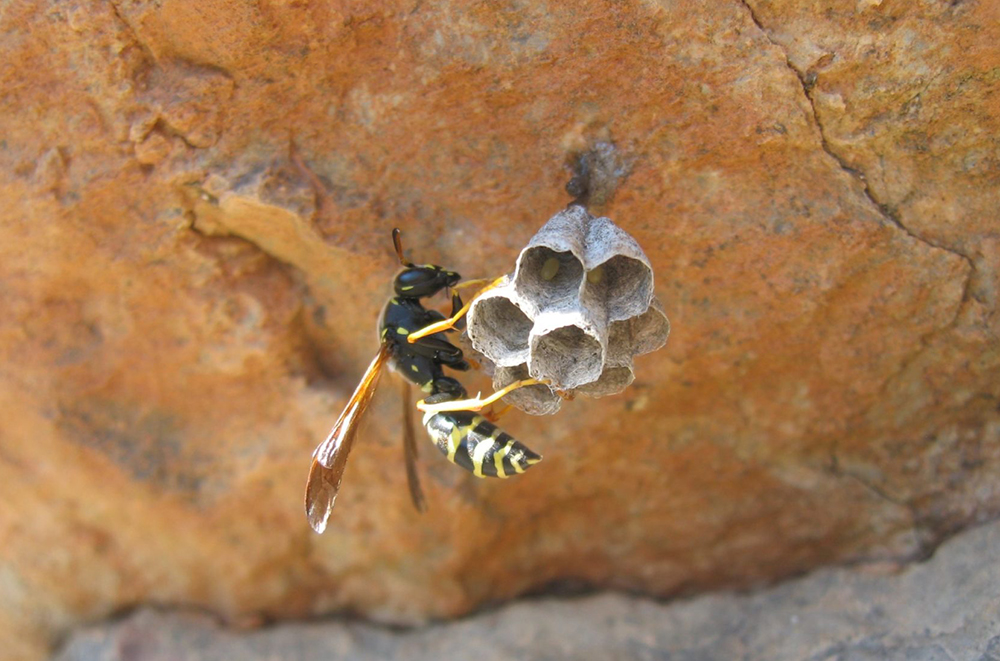
Die Berg-Feldwespe (hier die Königin am Nest) lebt auf über 1000 Metern Seehöhe. Sie ist eine von 3 untersuchten Arten, um herauszufinden, wie die Tiere auf höhere Temperaturen duch den Klimawandel reagieren. Foto: Kovac

Die Berg-Feldwespe (hier die Königin am Nest) lebt auf über 1000 Metern Seehöhe. Sie ist eine von 3 untersuchten Arten, um herauszufinden, wie die Tiere auf höhere Temperaturen duch den Klimawandel reagieren. Foto: Kovac

Wird es den Wespen zu heiß? FWF-Projekt von BiologInen der Uni Graz untersucht wie Insekten auf den Temperaturanstieg durch den Klimawandel reagieren

Eine Forschungsgruppe aus Graz untersuchte den Stoffwechsel von Wespen und konnte zeigen, dass der Energieverbrauch der Tiere mit ansteigenden Temperaturen stark zunimmt. Das könnte helfen, die Gefährdung von Insekten durch den Klimawandel genauer zu verstehen.

Durchschnittlich nimmt die Zahl der Insekten pro Jahrzehnt um fast zehn Prozent ab, bis zu 40 Prozent der Arten könnten in den nächsten Jahrzehnten aussterben. Die Gründe dafür sind vielfältig, Landnutzung und Pestizideinsatz sind wichtige Faktoren, doch die genauen Mechanismen sind kaum verstanden. Insbesondere ist bislang unklar, wie die Insekten auf den Temperaturanstieg durch den Klimawandel reagieren. Eine Gruppe um den Biologen Helmut Kovac hat nun in einem vom Wissenschaftsfonds FWF finanzierten Projekt den Energiehaushalt mehrerer Wespenarten in Bezug auf die Umgebungstemperatur genauer untersucht.

Kooperation mit Klimaforschung
Kovac betont, dass genaue Aussagen über Bedrohungsszenarien für Insekten durch den Klimawandel nach wie vor schwierig sind. „Man muss da wirklich jede Art genau analysieren. Noch ist schwer zu sagen, welche Arten wie gefährdet sind“, sagt Kovac. Die Wespen sind dabei nicht nur als Modellorganismus interessant, sondern nehmen im heimischen Ökosystem eine vielfach unterschätzte Rolle ein, indem sie Larven von Motten und ähnlichen Tieren fressen und so für die Landwirtschaft als Nützlinge gelten. Kovacs Erkenntnisse über den Stoffwechsel sollen als Grundlage für Forschungspartnerschaften mit Gruppen dienen, die auf Klimaforschung spezialisiert sind. „Dann können wir genauere Prognosen abgeben, welche Arten gefährdet sind und welche vielleicht sogar von höheren Temperaturen profitieren“, hofft Kovac.

>> Mehr erfahren: zum vollständigen Beitrag des FWF

created by FWF & Andreas Schweiger

Related news

Whistles against division: Rivka Saltiel experienced both unrest and solidarity in the US

Rivka Saltiel, a geographer from the University of Graz, has been working as a visiting professor in Minneapolis for the past five months and has witnessed first-hand the state of emergency and the deadly raids carried out by the immigration agency ICE. She reports on the collective solidarity of the population, the resistance to the President’s attempts to divide the community, and the power of informal social networks that ensure day-to-day provision and safety. These practices of solidarity are also relevant for Europe.

Record of reported species: Styria wins the global City Nature Challenge

Observers in Styria recorded 5,158 different animals, plants and fungi as part of the international City Nature Challenge between 24 and 27 April 2026. This saw the region take first place in the "species" category. Ostrava in the Czech Republic made the most observations, with just under 140,000, whilst the San Francisco Bay Area had the highest number of participants, namely 3,019.

Studying at the University of Graz: How to enrol

Ready for a new chapter in your life with the start of your studies at the University of Graz in the winter semester 2026/27? Here you will find information on deadlines, admission procedures, registration, and everything else you need to successfully start your studies in the fall.

Europe Day: Strengthening international expertise with Arqus

On 9 May, the spotlight will be on Europe. At the University of Graz, European cooperation is also a tangible part of everyday student life – not least through the Arqus university alliance. Master’s and PhD students can currently register for the Arqus micro-credential in ‘Advanced Creative Thinking and Communication’.

Begin of page section:
Additional information:

University of Graz
Universitaetsplatz 3
8010 Graz
Austria
  • Contact
  • Web Editors
  • Moodle
  • UNIGRAZonline
  • Imprint
  • Data Protection Declaration
  • Accessibility Declaration
Weatherstation
Uni Graz

End of this page section. Go to overview of page sections

End of this page section. Go to overview of page sections

Begin of page section:

End of this page section. Go to overview of page sections


