



Begin of page section:
Page sections:

  • Go to contents (Accesskey 1)
  • Go to position marker (Accesskey 2)
  • Go to main navigation (Accesskey 3)
  • Go to sub navigation (Accesskey 4)
  • Go to additional information (Accesskey 5)
  • Go to page settings (user/language) (Accesskey 8)
  • Go to search (Accesskey 9)

End of this page section. Go to overview of page sections

Begin of page section:
Page settings:

English en
Deutsch de
Search
Login

End of this page section. Go to overview of page sections

Begin of page section:
Search:

Search for details about Uni Graz
Close

End of this page section. Go to overview of page sections


Search

Begin of page section:
Main navigation:

Page navigation:

  • University

    University
    • About the University
    • Organisation
    • Faculties
    • Library
    • Working at University of Graz
    • Campus
    Developing solutions for the world of tomorrow - that is our mission. Our students and our researchers take on the great challenges of society and carry the knowledge out.
  • Research Profile

    Research Profile
    • Our Expertise
    • Research Questions
    • Research Portal
    • Promoting Research
    • Research Transfer
    • Ethics in Research
    • Commission for Scientific Integrity
    Scientific excellence and the courage to break new ground. Research at the University of Graz creates the foundations for making the future worth living.
  • Studies

    Studies
    • Prospective Students
    • Students
  • Community

    Community
    • International
    • Location
    • Research and Business
    • Alumni
    The University of Graz is a hub for international research and brings together scientists and business experts. Moreover, it fosters the exchange and cooperation in study and teaching.
  • Spotlight
Topics
  • Sustainable University
  • Researchers answer
  • Work for us
Close menu

End of this page section. Go to overview of page sections

Begin of page section:
You are here:

University of Graz News Herzblut & Energie

End of this page section. Go to overview of page sections

Tuesday, 10 December 2013

Herzblut & Energie

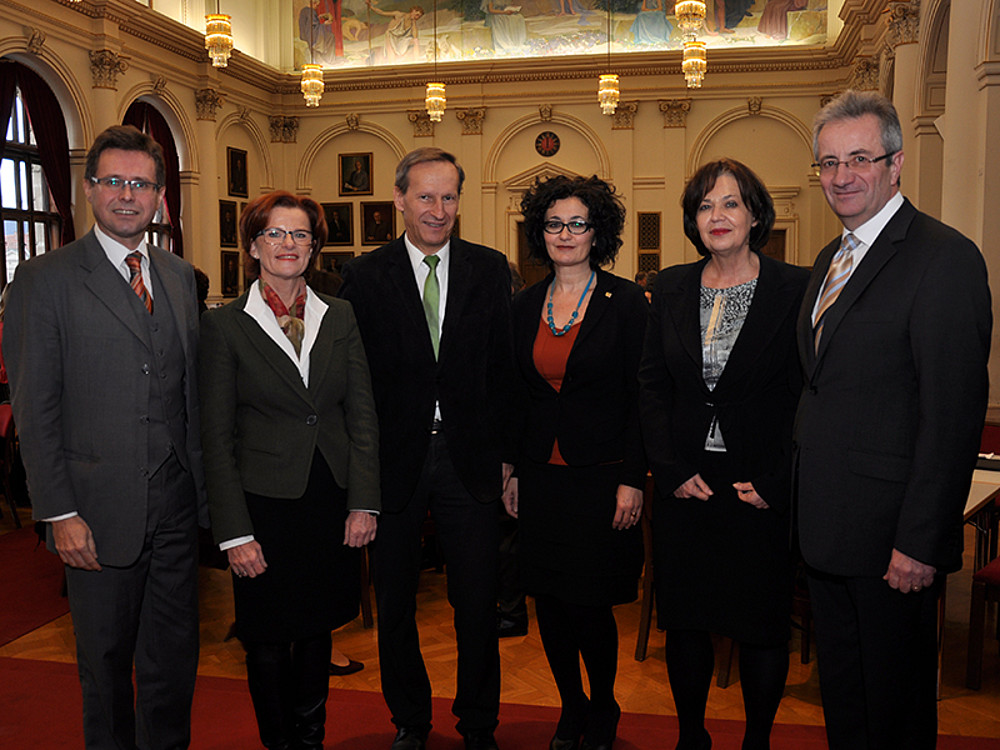
Uni-Graz-Vizerektor Martin Polaschek, PH-Steiermark-Rektorin Elgrid Messner, KPH-Rektor Siegfried Barones, Uni-Klagenfurt-Vizerektorin Cristina Beretta, PH-Kärnten-Rektorin Marlies Krainz-Dürr und PH-Burgenland-Rektor Walter Degendorfer (v.l.)

Uni-Graz-Vizerektor Martin Polaschek, PH-Steiermark-Rektorin Elgrid Messner, KPH-Rektor Siegfried Barones, Uni-Klagenfurt-Vizerektorin Cristina Beretta, PH-Kärnten-Rektorin Marlies Krainz-Dürr und PH-Burgenland-Rektor Walter Degendorfer (v.l.)

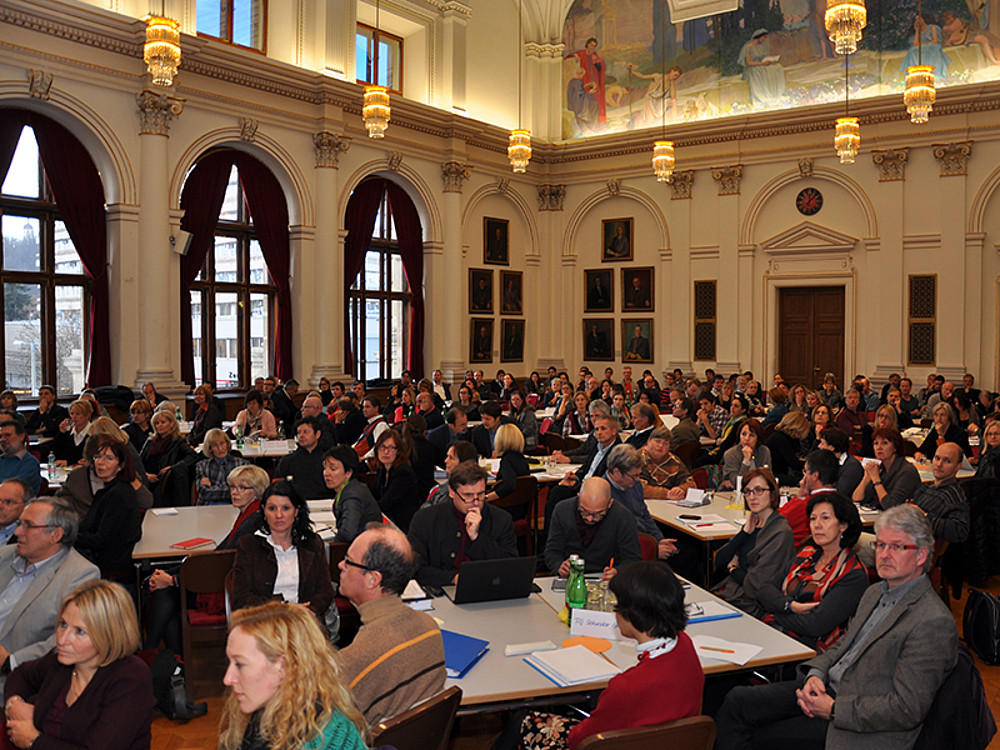
Mehr als 200 VertreterInnen von sechs Hochschulen diskutierten die gemeinsame Curricula-Entwicklung.

Mehr als 200 VertreterInnen von sechs Hochschulen diskutierten die gemeinsame Curricula-Entwicklung.

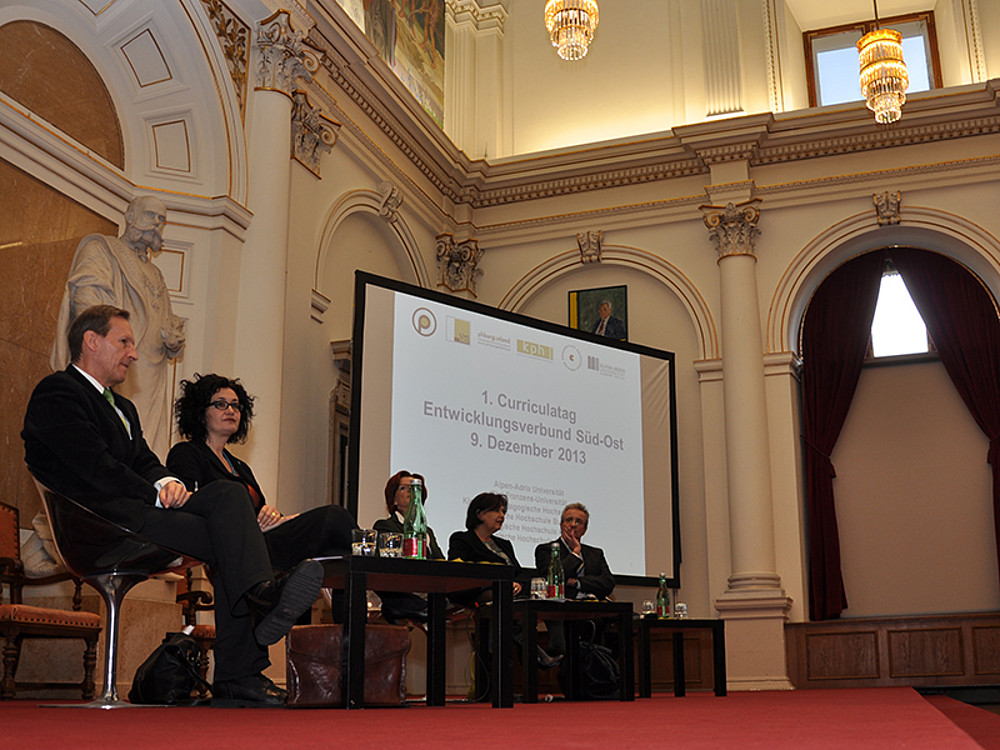
Am 9. Dezember 2013 ging in der Aula der Uni Graz der erste Curricula-Tag des Entwicklungsverbundes Süd-Ost über die Bühne.

Am 9. Dezember 2013 ging in der Aula der Uni Graz der erste Curricula-Tag des Entwicklungsverbundes Süd-Ost über die Bühne.

Erster Curricula-Tag: Hochschulen im Südosten Österreichs entwickeln gemeinsam neue Studienangebote

Der Entwicklungsverbund Süd-Ost ist österreichweit Pionier bei der gemeinsamen Curricula-Entwicklung für die Lehramtsstudien. Vier Hochschulen und zwei Universitäten in drei Bundesländern ziehen an einem Strang und starteten die gemeinsame Entwicklung der neuen Studienangebote. Am 9. Dezember 2013 trafen sich mehr als 200 VertreterInnen der sechs Hochschulen in der Aula der Uni Graz zum ersten Curricula-Tag des Entwicklungsverbundes Süd-Ost, um die Erstellung des neuen Lehramtsstudiums für LehrerInnen der Sekundarstufe breit zu diskutieren.
Der Entwicklungsverbund Süd-Ost setzt sich aus folgenden Institutionen zusammen: Uni Graz, Pädagogische Hochschule (PH) Steiermark, Kirchliche PH Graz, Private PH Burgenland, PH Kärnten sowie die Alpen-Adria-Universität Klagenfurt.

„Wir haben die Herausforderung angenommen und versuchen es mit viel Herzblut und Energie gemeinsam“, begrüßte Uni-Graz-Vizerektor Martin Polaschek die TeilnehmerInnen. PH-Steiermark-Rektorin Elgrid Messner dankte allen für das Engagement: „Wir stellen Kooperation statt Konkurrenz in den Vordergrund und setzen auf Wissenschafts- sowie Praxisorientierung.“
KPH-Rektor Siegfried Barones unterstrich im Rahmen der Eröffnung die „untrennbare Einheit“ von Bachelor- und Masterstudien. Geplant ist, dass künftig alle Primar- und SekundarstufenlehrerInnen – Volksschul-, Neue Mittelschule- und AHS-LehrerInnen – eine vierjährige Ausbildung zum Bachelor of Education absolvieren. An diese schließt eine einjährige Induktions- bzw. Einführungsphase an einer Schule an. Parallel dazu folgt ein eineinhalb- bis zweijähriges Masterstudium mit dem Master of Education als Abschluss.
Die Curricula-Entwicklung soll im Laufe des aktuellen Studienjahres abgeschlossen werden, die Genehmigung dann 2014/15 vorliegen. Das erste Studium soll 2015/16 am Start stehen.
created by Andreas Schweiger

Related news

Higher Education Strategy 2040: Austria’s universities on course for the future

Austria has 77 higher education institutions, which is above the EU average – but does this really make sense? The new Higher Education Strategy 2040 focuses on cooperation rather than mergers. As one of the six largest universities in Austria, the University of Graz plays a central role in this.

Climate research in Greenland: Old data provides new insights

The polar explorer and University of Graz professor Alfred Wegener left behind a unique collection of climate data from Greenland. A research team from the University of Graz is now analysing this 100-year-old treasure trove of data and comparing it with current measurements.

Diversity in nature and science: How we talk about plants and each other

Ginkgo, kiwi, hemp: they exist as male and female plants. Anyone who paid attention in biology class will confirm this. But is this categorisation, established by Carl von Linné almost 300 years ago, still valid today? An interdisciplinary team at the University of Graz is questioning these attributions and using this as a starting point to provide food for thought for gender-sensitive interaction between students, scientific and teaching staff.

Around the world in eight stops: the Long Night of Research at the University of Graz

On 24 April from 5 pm, you can take a short trip around the globe at the University of Graz, discovering pecularities of foreign countries or new local features in the entrance hall of the University Library. The itinerary takes you through introduced animal species, political attitudes and the omnipotence of algorithms. There will also be a programme in the historic reading hall, as well as at the UniGraz@Museum and the University Archive.

Begin of page section:
Additional information:

University of Graz
Universitaetsplatz 3
8010 Graz
Austria
  • Contact
  • Web Editors
  • Moodle
  • UNIGRAZonline
  • Imprint
  • Data Protection Declaration
  • Accessibility Declaration
Weatherstation
Uni Graz

End of this page section. Go to overview of page sections

End of this page section. Go to overview of page sections

Begin of page section:

End of this page section. Go to overview of page sections

