Begin of page section:
Page sections:

  • Go to contents (Accesskey 1)
  • Go to position marker (Accesskey 2)
  • Go to main navigation (Accesskey 3)
  • Go to sub navigation (Accesskey 4)
  • Go to additional information (Accesskey 5)
  • Go to page settings (user/language) (Accesskey 8)
  • Go to search (Accesskey 9)

End of this page section. Go to overview of page sections

Begin of page section:
Page settings:

English en
Deutsch de
Search
Login

End of this page section. Go to overview of page sections

Begin of page section:
Search:

Search for details about Uni Graz
Close

End of this page section. Go to overview of page sections


Search

Begin of page section:
Main navigation:

Page navigation:

  • University

    University
    • About the University
    • Organisation
    • Faculties
    • Library
    • Working at University of Graz
    • Campus
    Developing solutions for the world of tomorrow - that is our mission. Our students and our researchers take on the great challenges of society and carry the knowledge out.
  • Research Profile

    Research Profile
    • Our Expertise
    • Research Questions
    • Research Portal
    • Promoting Research
    • Research Transfer
    • Ethics in Research
    • Commission for Scientific Integrity
    Scientific excellence and the courage to break new ground. Research at the University of Graz creates the foundations for making the future worth living.
  • Studies

    Studies
    • Prospective Students
    • Students
    • Welcome Weeks for First Year Students
  • Community

    Community
    • International
    • Location
    • Research and Business
    • Alumni
    The University of Graz is a hub for international research and brings together scientists and business experts. Moreover, it fosters the exchange and cooperation in study and teaching.
Topics
  • Sustainable University
  • Researchers answer
  • Work for us
Close menu

End of this page section. Go to overview of page sections

Begin of page section:
You are here:

University of Graz News Heimgekehrt

End of this page section. Go to overview of page sections

Thursday, 21 January 2021

Heimgekehrt

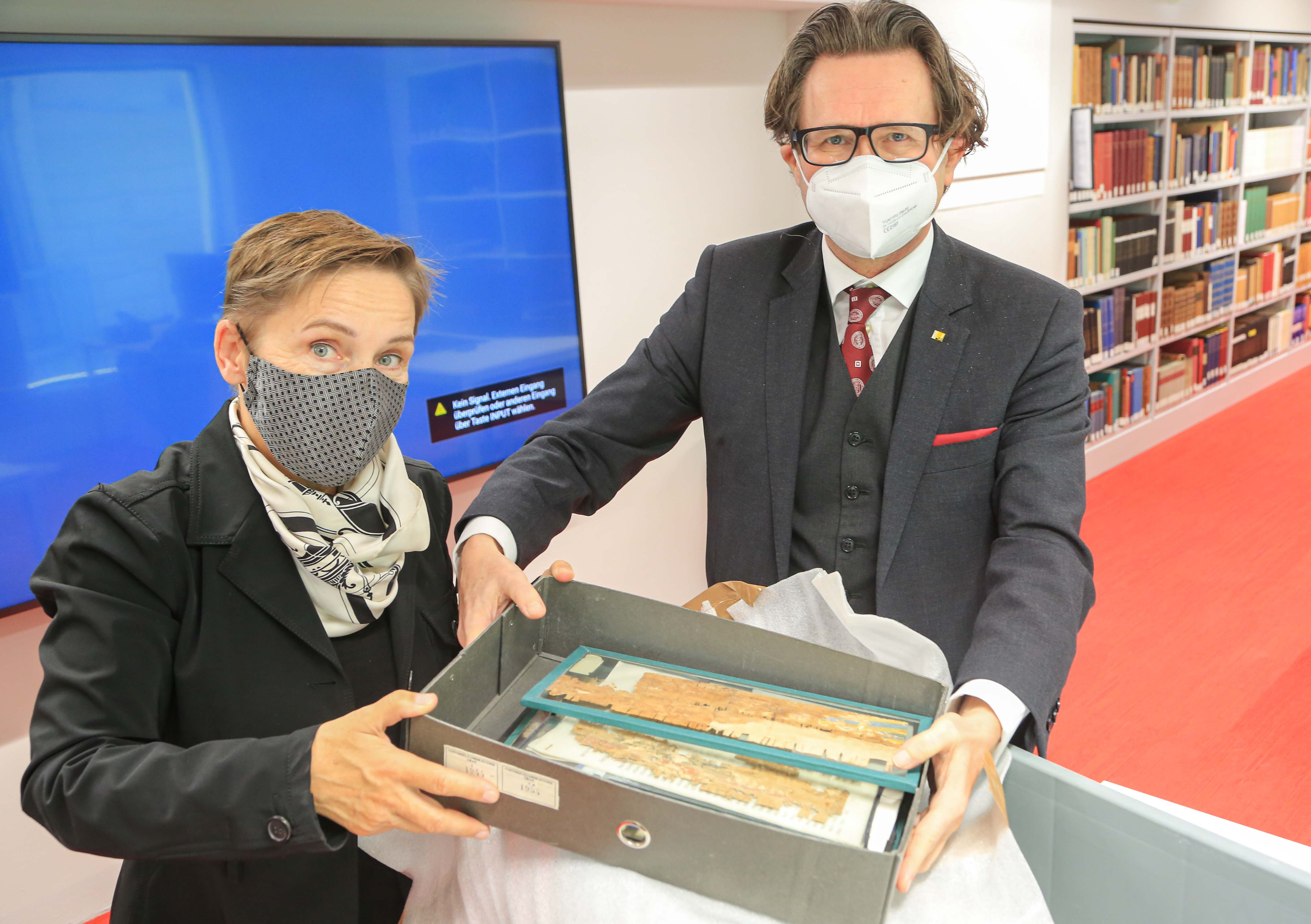
Rektor Martin Polaschek und Vizerektorin Petra Schaper-Rinkel nahmen die Unikate an der Uni Graz in Empfang. Fotos: Uni Graz/Tzivanopoulos

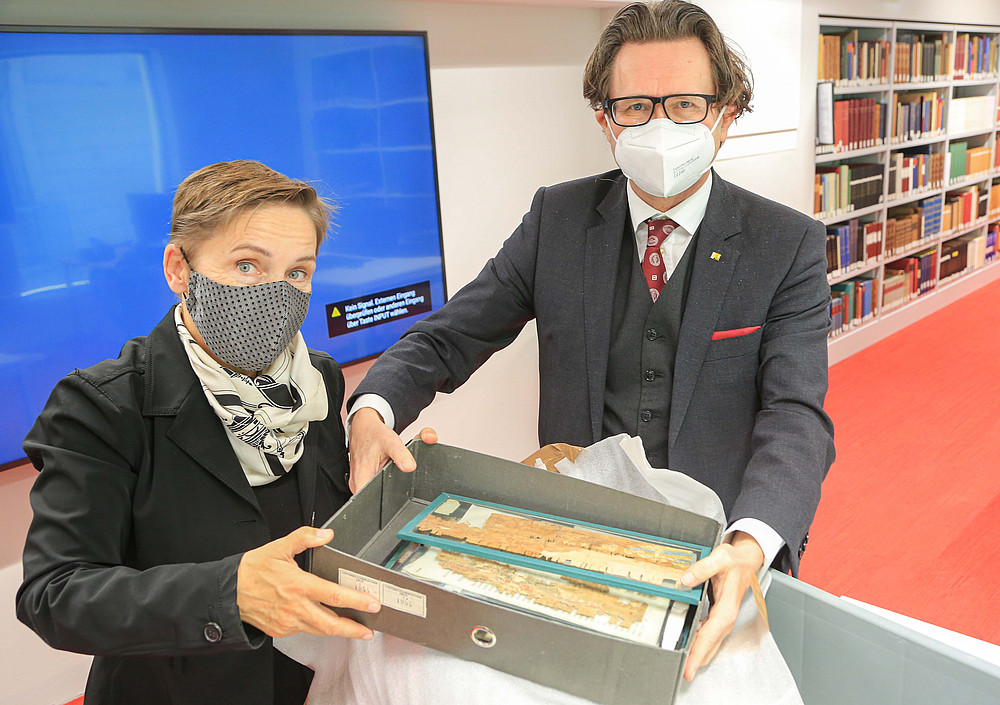
Rektor Martin Polaschek und Vizerektorin Petra Schaper-Rinkel nahmen die Unikate an der Uni Graz in Empfang. Fotos: Uni Graz/Tzivanopoulos

Nach vier Jahren im Exil zogen nun die Handschriften der Universitätsbibliothek in ihr neues Zuhause ein

In der Tat geht der gestrige Tag in die Geschichte der Universität Graz ein. Mit einem Sondertransport wurden die letzten Teile der Sondersammlungen der Universitätsbibliothek vom Außenlager in der Weinzöttlstraße 16 zurück in den neuen Tresorraum an den Universitätsplatz 3a gebracht. Da sich der Wert des Inhalts innerhalb des LKW nur schwer schätzen ließ – rund 500 Millionen Euro –, eskortierten drei Beamte der Grazer Polizei den Transport – sicherheitshalber. Am Campus wurden die Schriften von Rektor Martin Polaschek und Petra Schaper-Rinkel, Vizerektorin für Digitalisierung, in Empfang genommen. Zuerst verließen der Briefwechsel zwischen Johannes Kepler und des Mathematikers und Astronomen Paul Guldin, datiert 1618 bis 1627, sowie eine Zivil-Rechtshandschrift aus Bologna in lateinischer Sprache aus dem 14. Jahrhundert die Ladefläche des Transporters.
 

Aber kurz zurück zum Anfang der Geschichte. Vor vier Jahren übersiedelten die mehr als 3000 Handschriften und Inkunabeln, die an der Universitätsbibliothek aufbewahrt werden, in ein gesichertes Außenlager nach Graz Andritz. Die Bundesimmobiliengesellschaft und Universität Graz sanierten und erweiterten das Gebäude, im Herbst 2019 wurde es fertiggestellt und von der Bibliothek wieder bezogen. Während die neuen Bestände rasch zurückgesiedelt wurden, folgten in der Abteilung für Sondersammlungen monatelange Temperatur- und Klimamessungen im Tresor. „Während der Zeit des Umbaus mussten alle Bestände ausgelagert werden. Unsere wertvollsten Objekte werden jetzt zuletzt rückgeführt“, erzählt der wissenschaftliche Leiter der Sondersammlungen, Erich Renhart. Es kam die Corona-Krise, so entschied man sich den Transport auf Anfang 2021 zu verlegen. Am 20. Jänner war es dann so weit. „Wir haben die Schriften erst in dem Moment wieder bei uns zurückhaben wollen, wo wir die optimalsten Bedingungen für unsere wertvollsten Bestände geschaffen haben“, betont Vizerektorin Schaper-Rinkel.
 

Die Handschriften und Inkunabeln sind Objekte der Wissenschaft und stehen der Forschung zur Verfügung. Rund 40 Prozent aller Unikate sind bereits digital verfügbar und können über das Internet beforscht werden. Doch die beste Digitalisierung der Welt ersetzt eine Arbeit am Objekt nicht. „ForscherInnen und Studierende können mit den Handschriften wieder vor Ort arbeiten und sie verwenden - sobald es die Corona-Fallzahlen wieder erlauben“, freut sich Rektor Martin Polaschek. 

Weitere Infos: Homepage Abteilung für Sondersammlungen


ORF-Beitrag zur Übersiedelung


Die Ankunft der Handschriften am Campus.
created by Konstantinos Tzivanopoulos

Related news

Electrifying: Researchers film the first moments on the way from light to electricity

Physicists at the University of Graz (Austria), in collaboration with colleagues from Marburg University and Forschungszentrum Jülich (Germany), have achieved a scientific breakthrough. For the first time, the generation of electrical energy from light has been filmed and described theoretically. This work is of far-reaching significance, not least for optimising sustainable energy production from photovoltaics. This is because it provides fundamental building blocks for understanding the physical processes that take place, for example, in organic solar cells. The paper was published in the journal Physical Review X, one of the world’s most prestigious physics journals.

University of Graz: Working together to make Styria a sustainable centre of learning

Round table calls for sustainable funding for the 2028–2030 performance agreement period between the five Styrian universities and the federal government.

How can we teach using YouTube and AI? The University of Graz is strengthening media education in schools

A journey through the blood vessels using VR headsets brings biology lessons to life. An interactive quiz brings physics to life. The YouTube video explains the First World War. Whilst mobile phones are increasingly being banned from the classroom, social media platforms, apps and AI are playing an ever-greater role in knowledge transfer at school. But how can teaching with media be made even more effective? What are the challenges in media-based teaching? At the University of Graz, researchers are discussing these issues at a conference being held in Austria for the first time.

Jurassic Sounds: Biologist reconstructs insect songs from 165 million years ago

It was apparently not just the roars of the dinosaurs that made up the soundscape of the animal world during the Jurassic period. Crickets and grasshoppers communicated through a variety of songs and high-pitched sounds, as Thorin Jonsson from the Institute of Biology at the University of Graz discovered together with colleagues from the universities of Lincoln, Bristol (UK), Beijing (China) and Tempe (USA). The findings on what are so far the oldest traces of sound on Earth have just been published in the journal PNAS.

Begin of page section:
Additional information:

University of Graz
Universitaetsplatz 3
8010 Graz
Austria
  • Contact
  • Web Editors
  • Moodle
  • UNIGRAZonline
  • Imprint
  • Data Protection Declaration
  • Accessibility Declaration
Weatherstation
Uni Graz

End of this page section. Go to overview of page sections

End of this page section. Go to overview of page sections

Begin of page section:

End of this page section. Go to overview of page sections