Begin of page section:
Page sections:

  • Go to contents (Accesskey 1)
  • Go to position marker (Accesskey 2)
  • Go to main navigation (Accesskey 3)
  • Go to sub navigation (Accesskey 4)
  • Go to additional information (Accesskey 5)
  • Go to page settings (user/language) (Accesskey 8)
  • Go to search (Accesskey 9)

End of this page section. Go to overview of page sections

Begin of page section:
Page settings:

English en
Deutsch de
Search
Login

End of this page section. Go to overview of page sections

Begin of page section:
Search:

Search for details about Uni Graz
Close

End of this page section. Go to overview of page sections


Search

Begin of page section:
Main navigation:

Page navigation:

  • University

    University
    • About the University
    • Organisation
    • Faculties
    • Library
    • Working at University of Graz
    • Campus
    Developing solutions for the world of tomorrow - that is our mission. Our students and our researchers take on the great challenges of society and carry the knowledge out.
  • Research Profile

    Research Profile
    • Our Expertise
    • Research Questions
    • Research Portal
    • Promoting Research
    • Research Transfer
    • Ethics in Research
    Scientific excellence and the courage to break new ground. Research at the University of Graz creates the foundations for making the future worth living.
  • Studies

    Studies
    • Prospective Students
    • Students
  • Community

    Community
    • International
    • Location
    • Research and Business
    • Alumni
    The University of Graz is a hub for international research and brings together scientists and business experts. Moreover, it fosters the exchange and cooperation in study and teaching.
  • Spotlight
Topics
  • Our digital Advent calendar
  • Sustainable University
  • Researchers answer
  • Work for us
Close menu

End of this page section. Go to overview of page sections

Begin of page section:
You are here:

University of Graz News Guter Unterricht

End of this page section. Go to overview of page sections

Thursday, 12 December 2019

Guter Unterricht

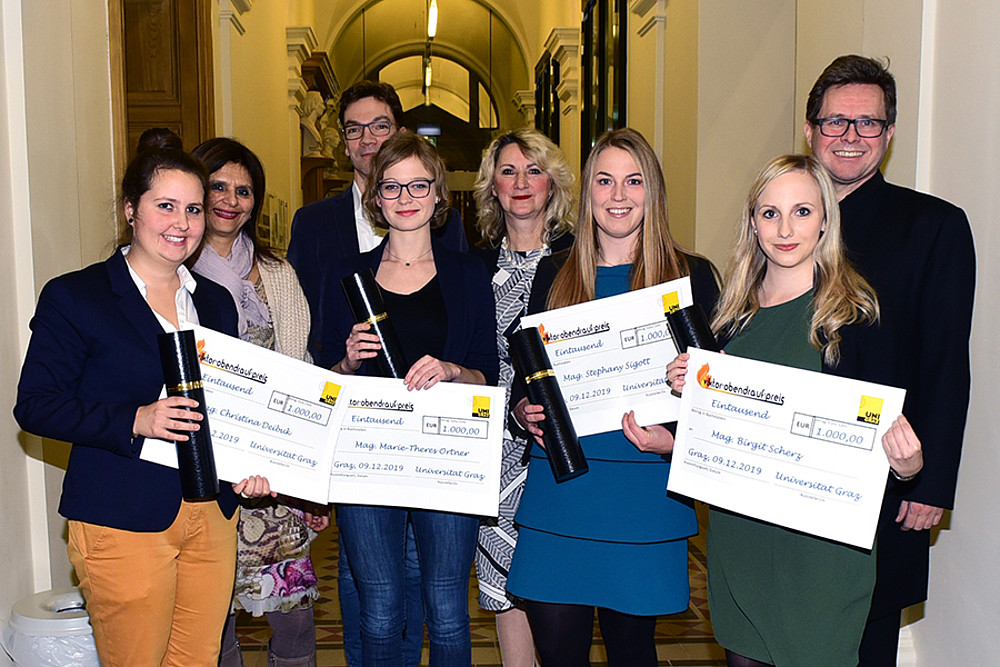
Die Preisträgerinnen und ihre BetreuerInnen: Christina Deibuk, Simona Bartoli-Kucher, Stephan Monschein, Marie-Theres Ortner, Margit Reitbauer, Stephany Sigott und Birgit Scherz mit Rektor Martin Polaschek (v.l.). Foto: Uni Graz/Pichler

Die Preisträgerinnen und ihre BetreuerInnen: Christina Deibuk, Simona Bartoli-Kucher, Stephan Monschein, Marie-Theres Ortner, Margit Reitbauer, Stephany Sigott und Birgit Scherz mit Rektor Martin Polaschek (v.l.). Foto: Uni Graz/Pichler

Viktor-Obendrauf-Preis prämiert herausragende Fachdidaktik-Diplomarbeiten

Wie lässt sich im Biologie-Unterricht handlungsorientierter Naturschutz lehren? Und wie können SchülerInnen die Grundwerkzeuge von BiologInnen – das Beobachten, Betrachten und Vergleichen – erwerben? Die erste Frage beantwortete Birgit Scherz, die zweite Marie-Theres Ortner in ihrer Diplomarbeit an der Universität Graz. Für ihre Unterrichtskonzepte erhielten die beiden am 9. Dezember 2019 den Viktor-Obendrauf-Preis. Ebenso wie zwei weitere Lehramtstudierende: Stephany Sigott untersuchte aus Sicht der Kognitiven Linguistik, wie sich optimale Lernleistungen hinsichtlich sprachlicher und fachlicher Kompetenzen erzielen lassen. Und Christina Deibuk entwickelte ein Konzept zur Bearbeitung des Themas Diversität im Italienisch-Unterricht.

Mit dem Viktor-Obendrauf-Preis prämiert die Universität Graz jedes Jahr AbsolventInnen für herausragende Abschlussarbeiten im Bereich der Fachdidaktik. „Wir wollen damit zum einen außergewöhnliche Leistungen unserer Studierenden würdigen und zum anderen die Bedeutung der Fachdidaktik als Wissenschaft hervorheben“, unterstrich Rektor Martin Polaschek bei der Verleihung.
Die Auszeichnung ehrt zugleich das Andenken an den Chemielehrer und Fachdidaktiker Viktor Obendrauf (1953-2010), der über viele Jahre SchülerInnen, Studierende und KollegInnen mit seinen Experimentalvorlesungen begeisterte.

Heuer vergab die Jury aufgrund der Qualtiät der Einreichungen vier statt der üblichen drei Preise, dotiert mit jeweils 1.000 Euro.

  • Christina Deibuk: „Le razze non esistono“ – Insegnare la cultura nella classe d'Italiano sulla base die testi di Igiaba Scego; Betreuerin: Simona Bartoli-Kucher
  • Marie-Theres Ortner: Das Potential von Zoos als außerschulische Lernorte für den Biologieunterricht. Ein Unterrichtskonzept in der Tierwelt Herberstein; Betreuer: Stephan Monschein
  • Birgit Scherz: „Nur was ich kenne, kann ich auch schützen“ – Zur handlungsorientierten Umsetzung des Themas Naturschutz im Unterrichtsfach Biologie und Umweltkunde; Betreuer: Stephan Monschein
  • Stephany Sigott: Integrating Content and Language: A Linguistic Analysis of Content and language integrated learning Classroom Discourse; Betreuerin: Margit Reitbauer


created by Gudrun Pichler

Related news

Semester abroad without barriers: University of Graz wins award for promoting inclusion

The University of Graz has been awarded the Internationalization Award for its new inclusion initiative. Students with fewer opportunities now also receive financial support for their semester abroad outside Europe.

Fair distribution: Researchers determine just greenhouse gas budgets for all EU regions

Ten years ago, on 12 December 2015, the Paris Climate Agreement was signed at the UN Climate Conference. In order to limit global warming to well below two degrees, only a certain amount of CO2 may be emitted worldwide. While the focus was originally on national emission targets, more than 200 subnational regions and almost 300 cities have now adopted their own targets. But how many emissions are they fairly entitled to? Researchers at the University of Graz have now developed transparent criteria for fair distribution at the subnational level for the first time and determined corresponding greenhouse gas budgets for all European regions. The paper was published today in the scientific journal Nature Communications.

Chemical Christmas show at the University of Graz: An explosive evening at the Schauspielh

At the beginning of December, the University of Graz transformed the theater into a laboratory: as part of “Chemical Life,” teacher training students staged a chemical Christmas show for Styrian school classes—complete with ethanol rockets, nitrogen snow, and glowing effects. An evening designed to inspire interest in studying chemistry.

Train by train: Koralm railway accelerates exchange between the Universities

Lectures at the University of Klagenfurt in the morning, seminars at the University of Graz in the afternoon: Austria's longest tunnel and a journey time of around 45 minutes make it easy. The Koralm railway increases the speed of networking between the two university locations. The collaboration builds on existing cooperation - for example in the areas of teacher training, Slavic studies and as employers, the universities are well coordinated.

Begin of page section:
Additional information:

University of Graz
Universitaetsplatz 3
8010 Graz
Austria
  • Contact
  • Web Editors
  • Moodle
  • UNIGRAZonline
  • Imprint
  • Data Protection Declaration
  • Accessibility Declaration
Weatherstation
Uni Graz

End of this page section. Go to overview of page sections

End of this page section. Go to overview of page sections

Begin of page section:

End of this page section. Go to overview of page sections