



Begin of page section:
Page sections:

  • Go to contents (Accesskey 1)
  • Go to position marker (Accesskey 2)
  • Go to main navigation (Accesskey 3)
  • Go to sub navigation (Accesskey 4)
  • Go to additional information (Accesskey 5)
  • Go to page settings (user/language) (Accesskey 8)
  • Go to search (Accesskey 9)

End of this page section. Go to overview of page sections

Begin of page section:
Page settings:

English en
Deutsch de
Search
Login

End of this page section. Go to overview of page sections

Begin of page section:
Search:

Search for details about Uni Graz
Close

End of this page section. Go to overview of page sections


Search

Begin of page section:
Main navigation:

Page navigation:

  • University

    University
    • About the University
    • Organisation
    • Faculties
    • Library
    • Working at University of Graz
    • Campus
    Developing solutions for the world of tomorrow - that is our mission. Our students and our researchers take on the great challenges of society and carry the knowledge out.
  • Research Profile

    Research Profile
    • Our Expertise
    • Research Questions
    • Research Portal
    • Promoting Research
    • Research Transfer
    • Ethics in Research
    • Commission for Scientific Integrity
    Scientific excellence and the courage to break new ground. Research at the University of Graz creates the foundations for making the future worth living.
  • Studies

    Studies
    • Prospective Students
    • Students
    • Welcome Weeks for First Year Students
  • Community

    Community
    • International
    • Location
    • Research and Business
    • Alumni
    The University of Graz is a hub for international research and brings together scientists and business experts. Moreover, it fosters the exchange and cooperation in study and teaching.
Topics
  • Sustainable University
  • Researchers answer
  • Work for us
Close menu

End of this page section. Go to overview of page sections

Begin of page section:
You are here:

University of Graz News Günstig, wirksam, ohne Nadel

End of this page section. Go to overview of page sections

Tuesday, 14 May 2013

Günstig, wirksam, ohne Nadel

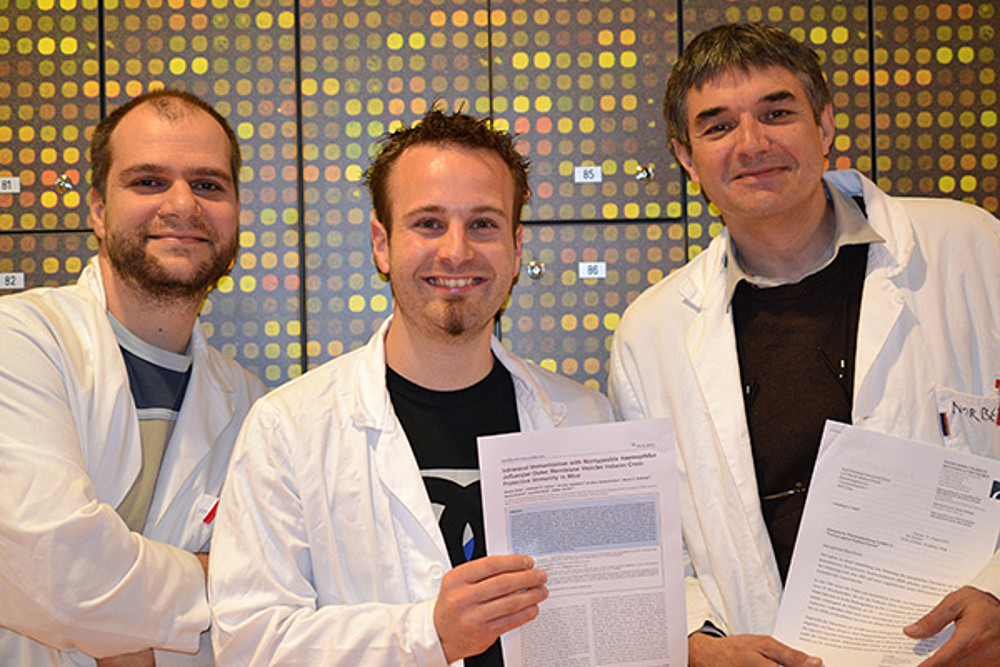
Patentes Team: Stefan Schild, Sandro Roier und Joachim Reidl entwickelten einen neuartigen Impfstoff.

Patentes Team: Stefan Schild, Sandro Roier und Joachim Reidl entwickelten einen neuartigen Impfstoff.

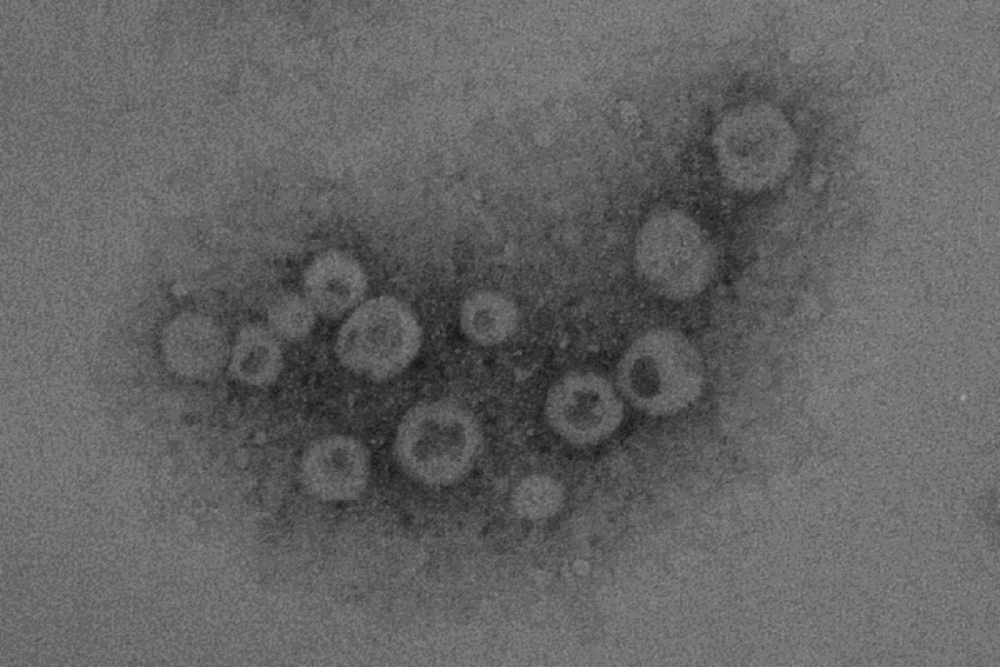
Erfolgreiches Mittel gegen Atemwegserkrankungen: Außenmembranvesikel unterm Elektronenmikroskop

Erfolgreiches Mittel gegen Atemwegserkrankungen: Außenmembranvesikel unterm Elektronenmikroskop

Uni Graz schafft Grundlage für neuartigen Impfstoff

Möglichst preisgünstig, effektiv und leicht zu verabreichen – das sind die wesentlichen Anforderungen an moderne Impfstoffe. Eine Erfindung von Sandro Roier, Msc., Assoz.Univ.-Prof. Dr. Stefan Schild und Univ.-Prof. Dr. Joachim Reidl vom Institut für Molekulare Biowissenschaften der Uni Graz erfüllt diese Kriterien. Die Immunisierung gegen gefährliche Atemwegserkrankungen bei Mensch und Tier ist zum Patent angemeldet, ein wissenschaftlicher Artikel dazu erscheint in der aktuellen Ausgabe des International Journal of Medical Microbiology.
Bestimmte Gruppen von krankheitserregenden Bakterien verfügen über eine zweite äußere Zellmembran, die abgestoßen werden kann. Dieses so genannten Außenmembranvesikel – kurz OMV – ist das Faksimile des lebenden Bakteriums. „OMVs besitzen exakt die Antigene in der natürlichen Anordnung und sind daher als Impfstoff perfekt geeignet“, erklärt Stefan Schild. Menschen und Tiere produzieren also Antikörper und Gedächtniszellen, ohne zu erkranken. Dem Biowissenschafter gelang es, unter anderem die abgestoßenen Membranen von Erregern von Atemwegserkrankungen zu isolieren und für weitere Anwendungen bereitzustellen. „Konkret handelt es sich um Stämme der Pasteurellaceae, die zum Beispiel Rindergrippe, Geflügelcholera oder beim Menschen Erkrankungen der oberen Atemwege auslösen“, präzisiert Schild. Bis dato musste bei betroffenen Tierfarmen in der Regel der gesamte Bestand getötet werden, Menschen konnten nur mit Antibiotika behandelt werden. „Das erhöht aber die Gefahr von Resistenzen signifikant“, ergänzt Joachim Reidl. Besonders bei Leuten, die etwa an der chronisch obstruktiven Lungenerkrankung COPD leiden, wird dies zunehmend zum Problem.
Da aber die einzelnen Stämme der Pasteurellaceae so unterschiedlich sind, konnte bislang noch kein wirksamer Impfstoff gefunden werden. Eine Behandlung mit OMVs bietet allerdings – so die überraschende Entdeckung des Grazer Forscherteams – umfassenden Schutz gegen verschiedene Erreger derselben Spezies. Ein weiterer enormer Vorteil des neuen Vakzins ist seine Haltbarkeit. „OMVs müssen zudem nicht gekühlt werden, was die Kosten reduziert und den Einsatz in Entwicklungsländern ungemein erleichtert“, betont Reidl. Außerdem kann der Impfstoff oral oder intranasal verabreicht werden. „Diese Methode ist nicht nur für Menschen wesentlich angenehmer, auch LandwirtInnen können das Mittel selbst anwenden – eine zusätzliche Ersparnis“, so Schild.


Patentierter Erfolg gegen Cholera
Auf Basis derselben Technologie hat Stefan Schild bereits einen Impfstoff gegen Cholera entwickelt, der patentiert wurde. Auch dazu konnte der Wissenschafter einen Artikel im renommierten Fachjournal Infection and Immunity publizieren, der kürzlich bereits online erschienen ist.

Die Publikationen im Detail

Immunogenicity of Pasteurella multocida and Mannheimia haemolytica outer membrane vesicles. Sandro Roier, Judith C. Fenninger, Deborah R. Leitner, Gerald N. Rechberger, Joachim Reidl, and Stefan Schild. IJMM in press

Lipopolysaccharide-modifications of a cholera vaccine candidate based on outer membrane vesicles reduce the endotoxicity and reveal the major protective antigen. Leitner DR, Feichter S, Schild-Prüfert K, Rechberger GN, Reidl J, Schild S. Infect Immun. 2013 Apr 29. [Epub ahead of print]


created by Dagmar Eklaude

Related news

A fresh start, a calling, holidays: what draws people from other career paths to teaching

They used to develop software; now they teach maths in the classroom. Career changers are expected to help address the shortage of qualified teachers in Austria’s schools. In their doctoral theses at the Institute for Educational Research and Teacher Training at the University of Graz, Melanie Gürentz and Claudia Mair examined how these new teachers perceive their new professional roles.

Talent Talks bridge the gap in career guidance

The Styrian Chamber of Commerce (WKO Steiermark), the Styrian Chamber of Labour (AK Steiermark) and the AMS are joining forces when it comes to training young people and, through the “Talent Talks”, are creating a seamless pathway to career guidance. This takes preparation and follow-up support – just in time for the start of the term and the scheme’s tenth anniversary – to a whole new level. A new survey conducted by the Talent Centre among 2,687 former participants to mark the anniversary shows just how important this development is. Of the young people who received follow-up support from the Talent Report, 74.6 per cent stated that they had a good understanding of their own strengths and talents following the Talent Check. Without follow-up support, the figure was 66.5 per cent – a significant difference of 8.1 percentage points.

ERC Starting Grants: three million euros for two researchers at the University of Graz

Two researchers from the University of Graz have secured prestigious and generously funded grants from the EU. Starting Grants from the European Research Council (ERC), each worth 1.5 million euros, have been awarded to the human geographer Heide Bruckner and the social scientist Silvana Weiss.

Austria’s emissions rose in 2025: University of Graz researchers analyse the causes

The Environment Agency Austria has today published the figures for the country’s greenhouse gas emissions in 2025. While emissions fell sharply year on year from 2022 to 2024, they rose again by just under 0.7 per cent in 2025. Researchers at the University of Graz have analysed how much of this increase was due to structural changes in the economy and how much was attributable to external factors over which there is little control. “In 2025, the colder winter compared with 2024 increased emissions by 0.81 per cent, while the weak economy reduced them by 0.38 per cent. If we factor out these influences, we find an underlying increase of 0.26 per cent compared with the previous year,” reports economist Karl Steininger. “This clearly means that Austria is not on track to meet its climate targets, which require a substantial reduction in emissions by 2030.”

Begin of page section:
Additional information:

University of Graz
Universitaetsplatz 3
8010 Graz
Austria
  • Contact
  • Web Editors
  • Moodle
  • UNIGRAZonline
  • Imprint
  • Data Protection Declaration
  • Accessibility Declaration
Weatherstation
Uni Graz

End of this page section. Go to overview of page sections

End of this page section. Go to overview of page sections

Begin of page section:

End of this page section. Go to overview of page sections