



Begin of page section:
Page sections:

  • Go to contents (Accesskey 1)
  • Go to position marker (Accesskey 2)
  • Go to main navigation (Accesskey 3)
  • Go to sub navigation (Accesskey 4)
  • Go to additional information (Accesskey 5)
  • Go to page settings (user/language) (Accesskey 8)
  • Go to search (Accesskey 9)

End of this page section. Go to overview of page sections

Begin of page section:
Page settings:

English en
Deutsch de
Search
Login

End of this page section. Go to overview of page sections

Begin of page section:
Search:

Search for details about Uni Graz
Close

End of this page section. Go to overview of page sections


Search

Begin of page section:
Main navigation:

Page navigation:

  • University

    University
    • About the University
    • Organisation
    • Faculties
    • Library
    • Working at University of Graz
    • Campus
    Developing solutions for the world of tomorrow - that is our mission. Our students and our researchers take on the great challenges of society and carry the knowledge out.
  • Research Profile

    Research Profile
    • Our Expertise
    • Research Questions
    • Research Portal
    • Promoting Research
    • Research Transfer
    • Ethics in Research
    • Commission for Scientific Integrity
    Scientific excellence and the courage to break new ground. Research at the University of Graz creates the foundations for making the future worth living.
  • Studies

    Studies
    • Prospective Students
    • Students
  • Community

    Community
    • International
    • Location
    • Research and Business
    • Alumni
    The University of Graz is a hub for international research and brings together scientists and business experts. Moreover, it fosters the exchange and cooperation in study and teaching.
  • Spotlight
Topics
  • Sustainable University
  • Researchers answer
  • Work for us
Close menu

End of this page section. Go to overview of page sections

Begin of page section:
You are here:

University of Graz News Grundrechte als Streitthema?

End of this page section. Go to overview of page sections

Friday, 27 October 2017

Grundrechte als Streitthema?
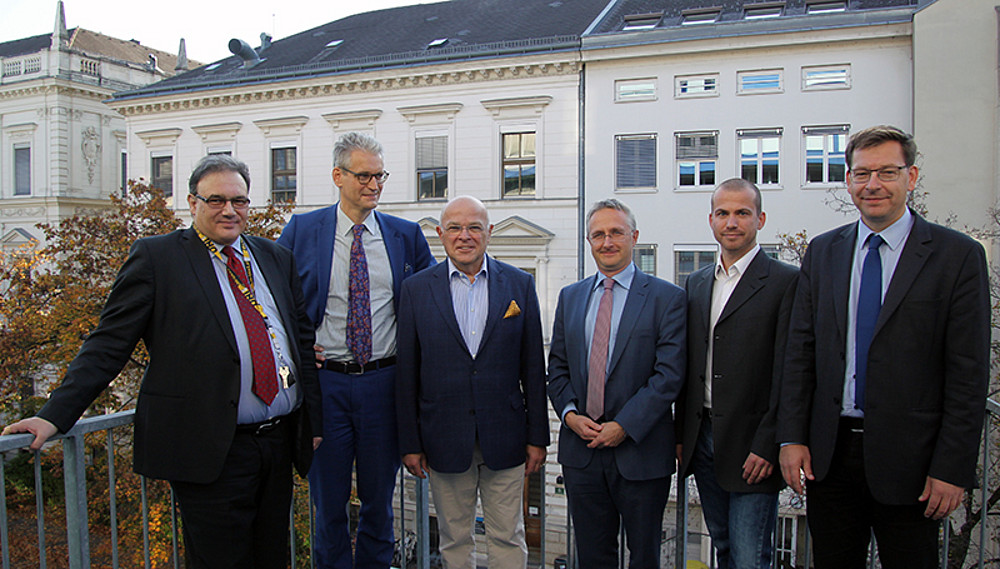
Hans-Peter Folz, Gabriel Toggenburg, Joseph Marko, Gerd Oberleitner, Markus Möstl und Stefan Storr (v.l.). Foto: Schmiedl/ETC

Hans-Peter Folz, Gabriel Toggenburg, Joseph Marko, Gerd Oberleitner, Markus Möstl und Stefan Storr (v.l.). Foto: Schmiedl/ETC

Podiumsdiskussion zu Menschenrechtsschutz in der EU

Nicht die Grundrechte an sich sorgten bei der Veranstaltung „Menschenrechtsschutz in der EU: Die Umsetzung der EU-Grundrechtecharta in den Mitgliedstaaten“ am 20. Oktober an der Universität Graz für Diskussionen, wohl aber die Frage, mit welchen juristischen Mitteln sie in den Mitgliedstaaten der Europäischen Union umgesetzt werden.

Nach der Eröffnung durch Univ.-Prof. Dr. Stefan Storr, Dekan der Rechtwissenschaftlichen Fakultät, stellte der Hauptredner, Hon.Prof. Dr. Gabriel Toggenburg, als Senior Legal Expert der Agentur der Europäischen Union für Grundrechte (FRA) in seinem Vortrag „Das Leben der Charta auf nationaler Ebene“ die Arbeit der Agentur und den aktuellen Grundrechtebericht 2017 vor.

Ergänzend beschrieb Dr. Markus Möstl vom Europäischen Trainings- und Forschungszentrum für Menschenrechte und Demokratie - ETC Graz in seinem Statement die Arbeit im multidisziplinären Forschungsnetzwerk FRANET, in dem das ETC Graz als Nationale Kontaktstelle Informationsanfragen aus nationaler Sicht beantwortet und die auf Österreich bezogenen Studien und Berichte erstellt. Beide Redner bezogen sich auf die Herausforderungen der Umsetzung von Grundrechten in wirksame und praktische Instrumente, die einen Einfluss auf das tägliche Leben haben, von Toggenburg beschrieben als „breites Tal zwischen dem Berg des Rechts und dem Berg des Alltagslebens“. Bei aller Schwierigkeit, Grundrechtsfortschritte auf formaler Ebene auf konkret spürbare Verbesserungen für die Menschen herunterzubrechen, gab der Experte mit Hinweisen zu Datenschutz und Schutz der Privatsphäre doch sehr konkrete Beispiele für die Auswirkungen des Grundrechtsschutzes auf das tägliche Leben der EuropäerInnen.

Eingriffe in das Alltagsleben des Individuums beziehungsweise die Abwehr von Eingriffen erläuterte Univ.-Prof. Dr. Hans-Peter Folz, Institut für Europarecht, an Hand von Entscheidungen des Europäischen Gerichtshofs (EuGH) und des Europäischen Gerichtshofs für Menschenrechte (EGMR) und verdeutlichte mit dem Beispiel des Europäischen Haftbefehls die Entscheidungsfindung von RichterInnen in der Abwägung zwischen Grundrechten und nationalem Recht.

Einspruch und etliche Diskussionsbeiträge aus dem Fachpublikum erntete schließlich Univ.-Prof. Dr. Joseph Marko, Institut für Öffentliches Recht und Politikwissenschaft, für seinen pointierten Beitrag, in dem er Grundlagen der Rechtswissenschaft auf Kopf stellte und eine Linie zu den heraufdämmernden Anforderungen eines „global“ oder „cosmopolitan law“ zog.
Als Moderator Ao.Univ.-Prof. Dr. Gerd Oberleitner, Institut für Völkerrecht und UNESCO-Lehrstuhl für Menschenrechte und Menschliche Sicherheit, schließlich zum Buffet bat, wurden die angeregten Diskussionen im informellen Rahmen noch lange fortgesetzt.

Die Veranstaltung war eine Kooperation des Dekanats der Rechtswissenschaftlichen Fakultät der Universität Graz, der Agentur der Europäischen Union für Grundrechte (FRA), des Europäische Trainings- und Forschungszentrum für Menschenrechte und Demokratie (Uni-ETC) und des Europäischen Trainings- und Forschungszentrums für Menschenrechte und Demokratie (ETC Graz).

created by Barbara Schmiedl & Gerhild Leljak

Related news

Higher Education Strategy 2040: Austria’s universities on course for the future

Austria has 77 higher education institutions, which is above the EU average – but does this really make sense? The new Higher Education Strategy 2040 focuses on cooperation rather than mergers. As one of the six largest universities in Austria, the University of Graz plays a central role in this.

Climate research in Greenland: Old data provides new insights

The polar explorer and University of Graz professor Alfred Wegener left behind a unique collection of climate data from Greenland. A research team from the University of Graz is now analysing this 100-year-old treasure trove of data and comparing it with current measurements.

Diversity in nature and science: How we talk about plants and each other

Ginkgo, kiwi, hemp: they exist as male and female plants. Anyone who paid attention in biology class will confirm this. But is this categorisation, established by Carl von Linné almost 300 years ago, still valid today? An interdisciplinary team at the University of Graz is questioning these attributions and using this as a starting point to provide food for thought for gender-sensitive interaction between students, scientific and teaching staff.

Around the world in eight stops: the Long Night of Research at the University of Graz

On 24 April from 5 pm, you can take a short trip around the globe at the University of Graz, discovering pecularities of foreign countries or new local features in the entrance hall of the University Library. The itinerary takes you through introduced animal species, political attitudes and the omnipotence of algorithms. There will also be a programme in the historic reading hall, as well as at the UniGraz@Museum and the University Archive.

Begin of page section:
Additional information:

University of Graz
Universitaetsplatz 3
8010 Graz
Austria
  • Contact
  • Web Editors
  • Moodle
  • UNIGRAZonline
  • Imprint
  • Data Protection Declaration
  • Accessibility Declaration
Weatherstation
Uni Graz

End of this page section. Go to overview of page sections

End of this page section. Go to overview of page sections

Begin of page section:

End of this page section. Go to overview of page sections


