Begin of page section:
Page sections:

  • Go to contents (Accesskey 1)
  • Go to position marker (Accesskey 2)
  • Go to main navigation (Accesskey 3)
  • Go to sub navigation (Accesskey 4)
  • Go to additional information (Accesskey 5)
  • Go to page settings (user/language) (Accesskey 8)
  • Go to search (Accesskey 9)

End of this page section. Go to overview of page sections

Begin of page section:
Page settings:

English en
Deutsch de
Search
Login

End of this page section. Go to overview of page sections

Begin of page section:
Search:

Search for details about Uni Graz
Close

End of this page section. Go to overview of page sections


Search

Begin of page section:
Main navigation:

Page navigation:

  • University

    University
    • About the University
    • Organisation
    • Faculties
    • Library
    • Working at University of Graz
    • Campus
    Developing solutions for the world of tomorrow - that is our mission. Our students and our researchers take on the great challenges of society and carry the knowledge out.
  • Research Profile

    Research Profile
    • Our Expertise
    • Research Questions
    • Research Portal
    • Promoting Research
    • Research Transfer
    • Ethics in Research
    • Commission for Scientific Integrity
    Scientific excellence and the courage to break new ground. Research at the University of Graz creates the foundations for making the future worth living.
  • Studies

    Studies
    • Prospective Students
    • Students
    • Registration for Study Programme (Winter semester 2026/27)
  • Community

    Community
    • International
    • Location
    • Research and Business
    • Alumni
    The University of Graz is a hub for international research and brings together scientists and business experts. Moreover, it fosters the exchange and cooperation in study and teaching.
Topics
  • Sustainable University
  • Researchers answer
  • Work for us
Close menu

End of this page section. Go to overview of page sections

Begin of page section:
You are here:

University of Graz News Green Academia Award for Earth Sciences, Business Administration and History

End of this page section. Go to overview of page sections

Tuesday, 23 September 2025

Green Academia Award for Earth Sciences, Business Administration and History

Group photo after the presentation of the Green Academia Award by the University of Graz 2025: Andrea Gössinger-Wieser, Peter Riedler, Margit Reitbauer, Steffen Birk, Marc Reimann, Joachim Reidl (from left). ©University of Graz / Pichler

From left: Andrea Gössinger-Wieser, Climate Protection Coordinator for Styria, Peter Riedler, Rector of the University of Graz, Margit Reitbauer, Dean of Studies at the Faculty of Humanities (for History, 3rd place), Steffen Birk, Vice Dean of Studies at the Faculty of Natural Sciences (for Earth Sciences, 1st place), Marc Reimann, Vice Dean of the Faculty of Social and Economic Sciences (for Business Administration, 2nd place), Joachim Reidl, Vice Rector for Research. Photo: University of Graz / Pichler

A high number of publications in prestigious research journals in combination with climate-friendly behaviour when it comes to international business trips – researchers from the Earth Sciences at the University of Graz best fulfilled this requirement last year. For this, they were presented with the Green Academia Award 2025 on 22 September. As winners, the scientific discipline received 50,000 euros. Business administration came in second place, receiving 20,000 euros, History in third place, receiving 10,000 euros. The prize money is intended be used for research and teaching projects that promote climate protection and sustainability.


Excellent research requires international networking and cooperation. In order to promote scientific achievements while reducing emissions from business travel, the University of Graz has launched the Green Academia Award. It aims to motivate researchers to make international exchanges more climate-friendly. 
“The Green Academia Award, which has now been presented for the third time, is an important measure taken by the University of Graz on its path to climate neutrality by 2040. The award-winning scientific disciplines demonstrate how excellence and climate protection can be reconciled with international mobility, which accounts for a large proportion of the university's greenhouse gas emissions,” says Rector Peter Riedler, emphasising the importance of the initiative. 
He presented the awards together with Joachim Reidl, Vice-Rector for Research, at the Styrian Climate and Energy Forum at Unicorn. “Science sets the course for the future and therefore bears a great responsibility. Climate protection plays a fundamental role in this. The Green Academia Award makes this commitment visible,” said Reidl, thanking the winners for their efforts.
To determine the winners of the Green Academia Award, a team of scientists led by Gottfried Kirchengast at the Wegener Centre of the University of Graz developed a special calculation method. The Office of Performance and Quality Management provided support in implementing this method. The calculation is based on a combination of the achievement of climate protection targets in the field of international business travel and research targets with regard to high-quality publications in the year prior to the award ceremony. Developments in each scientific discipline are considered separately in order to take into account the different conditions that apply in each branch.

Recognition award for ten other scientific disciplines
In addition to the three prizes of the Green Academia Award, recognition awards of 1,000 euros each were presented to ten other scientific disciplines. These were awarded to those who best fulfilled their climate protection goals in accordance with the Target and Performance Agreements of the University of Graz in the previous year: environmental systems sciences, molecular biosciences, psychology, pharmacy, economics, law, education sciences, geography, sociology and sports sciences.

More informationen on the Green Academia Award

empty picture
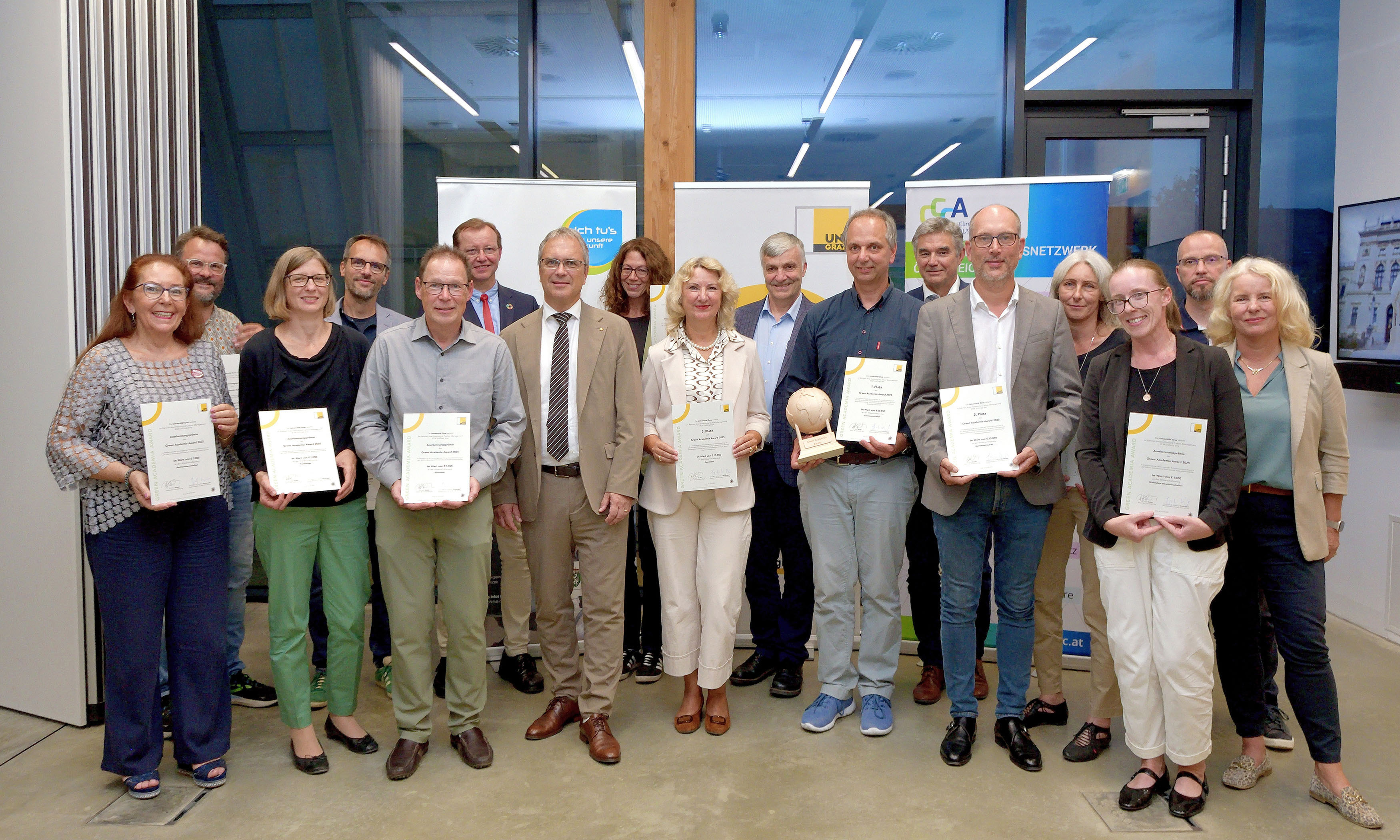
Group photo with representatives from all scientific disciplines that have been rewarded, with Andrea Gössinger-Wieser, Peter Riedler and Joachim Reidl ©University of Graz / Pichler
©University of Graz / Pichler
In addition to the three prizes of the Green Academia Award, recognition awards were presented to ten other scientific disciplines.
created by Gudrun Pichler

Related news

Complying with the norm: Why Do Standards Shape Our Lives, Elisabeth Staudegger?

Standards determine whether a sheet of paper fits in a printer or whether a charging plug can power multiple devices. These standards shape our everyday lives. But who actually sets these standards? Where are the weaknesses, and how could science help to improve them? Elisabeth Staudegger, Head of the ‘Law and IT’ Department at the Institute for Legal Foundations at the University of Graz, host the Academic Standards Day on 16 June. Here she relays how sciences can contribute to the topic of standardisation and reveals her personal favourite standard.

More body awareness than a culture war

In Italy, sex education lessons will in future only be permitted with parental consent, and will be banned entirely in nurseries and primary schools. At the same time, Pride Month highlights why knowledge about the body, relationships, boundaries and diversity is important for young people. A study by the University of Graz shows how important knowledge about the body, contraception, relationship skills and protection against violence is

Will Austria win the World Cup? Mathematician reveals calculation method

Michael Fischer uses the football tournament as a practical example for highschool lessons.

Survival strategies: How plants respond to drought

According to Geosphere Austria, this spring was the driest in Austria since records began around 170 years ago. The low rainfall put particular pressure on the agricultural sector. And climate change is set to make the situation even worse in the coming decades. We asked Johannes Liesche, a professor at the Department of Biology at the University of Graz, how plants react to water shortages and how they survive periods of drought.

Begin of page section:
Additional information:

University of Graz
Universitaetsplatz 3
8010 Graz
Austria
  • Contact
  • Web Editors
  • Moodle
  • UNIGRAZonline
  • Imprint
  • Data Protection Declaration
  • Accessibility Declaration
Weatherstation
Uni Graz

End of this page section. Go to overview of page sections

End of this page section. Go to overview of page sections

Begin of page section:

End of this page section. Go to overview of page sections