



Begin of page section:
Page sections:

  • Go to contents (Accesskey 1)
  • Go to position marker (Accesskey 2)
  • Go to main navigation (Accesskey 3)
  • Go to sub navigation (Accesskey 4)
  • Go to additional information (Accesskey 5)
  • Go to page settings (user/language) (Accesskey 8)
  • Go to search (Accesskey 9)

End of this page section. Go to overview of page sections

Begin of page section:
Page settings:

English en
Deutsch de
Search
Login

End of this page section. Go to overview of page sections

Begin of page section:
Search:

Search for details about Uni Graz
Close

End of this page section. Go to overview of page sections


Search

Begin of page section:
Main navigation:

Page navigation:

  • University

    University
    • About the University
    • Organisation
    • Faculties
    • Library
    • Working at University of Graz
    • Campus
    Developing solutions for the world of tomorrow - that is our mission. Our students and our researchers take on the great challenges of society and carry the knowledge out.
  • Research Profile

    Research Profile
    • Our Expertise
    • Research Questions
    • Research Portal
    • Promoting Research
    • Research Transfer
    • Ethics in Research
    Scientific excellence and the courage to break new ground. Research at the University of Graz creates the foundations for making the future worth living.
  • Studies

    Studies
    • Prospective Students
    • Students
  • Community

    Community
    • International
    • Location
    • Research and Business
    • Alumni
    The University of Graz is a hub for international research and brings together scientists and business experts. Moreover, it fosters the exchange and cooperation in study and teaching.
  • Spotlight
Topics
  • Sustainable University
  • Researchers answer
  • Work for us
Close menu

End of this page section. Go to overview of page sections

Begin of page section:
You are here:

University of Graz News Graz Mummy Book: Should the History of the Book be rewritten?

End of this page section. Go to overview of page sections

Thursday, 22 June 2023

Graz Mummy Book: Should the History of the Book be rewritten?

Frontview © Uni Graz/Kernasenko

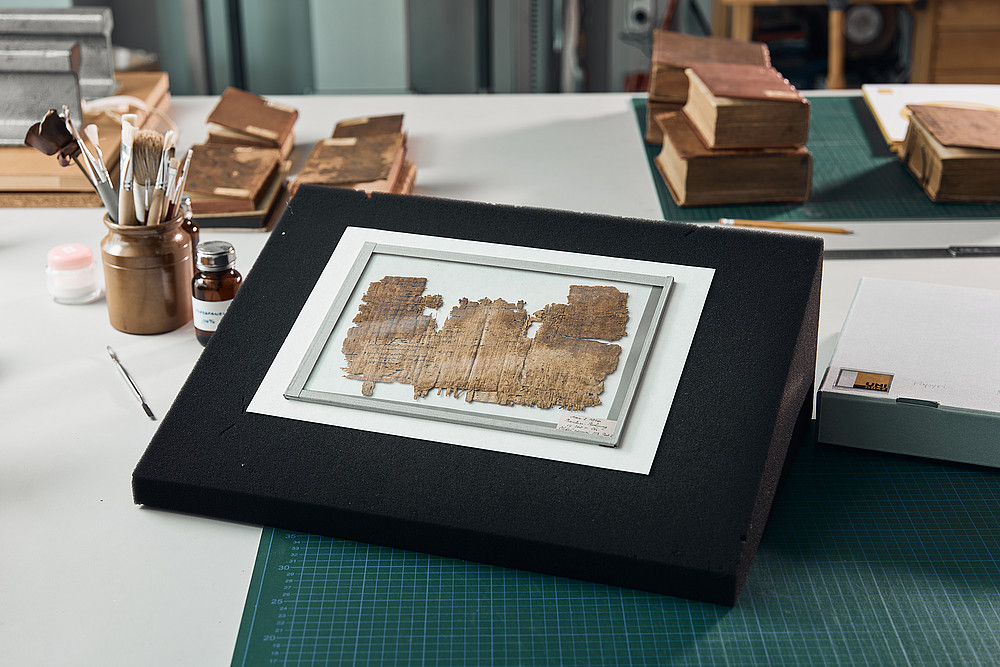
The oldest known book fragment in the world to date was recognized by conservators at the University of Graz by a thread remnant, sewing holes, the centerfold and the text arranged in columns. Photo: University of Graz/Kernasenko

During routine work on papyrus fragments in the Special Collections at Graz University Library, conservator Theresa Zammit Lupi came across a sensational find: an Egyptian papyrus from the 3rd century BC shows evidence of sewing, indicating that it must have been part of a book in codex form.

The fragment was found in 1902 in the wrapping of a mummy. Being 400 years older than the earliest known books to date, the find challenges the currently accepted timeline of book history.


Press conference 

The papyrus fragment (Graz, UBG Ms 1946), which measures only about 15 x 25 cm, has belonged to the University of Graz since 1904. Discovered during an excavation in the Egyptian necropolis of Hibeh (today El Hiba) south of Fayum (El-Fayoum), the fragment now belongs to a collection of 52 papyrus objects, some of which were used as so-called cartonnage for mummy wrappings in the Ptolemaic period (305-30 BC).

A very special to contribute to the history of the book

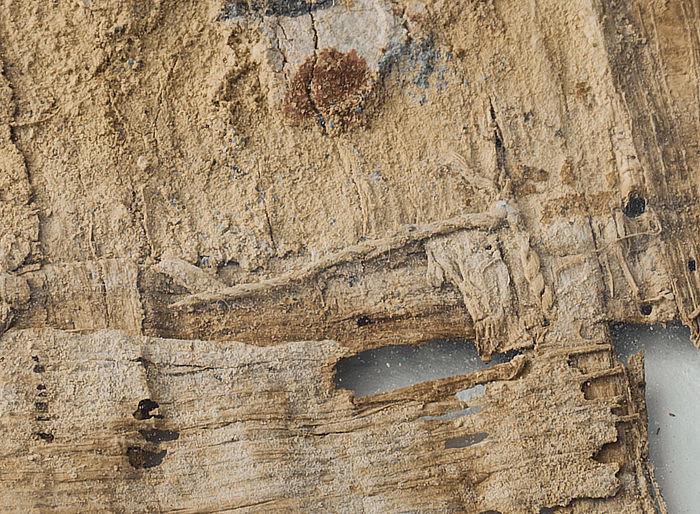
The Graz Mummy Book is a bifolio (folded leaf) from a notebook recording tax accounts for beer and oil in Greek around 260 BC. “This discovery was totally serendipitous. First I saw a piece of thread, only then did I notice the format of a book. I saw a central fold, the stitching holes and the written text within clearly defined margins on the papyrus. As a conservator, it feels very special to contribute to the history of the book. At the same time, you think it's surreal. It's like watching a movie!” Theresa Zammit Lupi, head of conservation of the Special Collections of Graz University Library, enthusiastically states about her discovery.


How does it feel to make such a discovery


The oldest surviving form of a book we know of to date

The earliest codices known to date with evidence of stitching in book form have been dated to 150-250 AD. Two such examples are located in the British Library (Add MS 34473) and the Chester Beatty Library, Dublin (CBL BP II). “The Graz Mummy Book was created 400 years earlier, making it the oldest surviving form of a book we know of to date,” emphasize Erich Renhart and Thomas Csanády, heads of the Special Collections at Graz University Library. “However, it is not unlikely that more such codex fragments exist in other collections that have just not been systematically searched for so far. After all, papyrus was a relatively cheap writing material, and large quantities of fragments have survived,” says Erich Renhart. “Researching the materiality and context of our objects plays a central role at the Special Collections. If our conservators did not also scientifically engage with the objects on a regular basis, this discovery would never have come about,” Thomas Csanády emphasises. 

Digitised cultural objects

Even in an age of progressive digitisation, libraries are places where work is consistently done on the preservation of historical cultural objects and where research is conducted. “It is thanks to the competence of the Special Collections team at Graz University Library that a fresh look at digitised objects that have already been known for a long time has led to new insights – such as the case of the Graz Mummy Book. We are eager to discuss the discovery and its consequences with the wider specialist community,” head of Graz University Library Pamela Stückler elaborates.

Motivated researchers

“The discovery of the historically important book fragment confirms the importance of the work of the motivated researchers at Graz University. It is also a mandate to conduct further research in this field,” says Peter Riedler, Rector of the University of Graz, underlining the find’s importance for the university. “Later this year, in the fall, we will invite international specialists to a meeting in Graz to discuss the book fragment and new insights gained from it,” concludes the rector.
>> all about the Graz Mummy Book

>> View Graz Mummy Book on unipub

Detailed view ©
©
The binding thread provided restorer Theresa Zammit Lupi with the clue that it could be a book fragment. Photo: Uni Graz/Kernasenko
Riedler, Stücker, Zammit Lupi and Renhart ©
©
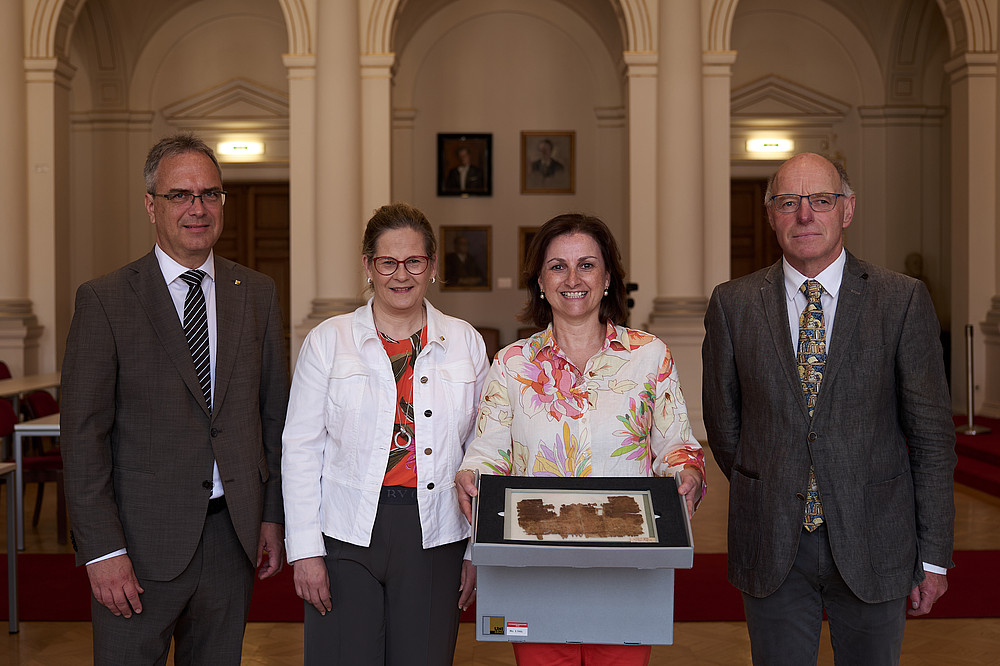
Rector Peter Riedler, UB Director Pamela Stückler, restorer Theresa Zammit Lupi and researcher Erich Renhart (from left) presented the discovery on the fragment at a press conference. Photo: Uni Graz/Kernasenko
created by Gerlinde Tuscher

Related news

When parents find it difficult to have a say

In her dissertation, translation scholar Marie Tschurtschenthaler examines how communication between compulsory schools and parents whose first language is not German works – and what role professional language mediation plays in this. Initial insights show that it is not just about language, but also about resources, responsibilities and the institutional framework.

AI in schools: Maria Bertel drafts legal guidelines for teachers

The legal expert and her team analysed the legal situation regarding the use of artificial intelligence in education as part of an EU project and answered open questions from practice.

Cosmetics in the environment: University of Graz proves danger to ants

Titanium dioxide, which is found in cosmetics, for example, is increasingly entering the environment in the form of nanoparticles. This could also put insects at risk. If ants ingest the substance in combination with the pesticide glyphosate, it disturbs the development of their offspring. Scientists at the University of Graz are drawing attention to the negative consequences of this toxic cocktail.

Varied and healthy: studies move

Exercise is the ideal way to balance out everyday stress, prevent illness and keep fit. Why this is the case, how to do it properly and what role human bodily functions and psychology play can be studied at the University of Graz.

Begin of page section:
Additional information:

University of Graz
Universitaetsplatz 3
8010 Graz
Austria
  • Contact
  • Web Editors
  • Moodle
  • UNIGRAZonline
  • Imprint
  • Data Protection Declaration
  • Accessibility Declaration
Weatherstation
Uni Graz

End of this page section. Go to overview of page sections

End of this page section. Go to overview of page sections

Begin of page section:

End of this page section. Go to overview of page sections