Begin of page section:
Page sections:

  • Go to contents (Accesskey 1)
  • Go to position marker (Accesskey 2)
  • Go to main navigation (Accesskey 3)
  • Go to sub navigation (Accesskey 4)
  • Go to additional information (Accesskey 5)
  • Go to page settings (user/language) (Accesskey 8)
  • Go to search (Accesskey 9)

End of this page section. Go to overview of page sections

Begin of page section:
Page settings:

English en
Deutsch de
Search
Login

End of this page section. Go to overview of page sections

Begin of page section:
Search:

Search for details about Uni Graz
Close

End of this page section. Go to overview of page sections


Search

Begin of page section:
Main navigation:

Page navigation:

  • University

    University
    • About the University
    • Organisation
    • Faculties
    • Library
    • Working at University of Graz
    • Campus
    Developing solutions for the world of tomorrow - that is our mission. Our students and our researchers take on the great challenges of society and carry the knowledge out.
  • Research Profile

    Research Profile
    • Our Expertise
    • Research Questions
    • Research Portal
    • Promoting Research
    • Research Transfer
    • Ethics in Research
    • Commission for Scientific Integrity
    Scientific excellence and the courage to break new ground. Research at the University of Graz creates the foundations for making the future worth living.
  • Studies

    Studies
    • Prospective Students
    • Students
    • Registration for Study Programme (Winter semester 2026/27)
    • Welcome Weeks for First Year Students
  • Community

    Community
    • International
    • Location
    • Research and Business
    • Alumni
    The University of Graz is a hub for international research and brings together scientists and business experts. Moreover, it fosters the exchange and cooperation in study and teaching.
Topics
  • Sustainable University
  • Researchers answer
  • Work for us
Close menu

End of this page section. Go to overview of page sections

Begin of page section:
You are here:

University of Graz News Graz Mummy Book: Should the History of the Book be rewritten?

End of this page section. Go to overview of page sections

Thursday, 22 June 2023

Graz Mummy Book: Should the History of the Book be rewritten?

Frontview © Uni Graz/Kernasenko
© Uni Graz/Kernasenko

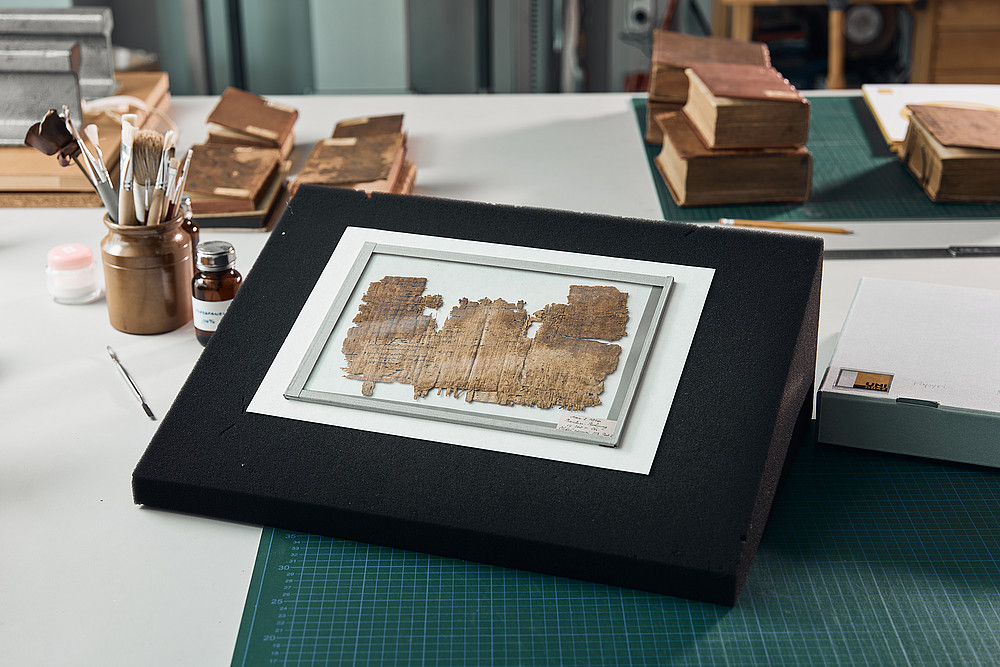
The oldest known book fragment in the world to date was recognized by conservators at the University of Graz by a thread remnant, sewing holes, the centerfold and the text arranged in columns. Photo: University of Graz/Kernasenko

During routine work on papyrus fragments in the Special Collections at Graz University Library, conservator Theresa Zammit Lupi came across a sensational find: an Egyptian papyrus from the 3rd century BC shows evidence of sewing, indicating that it must have been part of a book in codex form.

The fragment was found in 1902 in the wrapping of a mummy. Being 400 years older than the earliest known books to date, the find challenges the currently accepted timeline of book history.


Press conference 

The papyrus fragment (Graz, UBG Ms 1946), which measures only about 15 x 25 cm, has belonged to the University of Graz since 1904. Discovered during an excavation in the Egyptian necropolis of Hibeh (today El Hiba) south of Fayum (El-Fayoum), the fragment now belongs to a collection of 52 papyrus objects, some of which were used as so-called cartonnage for mummy wrappings in the Ptolemaic period (305-30 BC).

A very special to contribute to the history of the book

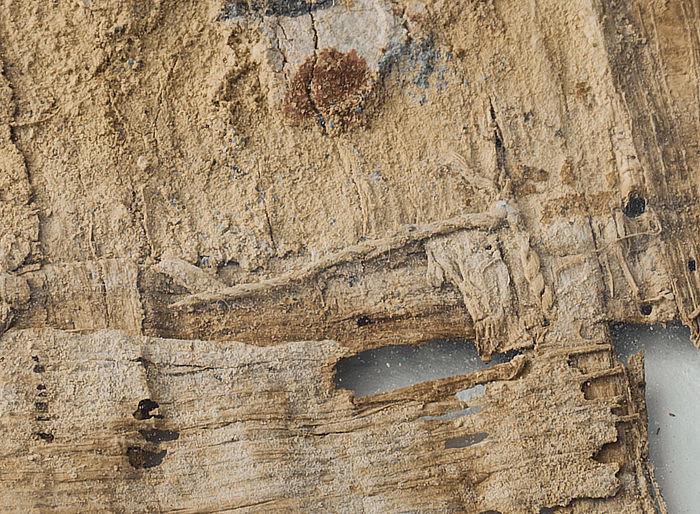
The Graz Mummy Book is a bifolio (folded leaf) from a notebook recording tax accounts for beer and oil in Greek around 260 BC. “This discovery was totally serendipitous. First I saw a piece of thread, only then did I notice the format of a book. I saw a central fold, the stitching holes and the written text within clearly defined margins on the papyrus. As a conservator, it feels very special to contribute to the history of the book. At the same time, you think it's surreal. It's like watching a movie!” Theresa Zammit Lupi, head of conservation of the Special Collections of Graz University Library, enthusiastically states about her discovery.


How does it feel to make such a discovery


The oldest surviving form of a book we know of to date

The earliest codices known to date with evidence of stitching in book form have been dated to 150-250 AD. Two such examples are located in the British Library (Add MS 34473) and the Chester Beatty Library, Dublin (CBL BP II). “The Graz Mummy Book was created 400 years earlier, making it the oldest surviving form of a book we know of to date,” emphasize Erich Renhart and Thomas Csanády, heads of the Special Collections at Graz University Library. “However, it is not unlikely that more such codex fragments exist in other collections that have just not been systematically searched for so far. After all, papyrus was a relatively cheap writing material, and large quantities of fragments have survived,” says Erich Renhart. “Researching the materiality and context of our objects plays a central role at the Special Collections. If our conservators did not also scientifically engage with the objects on a regular basis, this discovery would never have come about,” Thomas Csanády emphasises. 

Digitised cultural objects

Even in an age of progressive digitisation, libraries are places where work is consistently done on the preservation of historical cultural objects and where research is conducted. “It is thanks to the competence of the Special Collections team at Graz University Library that a fresh look at digitised objects that have already been known for a long time has led to new insights – such as the case of the Graz Mummy Book. We are eager to discuss the discovery and its consequences with the wider specialist community,” head of Graz University Library Pamela Stückler elaborates.

Motivated researchers

“The discovery of the historically important book fragment confirms the importance of the work of the motivated researchers at Graz University. It is also a mandate to conduct further research in this field,” says Peter Riedler, Rector of the University of Graz, underlining the find’s importance for the university. “Later this year, in the fall, we will invite international specialists to a meeting in Graz to discuss the book fragment and new insights gained from it,” concludes the rector.
>> all about the Graz Mummy Book

>> View Graz Mummy Book on unipub

Detailed view ©
©
The binding thread provided restorer Theresa Zammit Lupi with the clue that it could be a book fragment. Photo: Uni Graz/Kernasenko
Riedler, Stücker, Zammit Lupi and Renhart ©
©
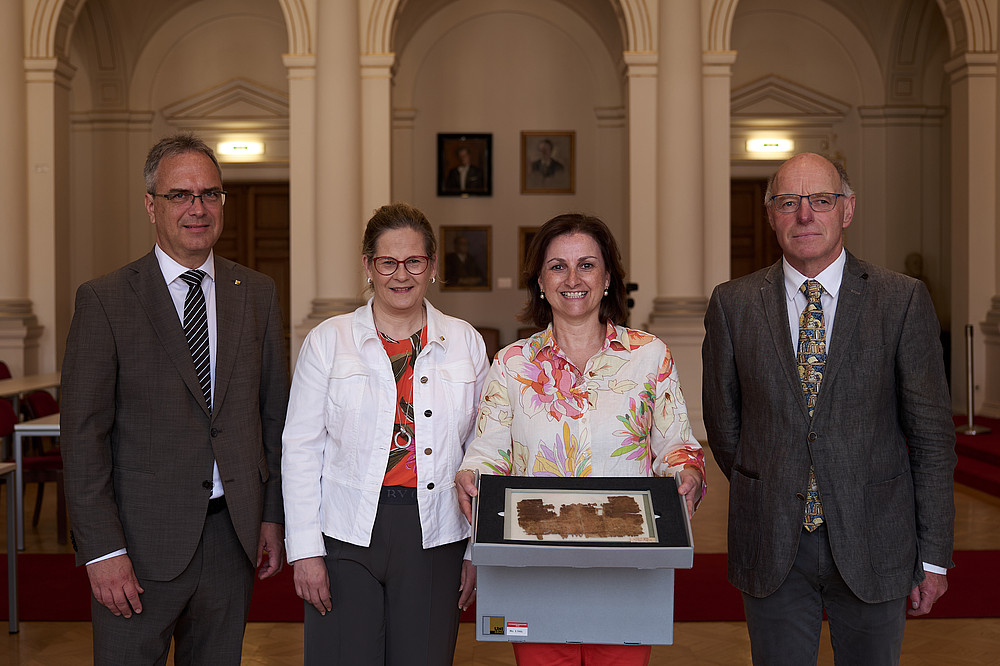
Rector Peter Riedler, UB Director Pamela Stückler, restorer Theresa Zammit Lupi and researcher Erich Renhart (from left) presented the discovery on the fragment at a press conference. Photo: Uni Graz/Kernasenko
created by Gerlinde Tuscher

Related news

Courtly Love and Aubergines: What Medieval Literature Has in Common with Emojis

Plants and fruits were already used as symbols of love in the Middle Ages. German studies scholar Isabella Managò, together with her colleagues Brigitte Spreitzer-Fleck and Julia Zimmermann, explains how this came about and why this figurative language remains familiar to us to this day.

New technology from the University of Graz reveals the hidden properties of tumour cells

It sounds like science fiction, but it could advance cancer research in the future: a team at the University of Graz, led by physicist Jan Enenkel, is developing a new laboratory device using laser technology that can be used to examine individual tumour cells. The idea is reminiscent of the medical tricorder from the Star Trek film series – albeit as a high-precision measurement platform. A spin-off fellowship from the Austrian Research Promotion Agency (FFG) is supporting the development of the technology at the University of Graz with around 500,000 euros.

Four introduced species of leafhoppers newly discovered in the Botanical Garden Graz

They have travelled to Europe as stowaways via international trade and are now rapidly taking over large parts of the continent: more and more insects from other parts of the world are becoming established here. Biologist Gernot Kunz recently discovered four species for the first time at the University of Graz Botanical Garden: the American grapevine leafhopper (Scaphoideus titanus), the wounded leafhopper from North America (Erasmoneura vulnerata) and the Japanese grape leafhopper (Arboridia kakogawana) – all three specialising in vines – as well as the Indian leafhopper Pediopsoides sharmai, which is associated with walnut trees.

Researchers at the University of Graz impress with their AI expertise

A total of 170 entries were submitted to the Austrian Academy of Sciences’ essay competition on the topic of artificial intelligence and science. Both first and second place went to researchers from the University of Graz.

Begin of page section:
Additional information:

University of Graz
Universitaetsplatz 3
8010 Graz
Austria
  • Contact
  • Web Editors
  • Moodle
  • UNIGRAZonline
  • Imprint
  • Data Protection Declaration
  • Accessibility Declaration
Weatherstation
Uni Graz

End of this page section. Go to overview of page sections

End of this page section. Go to overview of page sections

Begin of page section:

End of this page section. Go to overview of page sections