Begin of page section:
Page sections:

  • Go to contents (Accesskey 1)
  • Go to position marker (Accesskey 2)
  • Go to main navigation (Accesskey 3)
  • Go to sub navigation (Accesskey 4)
  • Go to additional information (Accesskey 5)
  • Go to page settings (user/language) (Accesskey 8)
  • Go to search (Accesskey 9)

End of this page section. Go to overview of page sections

Begin of page section:
Page settings:

English en
Deutsch de
Search
Login

End of this page section. Go to overview of page sections

Begin of page section:
Search:

Search for details about Uni Graz
Close

End of this page section. Go to overview of page sections


Search

Begin of page section:
Main navigation:

Page navigation:

  • University

    University
    • About the University
    • Organisation
    • Faculties
    • Library
    • Working at University of Graz
    • Campus
    Developing solutions for the world of tomorrow - that is our mission. Our students and our researchers take on the great challenges of society and carry the knowledge out.
  • Research Profile

    Research Profile
    • Our Expertise
    • Research Questions
    • Research Portal
    • Promoting Research
    • Research Transfer
    • Ethics in Research
    • Commission for Scientific Integrity
    Scientific excellence and the courage to break new ground. Research at the University of Graz creates the foundations for making the future worth living.
  • Studies

    Studies
    • Prospective Students
    • Students
    • Registration for Study Programme (Winter semester 2026/27)
    • Study Days 22-26 June 2026
  • Community

    Community
    • International
    • Location
    • Research and Business
    • Alumni
    The University of Graz is a hub for international research and brings together scientists and business experts. Moreover, it fosters the exchange and cooperation in study and teaching.
Topics
  • Sustainable University
  • Researchers answer
  • Work for us
Close menu

End of this page section. Go to overview of page sections

Begin of page section:
You are here:

University of Graz News Gesunde Bienen

End of this page section. Go to overview of page sections

Monday, 02 August 2021

Gesunde Bienen

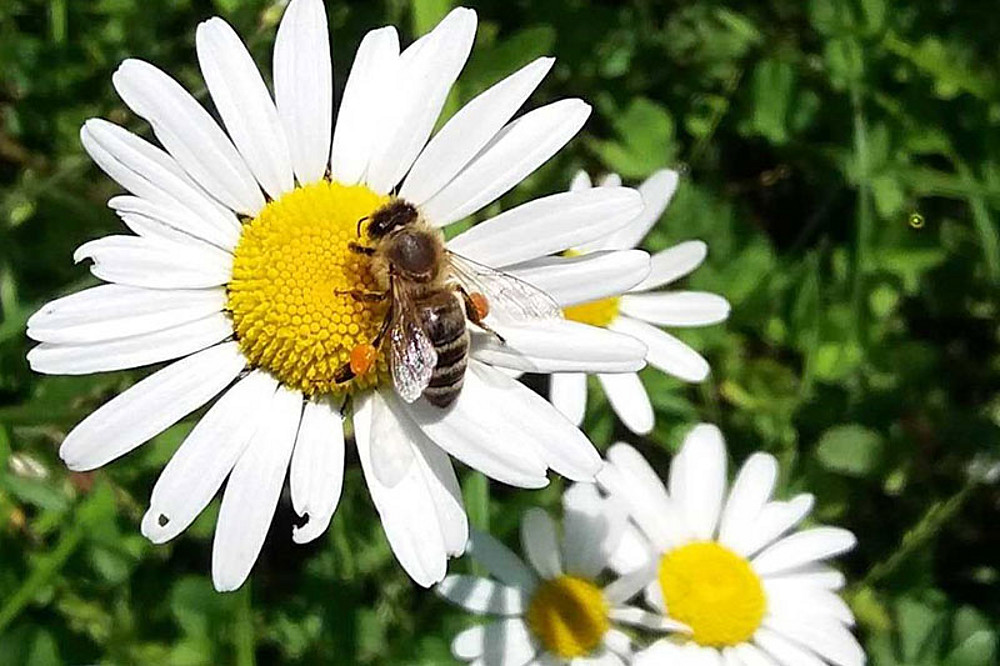
Die Bienenvölker in Österreich sind im Höhenflug: Die heurigen Winterverluste waren ähnlich gering wie im Vorjahr, zeigt eine Studie der Uni Graz. Foto: Uni Graz/Brodschneider

Die Bienenvölker in Österreich sind im Höhenflug: Die heurigen Winterverluste waren ähnlich gering wie im Vorjahr, zeigt eine Studie der Uni Graz. Foto: Uni Graz/Brodschneider

Uni-Graz-Studie bestätigt Winterverluste auf Vorjahresniveau

Die heimischen Honigbienen sind relativ gut über den letzten Winter gekommen: Nur 12,5 Prozent der Völker haben die kalte Jahreszeit nicht überlebt. „Damit liegen wir in etwa auf dem Niveau des Vorjahres“, erklärt Robert Brodschneider vom Institut für Biologie der Universität Graz, der die Studie seit mehr als einem Jahrzehnt durchführt. Heuer standen ihm dafür die Angaben von mehr als 1400 Imkereien mit 30.000 Bienenvölkern zur Verfügung. „Die Datenlage erlaubt auch kleinräumige Auswertungen, die zeigen, dass in einigen wenigen Bezirken Ausfälle von zwanzig Prozent oder sogar mehr zu verzeichnen waren“, ergänzt der Biologe.
 
Die verlorenen Völker werden üblicherweise im Laufe des Jahres durch die Arbeit der ImkerInnen wieder aufgebaut. Dennoch bescheren die Verluste dem Sektor finanzielle Einbußen: 32 Millionen Euro waren das laut Brodschneiders jüngster Studie im Winter 2016/17, in dem 23 Prozent der Bienenvölker starben. „Dies unterstreicht nicht nur die biologische Relevanz unserer Forschung, sondern auch den ökonomischen Stellenwert der Honigbiene in Österreich“, so der Wissenschafter. Aus dem umfangreichen, mehrjährigen Datensatz kann das Team der Universität Graz Ursachen und Maßnahmen zur Reduktion von Winterverlusten ableiten.

Publikation:
Popovska Stojanov, D.; Dimitrov, L.; Danihlík, J.; Uzunov, A.; Golubovski, M.; Andonov, S.; Brodschneider, R. Direct Economic Impact Assessment of Winter Honeybee Colony Losses in Three European Countries. Agriculture 2021, 11, 398.


Wintersterblichkeit von Honigbienen 2020/21

  Verlustrate in Prozent teilnehmende Imkereien Beteiligung der Imkereien in Prozent
Österreich 12,5 1406 4,4
Burgenland 11,6 43 6,7
Kärnten 14,2 154 5,1
Niederösterreich 14,1 310 6,7
Oberösterreich 12,7 294 3,6
Salzburg 10,8 74 2,9
Steiermark 11,0 216 5,3
Tirol 9,7 147 5,2
Vorarlberg 12,3 109 7,1
Wien 17,1 59 8,3


Wintersterblichkeit von Honigbienen in Österreich seit dem Winter 2007/08

Jahr Verlustrate in Prozent
2007/08 13,3
2008/09 9,3
2009/10 14,7
2010/11 16,4
2011/12 25,9
2012/13 17,3
2013/14 12,8
2014/15 28,4
2015/16 8,1
2016/17 23,0
2017/18 11,8
2018/19 15,2
2019/20 12,6
2020/21 12,5

Diese Untersuchung wurde nach Standards der internationalen Non-profit-Vereinigung COLOSS (Prevention of honey bee colony losses) durchgeführt. Eine eingehende wissenschaftliche Analyse der Ergebnisse der Überwinterung 2018/19 wurde in der Fachzeitschrift Diversity publiziert:

Oberreiter, H. & Brodschneider, R. (2020) Austrian COLOSS Survey of Honey Bee Colony Winter Losses 2018/19 and Analysis of Hive Management Practices. Diversity, 12, 99.


Entwicklung der Bienenhaltung in Österreich seit 1990 (Daten: Biene Österreich):

Jahr Anzahl BienenhalterInnen Anzahl Bienenvölker
1990 30.802 457.061
1995 28.447 393.723
2000 25.541 363.967
2003 24.421 327.346
2006 23.000 311.000
2010 24.451 367.583
2011 24.490 368.183
2012 25.099 376.485
2013 25.492 382.638
2014 25.277 376.121
2015 26.063 347.128
2016 26.609 354.080
2017 27.580 353.267
2018 28.432 373.412
2019 30.237 390.607
2020 31.923 426.121


Weiterführende Informationen:

www.zukunft-biene.at

www.bienenstand.at

www.coloss.org


created by Dagmar Eklaude

Related news

Getting even hotter: Researchers predict global warming of 1.7 degrees by 2027

While Europe is currently sweltering in the heat, global temperatures are also rising towards concerning record levels. In 2026, Earth’s surface air temperature is expected to reach 1.62 degrees, and in 2027 even 1.71 degrees Celsius above pre-industrial levels. The long-term temperature rise – an average over a 20-year period – is predicted to exceed the 1.5-degree threshold of the Paris Agreement as of 2026 already. For the first time, researchers at the University of Graz have been able to make such a forecast so far in advance. The intensifying El Niño climate event favors forecast skill and thereby facilitates a reliable computation.

Forest fire at Rosenhain: Volunteer fire brigade carried out an evacuation drill at the Jesuit refectory

Thick smoke in the stairwell, flames at the edge of the forest, people missing in the Jesuit refectory at the University of Graz: at Rosenhain, the Graz Volunteer Fire Brigade carried out a drill simulating a scenario that is becoming increasingly realistic given the heat and drought

Full effort in the heat: the Sports Centre was in full swing at the Kleeblattlauf

On 19 June 2026, 2,000 runners and hundreds of supporters made their way to the Rosenhain for a sporting end-of-term event.

Save, invest or guarantee: What Austrians expect from the state

Austria needs to make savings. But where? And what should the Republic actually be spending its money on? The answers are provided by the initial findings of a major study involving the University of Graz. 99 per cent of those surveyed are in favour of the state ensuring healthcare provision. Almost three-quarters would like to see more public funding for education, whilst only around three per cent are in favour of cuts in this sector.

Begin of page section:
Additional information:

University of Graz
Universitaetsplatz 3
8010 Graz
Austria
  • Contact
  • Web Editors
  • Moodle
  • UNIGRAZonline
  • Imprint
  • Data Protection Declaration
  • Accessibility Declaration
Weatherstation
Uni Graz

End of this page section. Go to overview of page sections

End of this page section. Go to overview of page sections

Begin of page section:

End of this page section. Go to overview of page sections