Begin of page section:
Page sections:

  • Go to contents (Accesskey 1)
  • Go to position marker (Accesskey 2)
  • Go to main navigation (Accesskey 3)
  • Go to sub navigation (Accesskey 4)
  • Go to additional information (Accesskey 5)
  • Go to page settings (user/language) (Accesskey 8)
  • Go to search (Accesskey 9)

End of this page section. Go to overview of page sections

Begin of page section:
Page settings:

English en
Deutsch de
Search
Login

End of this page section. Go to overview of page sections

Begin of page section:
Search:

Search for details about Uni Graz
Close

End of this page section. Go to overview of page sections


Search

Begin of page section:
Main navigation:

Page navigation:

  • University

    University
    • About the University
    • Organisation
    • Faculties
    • Library
    • Working at University of Graz
    • Campus
    Developing solutions for the world of tomorrow - that is our mission. Our students and our researchers take on the great challenges of society and carry the knowledge out.
  • Research Profile

    Research Profile
    • Our Expertise
    • Research Questions
    • Research Portal
    • Promoting Research
    • Research Transfer
    • Ethics in Research
    • Commission for Scientific Integrity
    Scientific excellence and the courage to break new ground. Research at the University of Graz creates the foundations for making the future worth living.
  • Studies

    Studies
    • Prospective Students
    • Students
  • Community

    Community
    • International
    • Location
    • Research and Business
    • Alumni
    The University of Graz is a hub for international research and brings together scientists and business experts. Moreover, it fosters the exchange and cooperation in study and teaching.
  • Spotlight
Topics
  • Sustainable University
  • Researchers answer
  • Work for us
Close menu

End of this page section. Go to overview of page sections

Begin of page section:
You are here:

University of Graz News Geschmeidige Synapsen

End of this page section. Go to overview of page sections

Friday, 30 September 2016

Geschmeidige Synapsen

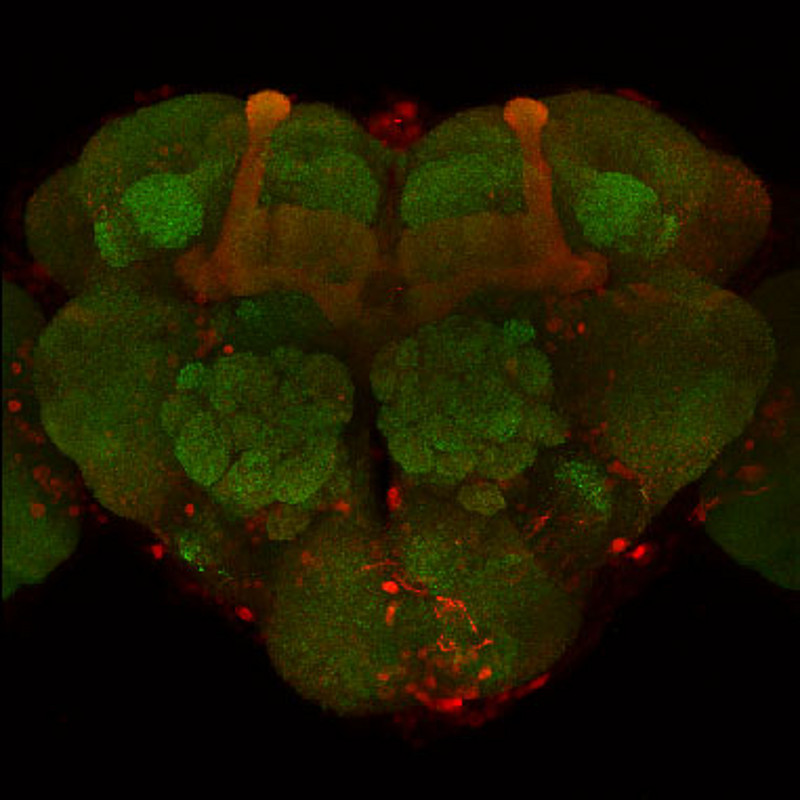
Mikroskopische Fluoreszenz-Aufnahme eines Drosophila-Gehirns von gealterten Fliegen, die an Morbus Parkinson leiden. Es sind sowohl synaptische Verbindungen zwischen den Nervenzellen (grün) als auch die krankheitsauslösenden Proteine (rot) dargestellt.

Mikroskopische Fluoreszenz-Aufnahme eines Drosophila-Gehirns von gealterten Fliegen, die an Morbus Parkinson leiden. Es sind sowohl synaptische Verbindungen zwischen den Nervenzellen (grün) als auch die krankheitsauslösenden Proteine selbst (rot) dargestellt. Foto: Uni Graz/Institut für Molekulare Biowissenschaften.

Forschergruppe zeigt, wie Spermidin altersbedingten Gedächtnisschwund umkehrt

Gedächtnisdefizite im Alter können einer deutsch-österreichischen Studie zufolge unter Umständen durch die Einnahme des Polyamin-Moleküls Spermidin gemindert oder behoben werden. Diese natürliche Substanz könne bewirken, dass Synapsen im Gehirn ihre Fähigkeit auch im Alter beibehielten, Nervenzellen zu verbinden, fanden die WissenschafterInnen um Prof. Dr. Stephan Sigrist von der Freien Universität Berlin, Prof. Dr. André Fiala von der Georg-August-Universität Göttingen und Univ.-Prof.Dr. Frank Madeo von der Karl-Franzens-Universität Graz durch Untersuchungen an der Fruchtfliege Drosopila melanogaster heraus. Die Synapsen könnten nach der Behandlung auch weiterhin im Gehirn neue Erinnerungen kodieren. Aus den Ergebnissen könnten Strategien für die Bekämpfung altersbedingter Demenz abgeleitet werden. Die Studie wurde in der aktuellen Ausgabe der renommierten Zeitschrift PLOS Biology veröffentlicht.


Synapsen, die Neuronen in unserem Gehirn verbinden, kodieren kontinuierlich neue Erinnerungen. Doch die Fähigkeit dazu – dem Lernen – kann bei manchen Menschen im Alter in drastischem Tempo und Umfang schwinden. Die Wissenschafter der drei Universitäten fanden heraus, dass die altersbedingte Demenz durch Veränderungen auf der Ebene der Synapsen mit ausgelöst wird. Der menschliche Körper bildet das hiervor schützende Spermidin zwar selbst, doch mit zunehmendem Alter weniger effektiv. Eine Verabreichung der Substanz könne also der Gedächtnisleistung aufhelfen, vermuten die Forscher. Die Wissenschafter wählten die Fruchtfliege Drosophila melanogaster, weil hier Erinnerungsprozesse auf molekularer Ebene ähnlich verlaufen wie bei Menschen; das Insekt ist damit ein geeignetes Modell für die Simulation von Altersprozessen. Durch Fütterung von Spermidin gelang es, den Gedächtnisverfall zu unterdrücken. Die Studie erweitert Ergebnisse einer Studie der Wissenschafter aus dem Jahr 2013.

>> Publikation

created by Gerhild Kastrun

Related news

Studying at the University of Graz: How to enrol

Ready for a new chapter in your life with the start of your studies at the University of Graz in the winter semester 2026/27? Here you will find information on deadlines, admission procedures, registration, and everything else you need to successfully start your studies in the fall.

Interpreting data: Why studies sometimes get it wrong

Hilmar Brohmer and Ziva Korda from the Institute of Psychology, together with 500 international colleagues, have re-evaluated a hundred scientific publications and have often come to different conclusions.

Crystal-clear: AI method revolutionises solar observation

The Sun makes life on Earth possible. However, its magnetic fields can also cause massive disruption. This makes it all the more important to gain a better understanding of the processes taking place on our nearest star. A research team from the University of Graz and the High Altitude Observatory in Boulder (USA) has succeeded in doing just that. The astrophysicists have developed an AI-supported method that makes even the smallest structures on the Sun visible. The scientists are convinced that this will bring about a lasting change in solar observation and that the new method can be used for the planned European Solar Telescope.

Long Night of Research: How many languages are there in the world?

From a linguistic perspective, there are worlds of difference between Bern, Berlin and Vienna. A dialect impersonator will demonstrate live just how varied German can sound. How many languages are there in the world? What are their distinctive features? Which of these are spoken in Austria? These and other questions will be answered during the Long Night of Research at the University of Graz: on Friday, 24 April 2025, from 5 pm to 11 pm, in the University Library. Visitors can immerse themselves in the diversity of languages without travelling far by taking part in a quiz at the station.

Begin of page section:
Additional information:

University of Graz
Universitaetsplatz 3
8010 Graz
Austria
  • Contact
  • Web Editors
  • Moodle
  • UNIGRAZonline
  • Imprint
  • Data Protection Declaration
  • Accessibility Declaration
Weatherstation
Uni Graz

End of this page section. Go to overview of page sections

End of this page section. Go to overview of page sections

Begin of page section:

End of this page section. Go to overview of page sections