



Begin of page section:
Page sections:

  • Go to contents (Accesskey 1)
  • Go to position marker (Accesskey 2)
  • Go to main navigation (Accesskey 3)
  • Go to sub navigation (Accesskey 4)
  • Go to additional information (Accesskey 5)
  • Go to page settings (user/language) (Accesskey 8)
  • Go to search (Accesskey 9)

End of this page section. Go to overview of page sections

Begin of page section:
Page settings:

English en
Deutsch de
Search
Login

End of this page section. Go to overview of page sections

Begin of page section:
Search:

Search for details about Uni Graz
Close

End of this page section. Go to overview of page sections


Search

Begin of page section:
Main navigation:

Page navigation:

  • University

    University
    • About the University
    • Organisation
    • Faculties
    • Library
    • Working at University of Graz
    • Campus
    Developing solutions for the world of tomorrow - that is our mission. Our students and our researchers take on the great challenges of society and carry the knowledge out.
  • Research Profile

    Research Profile
    • Our Expertise
    • Research Questions
    • Research Portal
    • Promoting Research
    • Research Transfer
    • Ethics in Research
    • Commission for Scientific Integrity
    Scientific excellence and the courage to break new ground. Research at the University of Graz creates the foundations for making the future worth living.
  • Studies

    Studies
    • Prospective Students
    • Students
    • Registration for Study Programme (Winter semester 2026/27)
  • Community

    Community
    • International
    • Location
    • Research and Business
    • Alumni
    The University of Graz is a hub for international research and brings together scientists and business experts. Moreover, it fosters the exchange and cooperation in study and teaching.
Topics
  • Sustainable University
  • Researchers answer
  • Work for us
Close menu

End of this page section. Go to overview of page sections

Begin of page section:
You are here:

University of Graz News Geisteswissen für die Wirtschaft

End of this page section. Go to overview of page sections

Monday, 11 April 2016

Geisteswissen für die Wirtschaft

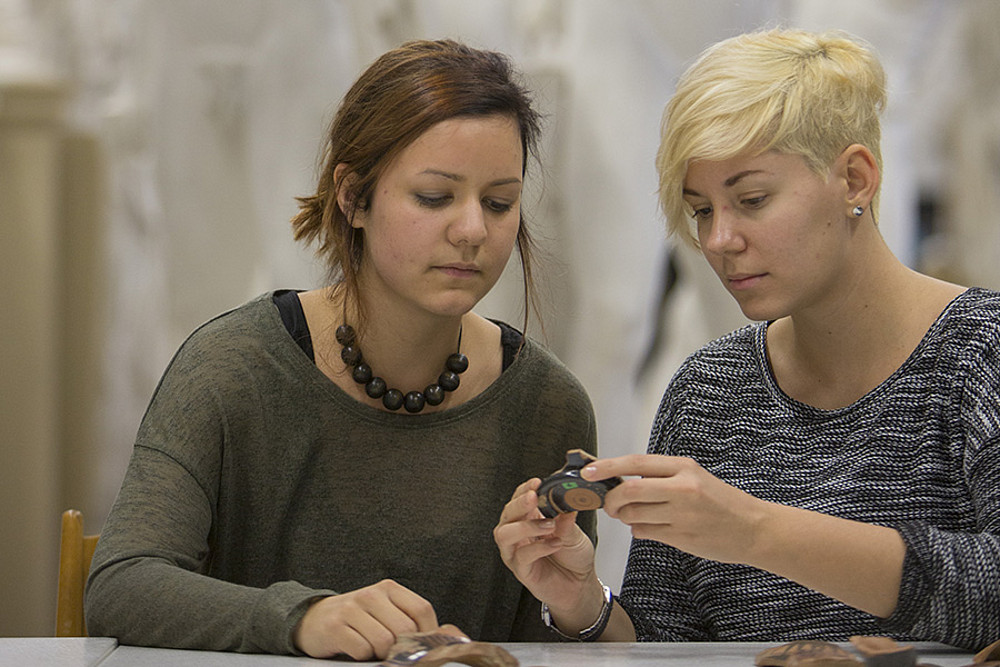
GeisteswissenschafterInnen verfügen über viele Kompetenzen, die in der Wirtschaft nachgefragt sind. Foto: Uni Graz/Lunghammer ©Helmut Lunghammer
©Helmut Lunghammer

GeisteswissenschafterInnen verfügen über viele Kompetenzen, die in der Wirtschaft nachgefragt sind. Foto: Uni Graz/Lunghammer

Uni Graz bringt ManagerInnen und DoktorandInnen zusammen

Sie glänzen durch zielgerichtete Recherche und lösungsorientiertes Vorgehen. Sie besitzen die Fähigkeit zu vernetztem Denken, sind kreativ, hartnäckig und initiativ. Diese und viele weitere Kompetenzen zeichnen wirtschaftsinteressierte GeisteswissenschafterInnen aus. Am 22. April 2016 bietet die Uni Graz Doktoratsstudierenden die Gelegenheit, ihre Fähigkeiten für die Wirtschaft vor international erfolgreichen Managementpersönlichkeiten unter Beweis zu stellen.

„Das Know-how von GeisteswissenschafterInnen ist gefragt“, bestätigt Historikerin Univ.-Prof. Dr. Renate Pieper. „Treten komplexe Probleme oder neue Aufgaben auf, wie im Bereich des Projektmanagements, in der Koordination zwischen Technik, Vertrieb und Finanzen oder im Kommunikationsmanagement wirken interdisziplinäre Teams Wunder.“ Die Forscherin hat unter Mitwirkung erfahrener Unternehmensführer daher 2015 diese Initiative gestartet, um Wirtschaft und Geisteswissenschaft stärker zusammenzubringen. Nach der erfolgreichen Premiere im Vorjahr geht die interdisziplinäre Zusammenarbeit in Form eines eintägigen Workshops heuer in die zweite Runde.

Neben Tipps und wertvollen Hinweisen für eine erfolgreiche Bewerbung können die DoktorandInnen beim „Business-Simulator“ anhand von komplexen Aufgaben aus der Wirtschaft Lösungen erarbeiten.
Konkrete Fragestellungen betreffen unter anderem, wie die optimale Projekt-Priorisierung aussieht, wie Aufgaben und Organisationsstrukturen eines schlagkräftigen und kostengünstigen Kompetenzzentrums gestaltet sind oder wie man eine Unternehmensgründung im Ausland entwickelt.

Geisteswissen schafft Wirtschaft
WANN: Freitag, 22. April 2016, 14 bis 19 Uhr
WO: Sitzungszimmer des Dekanats der Geisteswissenschaftlichen Fakultät, Hauptgebäude der Uni Graz, Universitätsplatz 3, 8010 Graz

„Geisteswissen schafft Wirtschaft“ ist eine Kooperation der Karl-Franzens-Universität Graz (Univ.-Prof. Dr. Renate Pieper, Institut für Geschichte), Career Center, DocService, Forschungsmanagement, Dekanat der Geisteswissenschaftlichen Fakultät und der Österreichischen HochschülerInnenschaft an der Karl-Franzens-Universität Graz sowie Dr. Andrea Schulze-Moews (LAB Company) und Dipl. Ing. Bernd Kirchhoff (KIRCHHOFF KOMPETENZ GmbH).

created by Andreas Schweiger

Related news

"Mathematics explains the world"

How can life be quantified? And what can science reveal that remains hidden from the naked eye? The 14th European Conference on Mathematical and Theoretical Biology at the University of Graz is dedicated to these questions. From 13 to 17 July, around 1,300 researchers from all over the world will gather on campus to discuss models, biological processes and the future of data-driven medicine. Klemens Fellner, Dean of the Faculty of Natural Sciences and Mathematics and a mathematician, talks about the language that explains the world

Internationally up-to-date: University of Graz offers new degree programmes in art studies

From the Old Masters to AI art – three newly designed degree programmes offer students at the University of Graz fresh perspectives on artistic production. In addition to historical art, the programmes place a greater emphasis on contemporary and global developments. The registration period is open.

The Nazi elite school Napola: Historian seeks memories and personal documents

They were to be brought up to become the future elite of National Socialism: boys and girls aged ten and over who, following the ‘Anschluss’ of Austria to the German Reich, attended a so-called Napola (short for Nationalpolitische Lehranstalt; also known as NPEA, Nationalpolitische Erziehungsanstalt). There were nine such institutions in what is now Austria between 1939 and 1945.

Heat-resistant: Eva Preinfalk explains how cities can protect their residents

Certain demographic and some occupational groups are particularly vulnerable to high temperatures. A range of measures is needed to provide relief for everyone, explains climate economist Eva Preinfalk.

Begin of page section:
Additional information:

University of Graz
Universitaetsplatz 3
8010 Graz
Austria
  • Contact
  • Web Editors
  • Moodle
  • UNIGRAZonline
  • Imprint
  • Data Protection Declaration
  • Accessibility Declaration
Weatherstation
Uni Graz

End of this page section. Go to overview of page sections

End of this page section. Go to overview of page sections

Begin of page section:

End of this page section. Go to overview of page sections