Begin of page section:
Page sections:

  • Go to contents (Accesskey 1)
  • Go to position marker (Accesskey 2)
  • Go to main navigation (Accesskey 3)
  • Go to sub navigation (Accesskey 4)
  • Go to additional information (Accesskey 5)
  • Go to page settings (user/language) (Accesskey 8)
  • Go to search (Accesskey 9)

End of this page section. Go to overview of page sections

Begin of page section:
Page settings:

English en
Deutsch de
Search
Login

End of this page section. Go to overview of page sections

Begin of page section:
Search:

Search for details about Uni Graz
Close

End of this page section. Go to overview of page sections


Search

Begin of page section:
Main navigation:

Page navigation:

  • University

    University
    • About the University
    • Organisation
    • Faculties
    • Library
    • Working at University of Graz
    • Campus
    Developing solutions for the world of tomorrow - that is our mission. Our students and our researchers take on the great challenges of society and carry the knowledge out.
  • Research Profile

    Research Profile
    • Our Expertise
    • Research Questions
    • Research Portal
    • Promoting Research
    • Research Transfer
    • Ethics in Research
    • Commission for Scientific Integrity
    Scientific excellence and the courage to break new ground. Research at the University of Graz creates the foundations for making the future worth living.
  • Studies

    Studies
    • Prospective Students
    • Students
    • Welcome Weeks for First Year Students
  • Community

    Community
    • International
    • Location
    • Research and Business
    • Alumni
    The University of Graz is a hub for international research and brings together scientists and business experts. Moreover, it fosters the exchange and cooperation in study and teaching.
Topics
  • Sustainable University
  • Researchers answer
  • Work for us
Close menu

End of this page section. Go to overview of page sections

Begin of page section:
You are here:

University of Graz News Needed more than ever: Muslim education

End of this page section. Go to overview of page sections

Wednesday, 11 November 2020

Needed more than ever: Muslim education

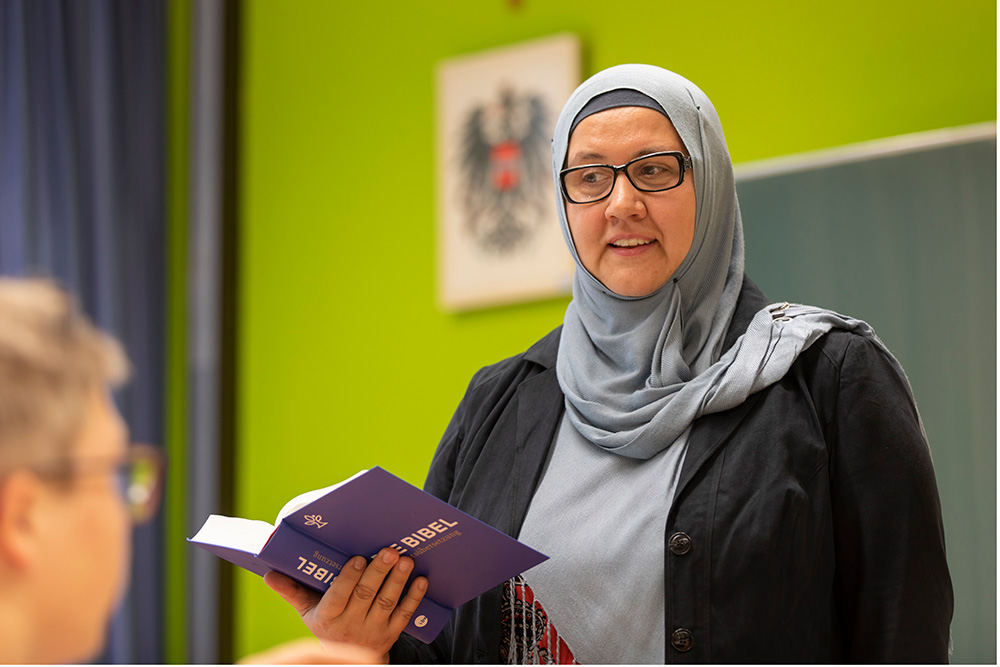
Mevlida Mesanovic, Muslim religious education specialist, sensitises teachers to recognise fundamentalist tendencies. Photo: Uni Graz/Lunghammer

Mevlida Mesanovic, Muslim religious education specialist, sensitises teachers to recognise fundamentalist tendencies. Photo: Uni Graz/Lunghammer

Certificates for Islamic religious education teachers

The terrorist attack in Vienna has once again shown us the disastrous implications of fanaticism. “A high-quality religious education provided by well-trained experts is an important step to help prevent radicalisation”, emphasises Wolfgang Weirer, Catholic religious education specialist at the University of Graz. Together with his Muslim colleague Mevlida Mešanović, he runs the university programme “Islamic Religious Education Studies in Austrian Society”, which was launched in 2018, and will award the graduates their final certificates online on Friday, 13 November 2020.

“Many people do not realise what an important service Islamic teachers render society, under difficult conditions. I would like to thank these highly committed colleagues for their challenging and skilled work, which is an essential part of integration in our schools,” says Weirer.
Mešanović adds: “Our main task in this training was to prepare educators for teaching Islamic religion at Austrian schools. We wanted to equip them with ideas and concepts which they could use in the classroom, which would also prove valuable to them and their pupils in their everyday lives. In this context, participants also dealt with topics such as preventing radical and fundamentalist tendencies. They are sensitised to recognise them, to expose them and, if necessary, to take preventive actions.

The four-semester study programme was conceived together with the Private University College of Teacher Education Diocese Graz-Seckau and is a mandatory further training course for Islamic teachers in Carinthia and Styria, which aims at ensuring high quality of Islamic religious education. “Essential components of this programme are the age-appropriate communication of faith and a context-sensitive interpretation of the Koran that is compatible with Central European values,” says Weirer. Inter-religious education fosters mutual understanding of different religious traditions, provides an anchor for young people and thus helps avoid social divisions.


The graduation cermenoy will take place on November 13th 2020 at 5 pm online.

Further Information
 

[Translate to English:]

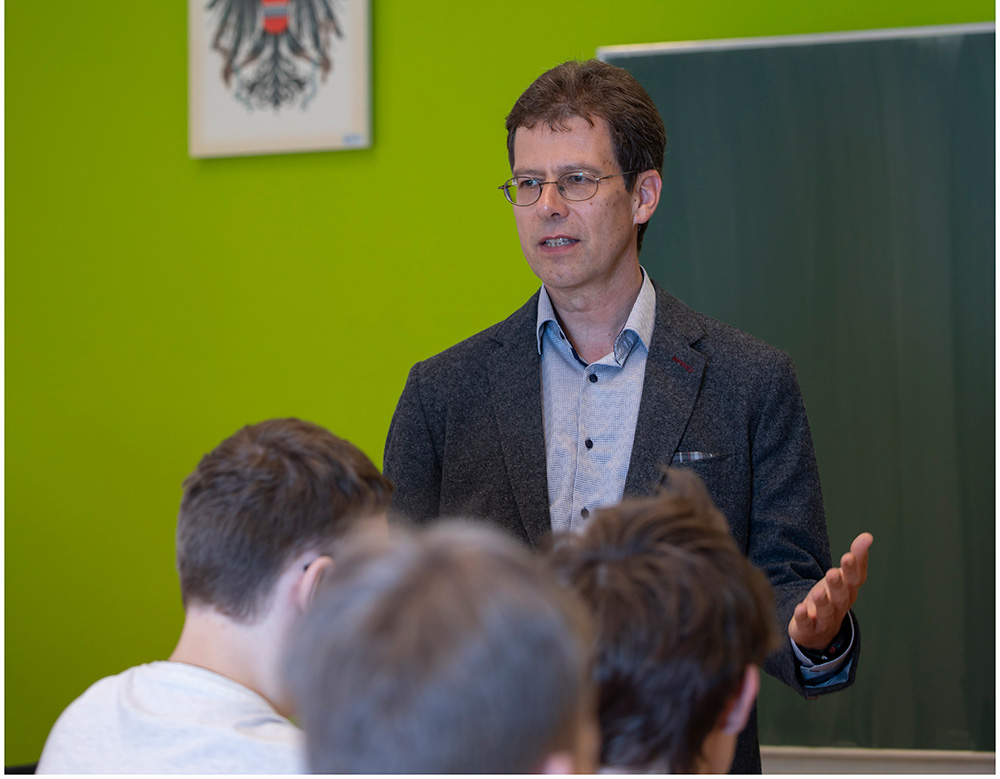
Wolfgang Weirer leitet den Lehrgang "Islamische Religionspädagogik im österreichischen Kontext". Foto: Uni Graz/Lunghammer

[Translate to English:]

[Translate to English:]

created by Dagmar Eklaude

Related news

Electrifying: Researchers film the first moments on the way from light to electricity

Physicists at the University of Graz (Austria), in collaboration with colleagues from Marburg University and Forschungszentrum Jülich (Germany), have achieved a scientific breakthrough. For the first time, the generation of electrical energy from light has been filmed and described theoretically. This work is of far-reaching significance, not least for optimising sustainable energy production from photovoltaics. This is because it provides fundamental building blocks for understanding the physical processes that take place, for example, in organic solar cells. The paper was published in the journal Physical Review X, one of the world’s most prestigious physics journals.

University of Graz: Working together to make Styria a sustainable centre of learning

Round table calls for sustainable funding for the 2028–2030 performance agreement period between the five Styrian universities and the federal government.

How can we teach using YouTube and AI? The University of Graz is strengthening media education in schools

A journey through the blood vessels using VR headsets brings biology lessons to life. An interactive quiz brings physics to life. The YouTube video explains the First World War. Whilst mobile phones are increasingly being banned from the classroom, social media platforms, apps and AI are playing an ever-greater role in knowledge transfer at school. But how can teaching with media be made even more effective? What are the challenges in media-based teaching? At the University of Graz, researchers are discussing these issues at a conference being held in Austria for the first time.

Jurassic Sounds: Biologist reconstructs insect songs from 165 million years ago

It was apparently not just the roars of the dinosaurs that made up the soundscape of the animal world during the Jurassic period. Crickets and grasshoppers communicated through a variety of songs and high-pitched sounds, as Thorin Jonsson from the Institute of Biology at the University of Graz discovered together with colleagues from the universities of Lincoln, Bristol (UK), Beijing (China) and Tempe (USA). The findings on what are so far the oldest traces of sound on Earth have just been published in the journal PNAS.

Begin of page section:
Additional information:

University of Graz
Universitaetsplatz 3
8010 Graz
Austria
  • Contact
  • Web Editors
  • Moodle
  • UNIGRAZonline
  • Imprint
  • Data Protection Declaration
  • Accessibility Declaration
Weatherstation
Uni Graz

End of this page section. Go to overview of page sections

End of this page section. Go to overview of page sections

Begin of page section:

End of this page section. Go to overview of page sections