



Begin of page section:
Page sections:

  • Go to contents (Accesskey 1)
  • Go to position marker (Accesskey 2)
  • Go to main navigation (Accesskey 3)
  • Go to sub navigation (Accesskey 4)
  • Go to additional information (Accesskey 5)
  • Go to page settings (user/language) (Accesskey 8)
  • Go to search (Accesskey 9)

End of this page section. Go to overview of page sections

Begin of page section:
Page settings:

English en
Deutsch de
Search
Login

End of this page section. Go to overview of page sections

Begin of page section:
Search:

Search for details about Uni Graz
Close

End of this page section. Go to overview of page sections


Search

Begin of page section:
Main navigation:

Page navigation:

  • University

    University
    • About the University
    • Organisation
    • Faculties
    • Library
    • Working at University of Graz
    • Campus
    Developing solutions for the world of tomorrow - that is our mission. Our students and our researchers take on the great challenges of society and carry the knowledge out.
  • Research Profile

    Research Profile
    • Our Expertise
    • Research Questions
    • Research Portal
    • Promoting Research
    • Research Transfer
    • Ethics in Research
    • Commission for Scientific Integrity
    Scientific excellence and the courage to break new ground. Research at the University of Graz creates the foundations for making the future worth living.
  • Studies

    Studies
    • Prospective Students
    • Students
    • Registration for Study Programme (Winter semester 2026/27)
  • Community

    Community
    • International
    • Location
    • Research and Business
    • Alumni
    The University of Graz is a hub for international research and brings together scientists and business experts. Moreover, it fosters the exchange and cooperation in study and teaching.
Topics
  • Sustainable University
  • Researchers answer
  • Work for us
Close menu

End of this page section. Go to overview of page sections

Begin of page section:
You are here:

University of Graz News Forschung fördern

End of this page section. Go to overview of page sections

Wednesday, 30 October 2019

Forschung fördern

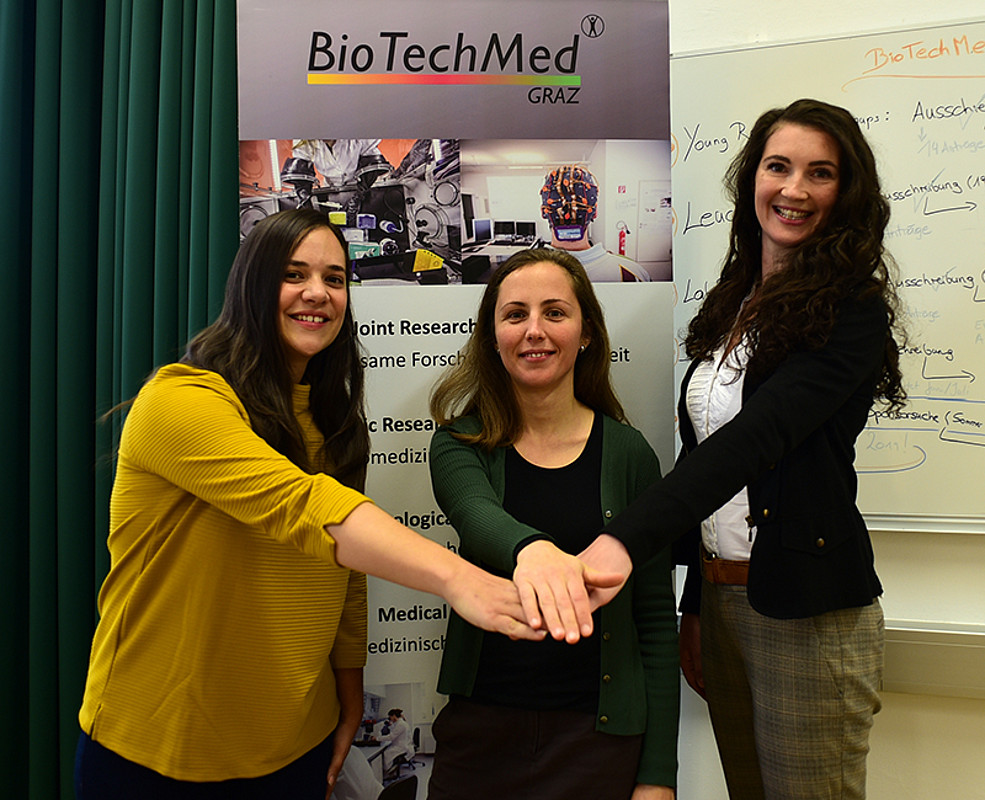
Junge Forscherinnen mit großer Förderung: Senka Holzer (Med Uni Graz), Natalia Zaretskaya (Uni Graz) und Anita Emmerstorfer-Augustin (TU Graz) erhielten zusammengerechnet 1,95 Millionen Euro vom Verbund BioTechMed-Graz für ihre Forschungsvorhaben. Alle Fotos: Uni Graz/Leljak.

Junge Forscherinnen mit großer Förderung: Senka Holzer (Med Uni Graz), Natalia Zaretskaya (Uni Graz) und Anita Emmerstorfer-Augustin (TU Graz) erhielten zusammengerechnet 1,95 Millionen Euro vom Verbund BioTechMed-Graz für ihre Forschungsvorhaben. Alle Fotos: Uni Graz/Leljak.

BioTechMed-Graz unterstützt wissenschaftliche Projekte mit insgesamt 3,15 Millionen Euro

BioTechMed-Graz, die Kooperation zwischen Universität Graz, Medizinischen Universität Graz und der TU Graz mit dem Ziel einer gemeinsamen Forschung für Gesundheit, fördert im Rahmen des „Young Researcher Groups“-Programms besonders herausragende und vielversprechende Postdocs beim Aufbau einer eigenständigen Forschungsgruppe.

In einem kompetitiven, öffentlichen Hearing wurden kürzlich drei Forscherinnen von einem Fachkomitee ausgewählt, jeweils eine von Uni Graz, Med Uni und TU Graz, und mit insgesamt 1,95 Millionen Euro gefördert:

•    Anita Emmerstorfer-Augustin (TU Graz): How membrane lipids cross-talk with the cell wall: A study using sterol modified Pichia pastoris
•    Senka Holzer (Med Uni Graz): Targeting Excitation-Transcription Coupling for Managing Hypertensive Cardiomyopathy
•    Natalia Zaretskaya (Uni Graz): Neural mechanisms of subjective visual experience

Auch die ProjektleiterInnen der Leuchtturmprojektausschreibung 2019 stellten ihre interdisziplinären und inter-universitären Projektideen der internationalen Fachjury und dem Publikum vor. Ziel der Leuchtturmprojekt-Förderung ist es, wissenschaftlich exzellente Projekte, die eine realistische Chance haben Drittmittelgroßprojekte zu akquirieren und somit die internationale Sichtbarkeit des Standortes Graz erhöhen, zu fördern. Hier wurden insgesamt 1,2 Millionen Euro für die Förderung folgender Projekte vergeben.

•    Brigitte Pertschy (Uni Graz): Dynamics of subcellular partitioning through protein modification
•    Thomas Pieber (Med Uni Graz): MIDAS - Inflammatory Mechanisms in Diabetes Uncovered by Tissue Imaging and Machine Learning

Die international renommierten ExpertInnen bewerteten alle Projektanträge aufgrund der schriftlichen Gutachten von FWF nominierten ExpertInnen, den Präsentationen vor Ort sowie der Diskussion mit den AntragsstellerInnen. Rund 140 Personen nutzten außerdem die Gelegenheit, die Präsentationen der Projektanträge im Meerscheinschloss zu verfolgen.
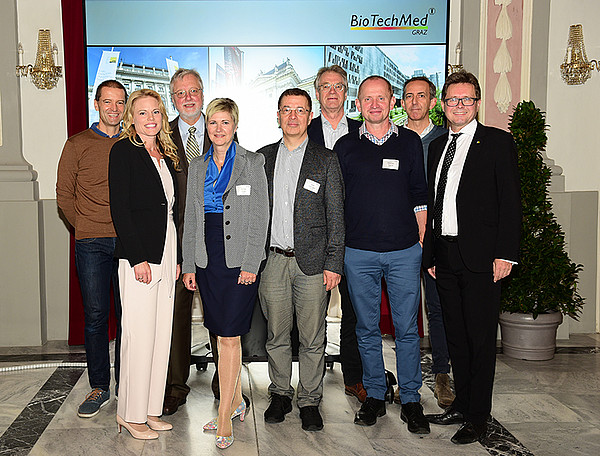

Vizerektor Christof Gattringer, Med Uni-Vizerektorin Caroline Schober-Trummler, BioTechMed-Direktor Rudolf Zechner, Review-Panel-Mitglieder Andrea Kübler, Arno Villringer, Dick Janssen und Stephan Sigrist, BioTechMed-Direktor Robert Krause mit Rektor Martin Polaschek (v.l.).
created by Gerhild Leljak

Related news

Complying with the norm: Why Do Standards Shape Our Lives, Elisabeth Staudegger?

Standards determine whether a sheet of paper fits in a printer or whether a charging plug can power multiple devices. These standards shape our everyday lives. But who actually sets these standards? Where are the weaknesses, and how could science help to improve them? Elisabeth Staudegger, Head of the ‘Law and IT’ Department at the Institute for Legal Foundations at the University of Graz, host the Academic Standards Day on 16 June. Here she relays how sciences can contribute to the topic of standardisation and reveals her personal favourite standard.

More body awareness than a culture war

In Italy, sex education lessons will in future only be permitted with parental consent, and will be banned entirely in nurseries and primary schools. At the same time, Pride Month highlights why knowledge about the body, relationships, boundaries and diversity is important for young people. A study by the University of Graz shows how important knowledge about the body, contraception, relationship skills and protection against violence is

Will Austria win the World Cup? Mathematician reveals calculation method

Michael Fischer uses the football tournament as a practical example for highschool lessons.

Survival strategies: How plants respond to drought

According to Geosphere Austria, this spring was the driest in Austria since records began around 170 years ago. The low rainfall put particular pressure on the agricultural sector. And climate change is set to make the situation even worse in the coming decades. We asked Johannes Liesche, a professor at the Department of Biology at the University of Graz, how plants react to water shortages and how they survive periods of drought.

Begin of page section:
Additional information:

University of Graz
Universitaetsplatz 3
8010 Graz
Austria
  • Contact
  • Web Editors
  • Moodle
  • UNIGRAZonline
  • Imprint
  • Data Protection Declaration
  • Accessibility Declaration
Weatherstation
Uni Graz

End of this page section. Go to overview of page sections

End of this page section. Go to overview of page sections

Begin of page section:

End of this page section. Go to overview of page sections


