



Begin of page section:
Page sections:

  • Go to contents (Accesskey 1)
  • Go to position marker (Accesskey 2)
  • Go to main navigation (Accesskey 3)
  • Go to sub navigation (Accesskey 4)
  • Go to additional information (Accesskey 5)
  • Go to page settings (user/language) (Accesskey 8)
  • Go to search (Accesskey 9)

End of this page section. Go to overview of page sections

Begin of page section:
Page settings:

English en
Deutsch de
Search
Login

End of this page section. Go to overview of page sections

Begin of page section:
Search:

Search for details about Uni Graz
Close

End of this page section. Go to overview of page sections


Search

Begin of page section:
Main navigation:

Page navigation:

  • University

    University
    • About the University
    • Organisation
    • Faculties
    • Library
    • Working at University of Graz
    • Campus
    Developing solutions for the world of tomorrow - that is our mission. Our students and our researchers take on the great challenges of society and carry the knowledge out.
  • Research Profile

    Research Profile
    • Our Expertise
    • Research Questions
    • Research Portal
    • Promoting Research
    • Research Transfer
    • Ethics in Research
    • Commission for Scientific Integrity
    Scientific excellence and the courage to break new ground. Research at the University of Graz creates the foundations for making the future worth living.
  • Studies

    Studies
    • Prospective Students
    • Students
    • Welcome Weeks for First Year Students
  • Community

    Community
    • International
    • Location
    • Research and Business
    • Alumni
    The University of Graz is a hub for international research and brings together scientists and business experts. Moreover, it fosters the exchange and cooperation in study and teaching.
Topics
  • Sustainable University
  • Researchers answer
  • Work for us
Close menu

End of this page section. Go to overview of page sections

Begin of page section:
You are here:

University of Graz News Gefährliche Chemie

End of this page section. Go to overview of page sections

Thursday, 28 September 2017

Gefährliche Chemie
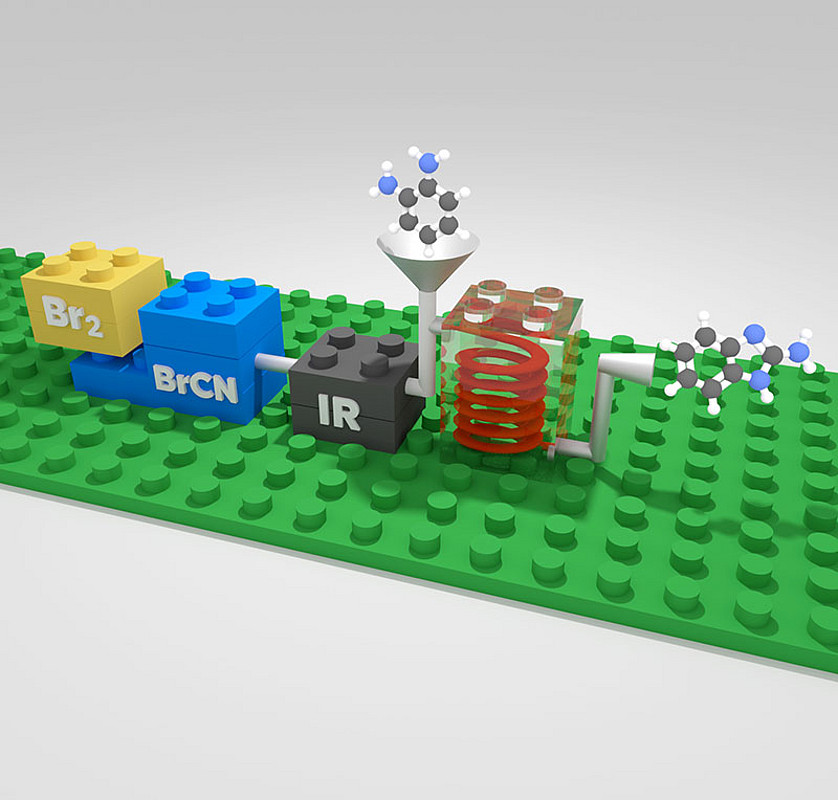
Im kontinuierlichen Verfahren wird das synthetisierte Bromcyan direkt anschließend zur Synthese des Endprodukts weiterverwendet. Auf diese Weise wird jeglicher Kontakt mit dem toxischen Reagens vermieden. Abbildung: Uni Graz/Kappe
Im kontinuierlichen Verfahren wird das synthetisierte Bromcyan direkt anschließend zur Synthese des Endprodukts weiterverwendet. Auf diese Weise wird jeglicher Kontakt mit dem toxischen Reagens vermieden. Abbildung: Uni Graz/Kappe

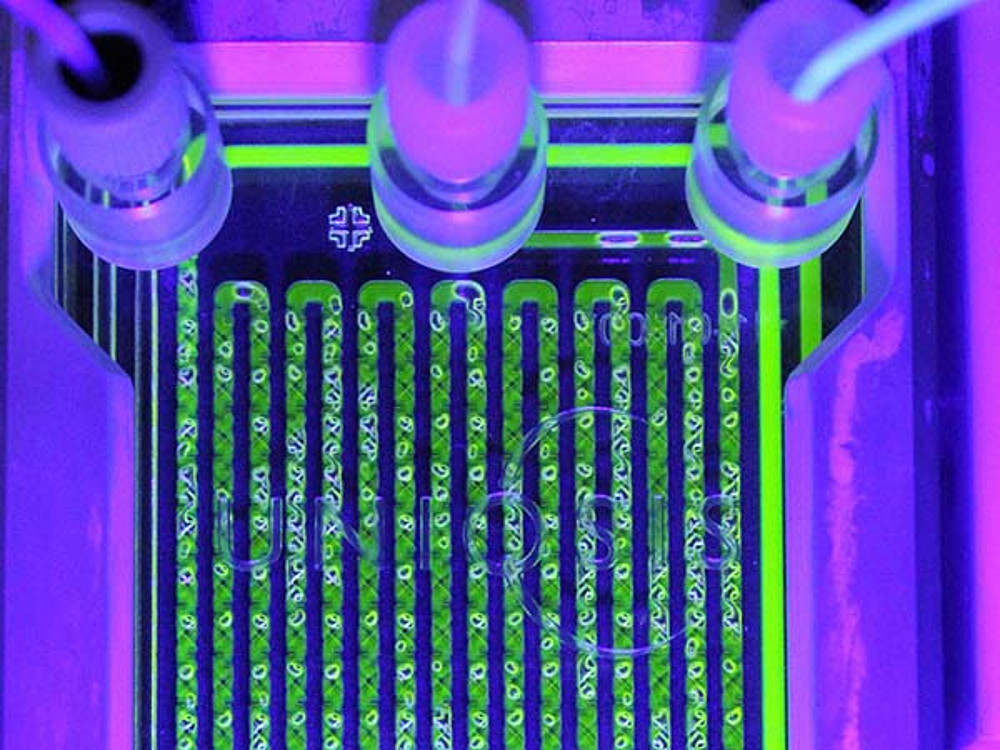
Durch den Flow-Reaktor werden die für eine Synthese benötigten Substanzen im Mikroliterbereich gepumpt. Foto: Pieber/Uni Graz

Durch den Flow-Reaktor werden die für eine Synthese benötigten Substanzen im Mikroliterbereich gepumpt. Foto: Pieber/Uni Graz

ForscherInnen der Uni Graz minimieren Sicherheitsrisiko beim Einsatz von Bromcyan in der chemischen Synthese

Bromcyan ist ein sehr gefährlicher Stoff, extrem giftig, sehr ätzend und bei der kleinsten Verunreinigung auch explosiv. Trotzdem kann die chemische Industrie auf dieses Reagens nicht verzichten: So wird es etwa zur Herstellung eines neuen Alzheimer-Medikaments benötigt. Besondere Herausforderungen stellen Transport und Lagerung dar, da sie mit großem Aufwand und hohen Kosten verbunden sind. Univ.-Prof. Dr. Oliver Kappe, Chemiker an der Karl-Franzens-Universität Graz, hat nun mit seinem Team eine Lösung für dieses Problem gefunden. Den ForscherInnen ist es erstmals gelungen, Bromcyan in einem kontinuierlichen Verfahren zu erzeugen und anschließend im selben Verfahren gleich in der Synthese weiterzuverwenden. Somit bleibt am Ende nichts von der gefährlichen Substanz übrig. Die Methode ermöglicht es, Bromcyan bei Bedarf überall dort zu produzieren, wo es benötigt wird. Ihre Entwicklung haben die ChemikerInnen zum Patent angemeldet. Publiziert wurde sie in der aktuellen Ausgabe der Fachzeitschrift Angewandte Chemie.

In kontinuierlichen Verfahren – englisch „Flow Chemistry“ – werden die für eine Synthese benötigten Substanzen durch Reaktionskammern im Mikroliterbereich gepumpt, in denen die einzelnen Prozesse nacheinander ablaufen. „Da in jeder Kammer immer nur eine geringe Menge einer Verbindung vorhanden ist und das Gemisch nicht wie beim herkömmlichen Batch-Verfahren nach jedem Schritt entnommen und für den nächsten aufbereitet werden muss, minimiert sich die Gefahr“, erklärt Kappe. Gleichzeitig können extreme Temperatur- und Druckbedingungen dafür sorgen, dass die Reaktionen um ein Vielfaches schneller ablaufen.

Bromcyan ist eine Verbindung aus Brom und Zyankali. „Da auch der Umgang mit Brom ein hohes Sicherheitsrisiko darstellt – Brom verdampft bereits bei Raumtemperatur und die Gase sind sehr giftig –, stellen wir auch dieses Element in Flow her“, berichtet der Chemiker. „Dazu braucht man Bromid und Bromat, zwei harmlose, anorganische Salze des Broms.“ In der Flow-Chemie sind alle Schritte, von der Synthese des Broms bis zur Weiterverwendung des Bromcyans, in einem Durchfluss möglich.

Die aktuelle Publikation ist die erste aus dem COMET K-Projekt CC FLOW (Center for Continuous Flow Synthesis and Processing) unter der Leitung von Oliver Kappe. COMET (Competence Centers for Excellent Technologies) ist eine Initiative der Österreichischen Forschungsförderungsgesellschaft FFG. CC FLOW ist am K1-Kompetenzzentrum RCPE (Research Center Pharmaceutical Engineering) angesiedelt.

Publikation

Integration of Bromine and Cyanogen Bromide Generators for the Continuous-Flow Synthesis of Cyclic Guanidines
G. Glotz, R. Lebel, D. Dallinger, C. O. Kappe
Angew. Chem. Int. Ed. 2017, 56, DOI:10.1002/anie.201708533

created by Gudrun Pichler

Related news

Jurassic Sounds: Biologist reconstructs insect songs from 165 million years ago

It was apparently not just the roars of the dinosaurs that made up the soundscape of the animal world during the Jurassic period. Crickets and grasshoppers communicated through a variety of songs and high-pitched sounds, as Thorin Jonsson from the Institute of Biology at the University of Graz discovered together with colleagues from the universities of Lincoln, Bristol (UK), Beijing (China) and Tempe (USA). The findings on what are so far the oldest traces of sound on Earth have just been published in the journal PNAS.

EU funding boosts international exchange between universities

The University of Graz is further expanding its international study opportunities through the European university alliance Arqus and is taking the lead in two key projects. In future, students will benefit from even more joint degree programmes and from simplified recognition of academic achievements through the Joint European Degree Label.

Rescue and risks: Researchers have surveyed public perceptions of AI

The use of artificial intelligence has had to be made transparent since 2 August 2026. The EU’s AI Act, which has been in force since then, also sets out how risky an application is and which security measures apply as a result. However, the assessment of risks by the legislation differs in some cases significantly from the perceptions of the Austrian public. This is the finding of a representative study carried out by data scientist Stefan Thalmann from the University of Graz and his team.

The Healing Sea: Researchers discover new approaches to treating chronic inflammation in sponges

Chronic inflammation plays a key role in many diseases, ranging from metabolic disorders and cardiovascular diseases to tissue damage following injuries or infections. “Normally, the body is able to resolve inflammation on its own. If this process becomes unbalanced, immune cells remain permanently active and continue to drive negative changes in the tissue,” explains Andreas Koeberle, a pharmacist at the University of Graz.

Begin of page section:
Additional information:

University of Graz
Universitaetsplatz 3
8010 Graz
Austria
  • Contact
  • Web Editors
  • Moodle
  • UNIGRAZonline
  • Imprint
  • Data Protection Declaration
  • Accessibility Declaration
Weatherstation
Uni Graz

End of this page section. Go to overview of page sections

End of this page section. Go to overview of page sections

Begin of page section:

End of this page section. Go to overview of page sections


