



Begin of page section:
Page sections:

  • Go to contents (Accesskey 1)
  • Go to position marker (Accesskey 2)
  • Go to main navigation (Accesskey 3)
  • Go to sub navigation (Accesskey 4)
  • Go to additional information (Accesskey 5)
  • Go to page settings (user/language) (Accesskey 8)
  • Go to search (Accesskey 9)

End of this page section. Go to overview of page sections

Begin of page section:
Page settings:

English en
Deutsch de
Search
Login

End of this page section. Go to overview of page sections

Begin of page section:
Search:

Search for details about Uni Graz
Close

End of this page section. Go to overview of page sections


Search

Begin of page section:
Main navigation:

Page navigation:

  • University

    University
    • About the University
    • Organisation
    • Faculties
    • Library
    • Working at University of Graz
    • Campus
    Developing solutions for the world of tomorrow - that is our mission. Our students and our researchers take on the great challenges of society and carry the knowledge out.
  • Research Profile

    Research Profile
    • Our Expertise
    • Research Questions
    • Research Portal
    • Promoting Research
    • Research Transfer
    • Ethics in Research
    • Commission for Scientific Integrity
    Scientific excellence and the courage to break new ground. Research at the University of Graz creates the foundations for making the future worth living.
  • Studies

    Studies
    • Prospective Students
    • Students
  • Community

    Community
    • International
    • Location
    • Research and Business
    • Alumni
    The University of Graz is a hub for international research and brings together scientists and business experts. Moreover, it fosters the exchange and cooperation in study and teaching.
  • Spotlight
Topics
  • Sustainable University
  • Researchers answer
  • Work for us
Close menu

End of this page section. Go to overview of page sections

Begin of page section:
You are here:

University of Graz News Economic impact: Federal Economic Chamber honors four students from the University of Graz

End of this page section. Go to overview of page sections

Friday, 19 July 2024

Economic impact: Federal Economic Chamber honors four students from the University of Graz

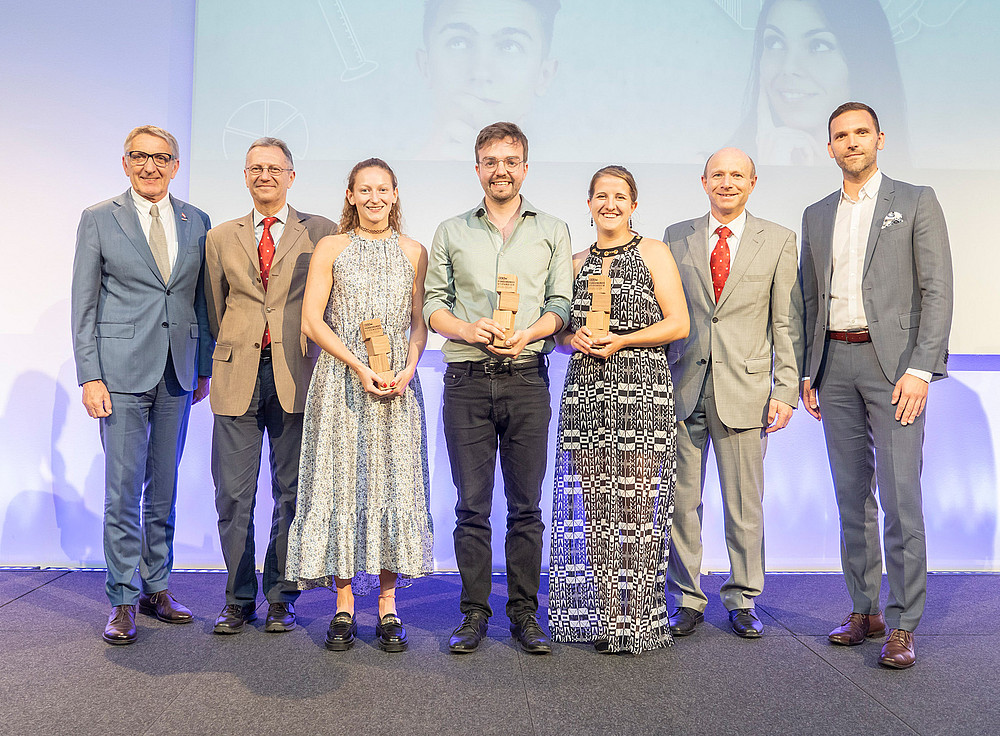
Josef Herk, Michael Kopel, Nicole Rauch, Matthias Salomon, Susanne Bräuer, Ulrich Pferschy and Gernot Faustmann on stage at the award ceremony for the research grants of the Economic Chamber ©Foto Fischer

Economic Chamber President Josef Herk (left) and Gernot Faustmann from Research Management at the University of Graz (right) congratulated the award winners: supervisors Michael Kopel and Nicole Rauch, Matthias Salomon, Susanne Bräuer and supervisor Ulrich Pferschy (from left). Scholarship holder Benjamin Gigerl and his supervisor Stephan Thalmann as well as Salomon's supervisor Karl Steininger are not in the picture. Photo: Fischer

The Styrian Economic Chamber supports 22 business-related Master's theses, four of them at the University of Graz.

Susanne Bräuer, Benjamin Gigerl, Nicole Rauch and Matthias Salomon recently were awarded their research scholarships at a ceremony at the Styrian Economic Chamber. They each received 2500 euros for their Master's theses, with a further 500 euros going to the supervising departments for project.

How can pickers in large warehouses collect ordered products as efficiently as possible in order to save time and effort? In cooperation with Knapp AG, Susanne Bräuer developed a mathematical optimisation model that can answer this question. The software saves as much as 20 percent in time.

Before transformers go into operation, they have to undergo extensive testing. If errors occur, this results in additional high costs. Benjamin Gigerl has developed a forecasting system based on AI that takes more than 100 different parameters into account and can predict the results of quality control with 80 percent accuracy. This means that measures can be taken before the actual inspection and a lot of money can be saved.

Nicole Rauch has analysed how individual companies are implementing the controversial EU supply chain law. Her conclusion: consumers are increasingly demanding transparency, so from an economic perspective, companies should implement the requirements today rather than tomorrow.

Is climate protection killing prosperity? Matthias Salomon looked at this question and examined scenarios on the path to climate neutrality. The sooner we reduce energy consumption or do without fossil fuels, the more resilient the economy will be in times of crisis. In the long term, climate protection is a prerequisite for prosperity.

Video with more detailed information on the four award-winning projects


created by Dagmar Eklaude

Related news

Around the world in eight stops: the Long Night of Research at the University of Graz

On 24 April from 5 pm, you can take a short trip around the globe at the University of Graz, discovering pecularities of foreign countries or new local features in the entrance hall of the University Library. The itinerary takes you through introduced animal species, political attitudes and the omnipotence of algorithms. There will also be a programme in the historic reading hall, as well as at the UniGraz@Museum and the University Archive.

Studying at the University of Graz: How to enrol

Ready for a new chapter in your life with the start of your studies at the University of Graz in the winter semester 2026/27? Here you will find information on deadlines, admission procedures, registration, and everything else you need to successfully start your studies in the fall.

Interpreting data: Why studies sometimes get it wrong

Hilmar Brohmer and Ziva Korda from the Institute of Psychology, together with 500 international colleagues, have re-evaluated a hundred scientific publications and have often come to different conclusions.

Crystal-clear: AI method revolutionises solar observation

The Sun makes life on Earth possible. However, its magnetic fields can also cause massive disruption. This makes it all the more important to gain a better understanding of the processes taking place on our nearest star. A research team from the University of Graz and the High Altitude Observatory in Boulder (USA) has succeeded in doing just that. The astrophysicists have developed an AI-supported method that makes even the smallest structures on the Sun visible. The scientists are convinced that this will bring about a lasting change in solar observation and that the new method can be used for the planned European Solar Telescope.

Begin of page section:
Additional information:

University of Graz
Universitaetsplatz 3
8010 Graz
Austria
  • Contact
  • Web Editors
  • Moodle
  • UNIGRAZonline
  • Imprint
  • Data Protection Declaration
  • Accessibility Declaration
Weatherstation
Uni Graz

End of this page section. Go to overview of page sections

End of this page section. Go to overview of page sections

Begin of page section:

End of this page section. Go to overview of page sections